Ethno Guessr Alternatives: Whose Face Is in the Picture
Every alternative to the ethno guessr quiz is a picture with a provenance, and the five kinds differ by whose face is in it and who agreed to be there. Each of the five answers a different question.
The picture comes before the game
Every option in this genre shows a face and asks for a place. The face is the product; the map, the timer and the leaderboard are packaging. That order is easy to lose when the comparison is written as a feature table, because a feature table can only count menus and modes. What actually separates one site from another, before any question of quality, is where its pictures come from and who is inside them. Five arrangements account for nearly every page in the category, and each carries a different evidentiary weight, so what counts as a correct answer changes with the image.
The five are not ranked, and a reader who takes the list as a hierarchy will pick badly. A composite of nineteenth-century plates, a photograph contributed by a player, a selfie sent to a classifier and a scanned plate in an archive each answer a different question. None is a better instrument than the others for a task it was not built for. Naming the picture is the part of the decision that takes a minute and settles more than a page of mode names.
The composite is an average of archived plates
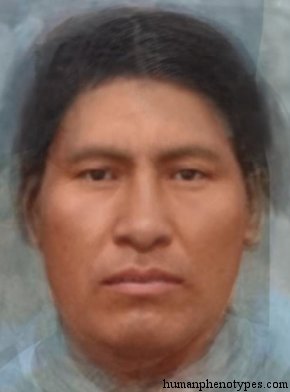
The dominant format takes portraits out of the typological literature, from Ripley's 1899 plates through Eickstedt's 1934 survey to Biasutti's 1941 atlas, scales each face into a shared frame, places landmarks on brow, orbit, nostril and mouth corner, and warps every portrait onto the mean. The result is a face nobody was ever photographed wearing. It is a diagram of a shared architecture, and that is exactly what makes it usable as an answer key: the label belongs to a documented centre rather than to a sitter.
Both of the best-known sites in the category run this loop. hbd.gg states the premise in its own metadata as guessing "the geographic origin of ethnic groups based on their phenotype", and this site builds its daily draw from the same technique. Averaging also does quiet work on the ethics: no individual in the input can be picked out of the output, because the output is a mean. The cost is that the picture inherits the assumptions of whoever took the original photographs, and none of those photographers could check their categories against a genome.
A contributed portrait is the one face with consent
hbd.gg runs six modes, and one of them changes what the picture is. Its Genomes card reads "See real photos and guess their AncestryDNA results on the map", and the site carries an upload page for contributors. That is a different basis for a round: the sitter is a living volunteer, the answer is that person's own test result, and the photograph was handed over deliberately. No composite can make that claim. It is the strongest thing the site does, and nothing here replaces it.
It also changes what a round can be wrong about. A composite round is scored against a centre that was written down before the image existed; a Genomes round is scored against one person's report of their own test. The first is a statement about a distribution, the second a statement about a named person who chose to appear, and the second is the only one in the genre that could be checked with its subject. A player who wants that exchange should take it, and no amount of catalogue depth substitutes.
The selfie leaves the sitter holding the question
The third arrangement is a model that accepts your own photograph and returns a spread of labels. Here the picture is not archive material, and there is no documented centre for the answer to be measured against; the nearest thing to a reference is whatever the training set encoded. The practical questions become immediate rather than academic: does the image stay on the device, does it reach a server, is it retained, and is there a route to delete it.
A label read off a face is a statement about visible traits, and visible traits rest on a modest number of genes with wide overlap between regions. Whatever the interface implies, the number at the end is a similarity against a training set, not a record of descent. That does not make it worthless. It makes it a description, which is a smaller and more durable thing than the answer most people are looking for when they photograph themselves.
The record is a plate with a citation
The fourth arrangement treats the picture as a document rather than an illustration. This catalogue publishes 209 entries carrying 1,465 references between them, roughly seven to an entry, and every description is dated by the literature it rests on. A reader can therefore open the source for a face and read what the observer wrote, in which year, at which place. Four entries show what that buys, and each one also shows how much has moved since the plate was made.
- Patagonid Proper covered the cool grasslands of Patagonia, was pushed back by Mapuche expansion and then by European settlement, and probably included a very tall subvariety, the extinct Tiremenen. Today it is recorded in some Tehuelche, often mixed.
- Mountain Dama is an ancient type of the Namibian highlands around the Brandberg and Otavi ranges, still found in the nineteenth century among Mountain Damara groups such as the Haukhoin and Kattea, and now only as an admixed minority element.
- South Australid belonged to the Murray basin of south-eastern Australia, where settlers took the fertile land first; the entry records it as almost extinct in pure form, with many mixed descendants remaining.
- Savolaxid is named after the Savolaxia province of Finland, an administrative unit rather than a people, with its core in eastern Finland, Karelia and northern Russia.
The picture is also a legal object
Copyright and consent are separate questions, and both apply to the same plate. In the United States, a work published at least ninety-five years before the current year has entered the public domain, which since 1 January 2026 covers anything published through 1930. The European Union runs on life plus seventy years, so plates by authors who died in the 1960s stay protected into the 2030s. The identical photograph is free to reuse in one jurisdiction and encumbered in another, which is one reason the same archive turns up on some sites and not others.
Public domain is not consent. The people in those plates were measured and photographed in surveys, colonial expeditions, conscript armies and prison populations, settings in which participation in any modern sense was rarely on offer. That applies to this catalogue as much as to any competitor, and it is the clearest argument for the contributed portrait: it is the only arrangement in the genre where the person in the frame chose to be there, and where the label came from them rather than from an observer.
Which picture fits your question
A player who wants variety, a themed round, or a session longer than ten faces is best served by the multi-mode menu, and the Genomes offer has no equivalent on this site. A reader who wants to see where a pattern was documented, with a citation attached and a date on the record, is better served by the catalogue. A reader who wants their own face labelled should treat any classifier, including the loudest ones, as a demonstration. This site runs a quiz as well, so its preference for its own arrangement is not a neutral verdict.
The check costs about a minute. Ask whose face is in the picture, whether that person agreed to it, what the answer was checked against, and whether the page names a source you can open. A site that answers those four questions plainly is a game you can reason about. A site that answers none of them is asking you to trust the picture instead of reading it.
Frequently Asked Questions
- Is there a free alternative to the ethno guessr quiz?
- Yes, and several kinds. A multi-mode quiz such as hbd.gg is free to play and covers more formats than a single daily draw. Catalogues of documented appearance patterns are free to read and carry citations. A model that labels your own photograph may be free or metered, and its output is a similarity score rather than a record. The useful filter is not price but provenance: find out where the pictures come from and what the answer is checked against before deciding that two free options are interchangeable.
- Why does it matter whose face is in the picture?
- Because the picture decides what a correct answer can mean. A composite has no sitter, so the answer is a documented centre chosen when the entry was written. A contributed portrait has a sitter who agreed to appear, so the answer is that person's own test result. A selfie has a sitter who never agreed to be part of a dataset. The three support different claims, and a player who confuses them will read a distribution as a fact about an individual.
- Can an alternative quiz tell me my own ethnicity?
- No. Every format described here returns something about a map or a training set, not about your family record. A quiz scores the distance between your pin and a documented centre; a photo classifier returns a label with a confidence and no ground truth to check it against. If the actual question is your own ancestry, the instruments that answer it are a paper trail and a genetic test, both of which report estimates with stated uncertainty rather than a single name.
Related Phenotypes
Faces from the encyclopedia that appear in this article. Open any entry for its full description, distribution, and references.
Patagonid (proper)
South America
The most characteristic variety of the Patagonid group. Once dominated the cool grasslands of Patagonia. Was pushed back by Mapuche as well ...
Mountain Dama
Sub-Saharan Africa
Ancient type of the Namibian highlands, especially the Brandberg and Otavi mountains. Probably a relict of groups that were widespread in So...
South Australid
Australia
Australid subtype with proto-Caucasiform features associated with the people of the Murray basin of Southeastern Australia. Originally the m...
Savolaxid
Northern Europe
East Baltid variety, named after the Savolaxia province of Finland, similar to Neo Danubian. Core population in Eastern Finland, Karelia, an...
Test what you learned
Put your eye for regional faces to work in the daily quiz — a composite face, a world map, and your best guess.