South Australid Phenotype - Face Features & Origin
Australid subtype with proto-Caucasiform features associated with the people of the Murray basin of Southeastern Australia. The entry below collects the South Australid composite face, its documented distribution around 35.2° S, 143.5° E in Australia, its physical characteristics, the research history behind the name, and the academic references that support all of it.
Average Face
The South Australid composite below is not a photograph of a real person. Historical anthropologists aligned multiple individual portraits from the South Australid reference population and averaged them into one image, so recurring structures — skull outline, nose form, lip thickness, brow position — dominate while individual idiosyncrasies cancel out.
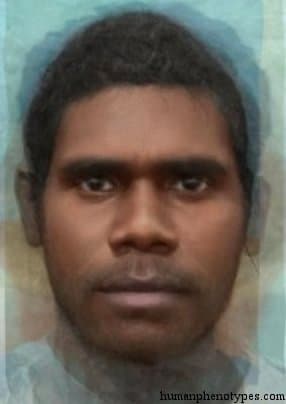
Composite source: Human Phenotypes — South Australid
Geographic Distribution
Geographically, South Australid anchors to 35.2° S, 143.5° E (Australia). That is the point where historical anthropologists judged South Australid most concentrated, not a hard edge; modern migration and intermarriage have long since softened whatever boundaries once existed.
Physical Characteristics
Medium to dark reddish-brown skin with wavy to tight-curly brown or black hair.
- Medium height, brachyskelic, mesomorph
- Dolichocephalic, sometimes mesocephalic, chamae- orthocranic and large-headed
- Nose platyrrhine, but relatively high and long
- Face even more massive and robust than in other Australids
- Supraorbital arches strong, deep-set eyes, forehead and chin receding, prognathy common, body hair strong
Historical Background
Australid subtype with proto-Caucasiform features associated with the people of the Murray basin of Southeastern Australia. Originally the most numerous Australid type, European settlers colonised the fertile lands of the South-East first and pushed back the natives. Today almost extinct in pure form, many mixed individuals remain. Was typical for Wiradjuri, Darling, Narungga, Wirangu, and related people.
Research History & Naming
The passage below traces who first defined South Australid, which rival names competed with it, and how later authors consolidated or disputed the classification — the raw material of any serious phenotype reference.
The type was identified as Murrayian by Birdsell (1942) , who speculated about relationships to Ainu. The type was adopted as Murra(y/i)an by other authors ( Hooton, 1946 ; Coon et al, 1950 ; Cole, 1965 ). Lundman ( 1967 , 1988 ) named it South Australid / Murrayid. Biasutti (1967) separated it as the Murray subrace.
Comparison With Nearby Phenotypes
The five phenotypes whose documented centers lie closest to South Australid, ranked by great-circle distance. They are the types players most often confuse with South Australid in the quiz, precisely because their distributions overlap.
| Phenotype | Region | Distance | Distinguishing trait |
|---|---|---|---|
| Desert Australid | Australia | 717 km | Dark, sometimes medium brown skin. |
| Tasmanid | Australia | 805 km | Dark brown, sometimes black skin with kinky hair. |
| Barrinean | Australia | 2,005 km | Dark brown skin with curly or tight-curly brown-black hair. |
| North Australid | Australia | 2,328 km | Dark brown, sometimes black skin with wavy or curly hair. |
| Paleo Melanesid | Melanesia | 2,367 km | Dark brown skin. |
South Australid in the Game
South Australid is one of the faces that can appear in Classic Daily and Challenge Mode. When it does, the winning pin lands near 35.2° S, 143.5° E in Australia — and because the scoring decays with distance, recognizing the region matters more than pixel-perfect placement.
South Australid Phenotype FAQ
- Where does the South Australid phenotype come from?
- Historical sources center the South Australid phenotype on 35.2° S, 143.5° E (Australia). Treat that as a rough anchor: the type appeared across a wider surrounding area — its nearest documented neighbors, Desert Australid and Tasmanid, sit 717 and 805 km from the reference point — and its present-day distribution no longer matches the historical map.
- What does the South Australid phenotype look like?
- The composite emphasizes recurring traits: medium to dark reddish-brown skin with wavy to tight-curly brown or black hair. The full trait list for South Australid appears in the physical characteristics section above.
- Is the South Australid phenotype a race or a nationality?
- No. Phenotypes like South Australid are descriptive averages, not ancestry groups. South Australid is one of several types documented in and around Australia — see the comparison table above — and the same individual can carry traits associated with several of them at once. The South Australid entry describes a statistical pattern, not a group of people and not a nationality.
- How does South Australid appear in the game?
- When the South Australid face comes up in Classic Daily or Challenge Mode, you pin the world map where you believe the type is historically most common, and the score decays with your distance to 35.2° S, 143.5° E. The nearest documented type, Desert Australid, lies about 717 km away, so regional placement usually carries most of the score.
References & Literature
The South Australid phenotype entry above is compiled from the 7 academic references. Readers are encouraged to consult the original South Australid sources for verification and deeper context.
- Birdsell, J. B. 1942. The Trihybrid Origin of the Australian Aborigine. Harvard University.
- Hooton, E.A. 1946. Up from the Ape. Rev. ed. Macmillan Company . New York.
- Coon, C. S., Garn, S. M. and Birdsell, J. B. 1950. Races: a Study of Race formation in Man. Charles C. Thomas. Springfield.
- Cole, S. 1965. Races of Man. Butler & Tanner Ltd. Frome and London.
- Lundman, B. 1967. Geographische Anthropologie. Rassen und Völker der Erde. G. Fischer, Stuttgart
- Lundman, B. 1988. Jordens folkstammar. Huddinge.
- Biasutti, R. 1967 (1941). Le Razze e i Popoli della terra. 4th Ed. Vol 1-4. U.T.E.T., Torino.
Related Phenotypes
Other human phenotypes whose documented centers lie in the same part of the map as South Australid.
Desert Australid
Australia · 717 km away
Australid desert variety adapted to the arid interior of Australia. Has furnished the general public idea of the typical Australian Aborigin...
Tasmanid
Australia · 805 km away
Insular, slightly gracilised Australid subtype of Tasmania. Similar to Barrinean, sometimes also associated with Melanesid or Negritid. Most...
Barrinean
Australia · 2,005 km away
Australid subtype of the forest belt associated with the Australian pygmies. Could be the remnant of an ancient Negrito strain that once occ...
North Australid
Australia · 2,328 km away
Australid type of Northern and Central Australia typical for the Gulf of Carpentaria. Shows some similarities to Paleo Melanesids. By some a...
Paleo Melanesid
Melanesia · 2,367 km away
Melanesid variety with very ancient features, closer to Australids. Typified by the Kanak of New Caledonia, in its purest form in the north ...
Further Reading
Background articles from the blog that explain where the South Australid type fits, how these composites are built, and what a face can and cannot tell you.
AI Ethnicity Test: What a Measurement Would Require
A laboratory test has a reference standard, a defined construct and a published error bar. A face-based ethnicity tool owns none of...
What Ethnicity Am I? Three Ways to Actually Answer It
The question is personal, but the answers arrive from three different places: records, DNA, and appearance. Each can tell you something...