Tasmanid Phenotype - Face Features & Origin
Insular, slightly gracilised Australid subtype of Tasmania. Its reference coordinates sit near 42.0° S, 146.6° E in Australia. Rather than a single portrait, the Tasmanid composite below is a statistical average, and the surrounding sections — traits, distribution, research history, references — give that average its context.
Average Face
What you see below is a statistical construction of the Tasmanid reference population. Faces recorded from the Tasmanid sample were overlaid and merged; the result keeps the features most members shared and discards personal variation. It reads like a Tasmanid portrait, but it works like a histogram.
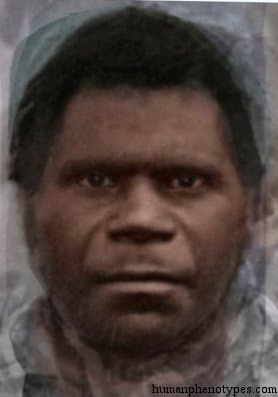
Composite source: Human Phenotypes — Tasmanid
Geographic Distribution
Geographically, Tasmanid anchors to 42.0° S, 146.6° E (Australia). That is the point where historical anthropologists judged Tasmanid most concentrated, not a hard edge; modern migration and intermarriage have long since softened whatever boundaries once existed.
Physical Characteristics
Dark brown, sometimes black skin with kinky hair.
- Rather short, brachyskelic, mesomorph
- Mesocephalic sometimes dolichocephalic, chamae- orthocranic
- The nose is hyperplatyrrhine, very short, medium-high with a thick tip
- Faces are broad and short, mouth large, convex upper lip, prognathy mild
- Supraorbital arches and body hair strong
Historical Background
Insular, slightly gracilised Australid subtype of Tasmania. Similar to Barrinean, sometimes also associated with Melanesid or Negritid. Most likely developed due to isolation after Tasmania split off Australia. Extinct today, the last full-blooded male / female died in 1869 / 1876. European colonists had wiped out the type within a few decades by war, displacement, and most importantly introduced diseases. However, a few descendants of mixed ancestry remain.
Research History & Naming
The passage below traces who first defined Tasmanid, which rival names competed with it, and how later authors consolidated or disputed the classification — the raw material of any serious phenotype reference.
Some regarded it as a Melanesid subtype ( Eickstedt, 1934 ; Abbie, 1958 ). Others believed it to be an Australid-Negritid Tasmanian subrace ( Hooton, 1946 ; Coon et al., 1950 ). Ludman (1967 who called it Tasmanid and Biasutti (1967) regard it as an Australid subrace. Anthropometric analysis seem to support this ( Pietrusewsky, 2005 ).
Comparison With Nearby Phenotypes
Geography, not alphabet, ordered this table: the five phenotype centers closest to Tasmanid's, with the traits most likely to be mistaken for it (South Australid leads at 805 km). In gameplay, these five account for most of the wrong-but-nearby pins against Tasmanid.
| Phenotype | Region | Distance | Distinguishing trait |
|---|---|---|---|
| South Australid | Australia | 805 km | Medium to dark reddish-brown skin with wavy to tight-curly brown or black hair. |
| Desert Australid | Australia | 991 km | Dark, sometimes medium brown skin. |
| South Polynesid | Polynesia | 2,165 km | Medium brown, velvet-like skin, wavy or curly usually brown-black hair. |
| Paleo Melanesid | Melanesia | 2,744 km | Dark brown skin. |
| Barrinean | Australia | 2,756 km | Dark brown skin with curly or tight-curly brown-black hair. |
Tasmanid in the Game
In gameplay terms, Tasmanid rewards region-level recall: the score is computed from the distance between your pin and 42.0° S, 146.6° E. Players often confuse Tasmanid with South Australid (805 km out) in the comparison table above — those confusions are exactly what the distance penalty is designed to expose.
Tasmanid Phenotype FAQ
- Where does the Tasmanid phenotype come from?
- Historical sources center the Tasmanid phenotype on 42.0° S, 146.6° E (Australia). Treat that as a rough anchor: the type appeared across a wider surrounding area — its nearest documented neighbors, South Australid and Desert Australid, sit 805 and 991 km from the reference point — and its present-day distribution no longer matches the historical map.
- What does the Tasmanid phenotype look like?
- The composite emphasizes recurring traits: dark brown, sometimes black skin with kinky hair. The full trait list for Tasmanid appears in the physical characteristics section above.
- Is the Tasmanid phenotype a race or a nationality?
- No — and the Tasmanid naming history above shows why. Tasmanid was defined, renamed, and regrouped repeatedly by different researchers, which is the opposite of how a fixed racial category would behave. A phenotype is a recurring bundle of visible traits recorded across a population; the Tasmanid label says nothing about where any individual's ancestors were born.
- How does Tasmanid appear in the game?
- When the Tasmanid face comes up in Classic Daily or Challenge Mode, you pin the world map where you believe the type is historically most common, and the score decays with your distance to 42.0° S, 146.6° E. The nearest documented type, South Australid, lies about 805 km away, so regional placement usually carries most of the score.
References & Literature
The Tasmanid phenotype entry above is compiled from the 7 academic references. Readers are encouraged to consult the original Tasmanid sources for verification and deeper context.
- Eickstedt, E. von. 1934. Rassenkunde und Rassengeschichte der Menschheit. Ferdinand Enke. Stuttgart.
- Abbie, A. A. 1958. The Original Australians. The Leech 28, 120-130.
- Hooton, E.A. 1946. Up from the Ape. Rev. ed. Macmillan Company . New York.
- Coon, C. S., Garn, S. M. and Birdsell, J. B. 1950. Races: a Study of Race formation in Man. Charles C. Thomas. Springfield.
- Lundman, B. 1967. Geographische Anthropologie. Rassen und Völker der Erde. G. Fischer, Stuttgart
- Biasutti, R. 1967 (1941). Le Razze e i Popoli della terra. 4th Ed. Vol 1-4. U.T.E.T., Torino.
- Pietrusewsky, M. 2005. The physical anthropology of the Pacific, East Asia and Southeast Asia. In: Genetics and Physcial Anthropology.
Related Phenotypes
More entries from the same region of the historical map as Tasmanid, each with its own composite and trait profile.
South Australid
Australia · 805 km away
Australid subtype with proto-Caucasiform features associated with the people of the Murray basin of Southeastern Australia. Originally the m...
Desert Australid
Australia · 991 km away
Australid desert variety adapted to the arid interior of Australia. Has furnished the general public idea of the typical Australian Aborigin...
South Polynesid
Polynesia · 2,165 km away
Southern Polynesid variety. Some assume similarities with the first Polynesid variety that migrated from South-East Asia into Oceania. Found...
Paleo Melanesid
Melanesia · 2,744 km away
Melanesid variety with very ancient features, closer to Australids. Typified by the Kanak of New Caledonia, in its purest form in the north ...
Barrinean
Australia · 2,756 km away
Australid subtype of the forest belt associated with the Australian pygmies. Could be the remnant of an ancient Negrito strain that once occ...
Further Reading
Background articles from the blog that explain where the Tasmanid type fits, how these composites are built, and what a face can and cannot tell you.
Guess My Ethnicity: What One Guess Can Carry
When someone types guess my ethnicity, they are asking a stranger to place a bet, and the odds depend far more on the list of labels...
AI Ethnicity Test: What a Measurement Would Require
A laboratory test has a reference standard, a defined construct and a published error bar. A face-based ethnicity tool owns none of...