Desert Australid Phenotype - Face Features & Origin
Historical anthropology places the Desert Australid phenotype in Australia, with a documented center near 33.9° S, 151.2° E. Australid desert variety adapted to the arid interior of Australia. The sections that follow unpack the Desert Australid entry in practice: the composite face, the traits it summarizes, the naming history, and the sources.
Average Face
Averaging the portraits behind Desert Australid leaves the features that repeat and erases the ones that do not. That is exactly how the Desert Australid composite below was built: individual photographs were aligned and statistically merged, exaggerating shared structure into a single reference face that no actual person looks like.
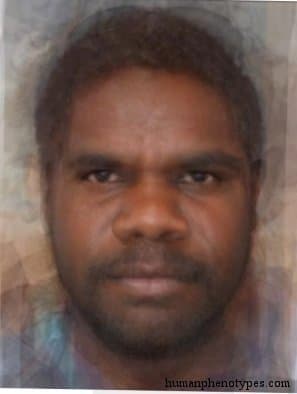
Composite source: Human Phenotypes — Desert Australid
Geographic Distribution
Desert Australid is documented across Australia, with its historical reference center near 33.9° S, 151.2° E. The coordinates mark where the type was most characteristic roughly 1500 years ago; population movements since then have scattered and blended the distribution far beyond that point.
Physical Characteristics
Dark, sometimes medium brown skin.
- Curly or wavy hair that varies from blonde to brown-black
- Medium height, hyperbrachyskelic, ectomorph
- (Hyper-)dolichocephalic, chamae- orthocranic, rather small-headed
- Extremely short face that is wide relative to forehead and skull
- Nose (hyper-)platyrrhine, short with a high back and depressed root, often concave
- Supraorbital arches strong, deep-set eyes, facial features very robust
- Mildly prognathous, body hair medium
Historical Background
Australid desert variety adapted to the arid interior of Australia. Has furnished the general public idea of the typical Australian Aborigine. Basically a North-South Australid blend with a variety of exaggerated features. Typical tribes include Ngaanyatjarra, Pintupi, and Pitjantjatjara. The desert people have had contact to European colonisers only since the 20th century, thus the type is still relatively common.
Research History & Naming
Every label in the historical catalogue has an author and a date, and Desert Australid has accumulated its share of competing attributions. For Desert Australid, the literature extract below shows the naming chain — from the first definition through the later revisions that shaped the current entry.
The type was identified as a specialised Western Desert type by Birdsell ( 1942 , 1949 ). In accordance the specialised blend was also mentioned by other authors ( Hooton, 1946 ; Cole, 1965 ).
Comparison With Nearby Phenotypes
The five phenotypes whose documented centers lie closest to Desert Australid, ranked by great-circle distance. They are the types players most often confuse with Desert Australid in the quiz, precisely because their distributions overlap.
| Phenotype | Region | Distance | Distinguishing trait |
|---|---|---|---|
| South Australid | Australia | 717 km | Medium to dark reddish-brown skin with wavy to tight-curly brown or black hair. |
| Tasmanid | Australia | 991 km | Dark brown, sometimes black skin with kinky hair. |
| Paleo Melanesid | Melanesia | 1,772 km | Dark brown skin. |
| Barrinean | Australia | 1,929 km | Dark brown skin with curly or tight-curly brown-black hair. |
| South Polynesid | Polynesia | 2,075 km | Medium brown, velvet-like skin, wavy or curly usually brown-black hair. |
Desert Australid in the Game
Desert Australid is one of the faces that can appear in Classic Daily and Challenge Mode. When it does, the winning pin lands near 33.9° S, 151.2° E in Australia — and because the scoring decays with distance, recognizing the region matters more than pixel-perfect placement.
Desert Australid Phenotype FAQ
- Where does the Desert Australid phenotype come from?
- Historical sources center the Desert Australid phenotype on 33.9° S, 151.2° E (Australia). Treat that as a rough anchor: the type appeared across a wider surrounding area — its nearest documented neighbors, South Australid and Tasmanid, sit 717 and 991 km from the reference point — and its present-day distribution no longer matches the historical map.
- What does the Desert Australid phenotype look like?
- The composite emphasizes recurring traits: dark, sometimes medium brown skin. The full trait list for Desert Australid appears in the physical characteristics section above.
- Is the Desert Australid phenotype a race or a nationality?
- No. Phenotypes like Desert Australid are descriptive averages, not ancestry groups. Desert Australid is one of several types documented in and around Australia — see the comparison table above — and the same individual can carry traits associated with several of them at once. The Desert Australid entry describes a statistical pattern, not a group of people and not a nationality.
- How does Desert Australid appear in the game?
- When the Desert Australid face comes up in Classic Daily or Challenge Mode, you pin the world map where you believe the type is historically most common, and the score decays with your distance to 33.9° S, 151.2° E. The nearest documented type, South Australid, lies about 717 km away, so regional placement usually carries most of the score.
References & Literature
Primary sources for the Desert Australid entry, listed as cited in the historical literature. The naming and classification debates around Desert Australid referenced above run through these works.
- Birdsell, J. B. 1942. The Trihybrid Origin of the Australian Aborigine. Harvard University.
- Birdsell, J. B. 1949. The Racial Origin of the Extinct Tasmanians. Rec. Q. Victoria Mus., Launceston 2,3. 105-122.
- Hooton, E.A. 1946. Up from the Ape. Rev. ed. Macmillan Company . New York.
- Cole, S. 1965. Races of Man. Butler & Tanner Ltd. Frome and London.
Related Phenotypes
Other human phenotypes whose documented centers lie in the same part of the map as Desert Australid.
South Australid
Australia · 717 km away
Australid subtype with proto-Caucasiform features associated with the people of the Murray basin of Southeastern Australia. Originally the m...
Tasmanid
Australia · 991 km away
Insular, slightly gracilised Australid subtype of Tasmania. Similar to Barrinean, sometimes also associated with Melanesid or Negritid. Most...
Paleo Melanesid
Melanesia · 1,772 km away
Melanesid variety with very ancient features, closer to Australids. Typified by the Kanak of New Caledonia, in its purest form in the north ...
Barrinean
Australia · 1,929 km away
Australid subtype of the forest belt associated with the Australian pygmies. Could be the remnant of an ancient Negrito strain that once occ...
South Polynesid
Polynesia · 2,075 km away
Southern Polynesid variety. Some assume similarities with the first Polynesid variety that migrated from South-East Asia into Oceania. Found...
Further Reading
Background articles from the blog that explain where the Desert Australid type fits, how these composites are built, and what a face can and cannot tell you.
AI Ethnicity Guesser: What the Tools Really Return
An AI ethnicity guesser returns a label from a fixed list rather than a measurement of ancestry. Here is what the models are trained on...
Human Phenotypes: A Field Guide to the 209 Types
Nordid, Huanghoid, Bantuid, Andid - the named human phenotypes are a century-old vocabulary for visible variation.