Ethnicity Guessing Game: Why a Near Miss Feels Like Knowing
The pull of a face-guessing round comes from a gap in the player's knowledge, not from any hidden fact about the face, and curiosity explains why. What near-miss studies add, and what the score really measures.
A guess has to commit first
Every guessing game rests on a single structural move: the player commits to an answer before the answer arrives. Remove that commitment and the game dissolves, because a question you can look up is a search rather than a guess. The rules of this genre are thinner than the box suggests. A composite face appears, a world map waits, one pin goes down, and a score comes back. Everything the player will remember happens in the seconds between the pin landing and the reveal, and the design of those seconds is the design of the game.
The genre borrowed its shape from geography play, where the answer key is a coordinate pair recorded by a camera van: exact, arbitrary and checkable. Here the photograph becomes a composite face and the coordinate becomes a documented distribution, which changes what the reveal can honestly tell you. A pin near the mark means a catalogue pattern was reported in that region during the documented period. That is a narrower claim than the flash of recognition that arrives with a good guess, and the narrowness is what makes the feeling worth examining.
Curiosity needs a pointed gap
George Loewenstein set out the modern account of curiosity in a 1994 review for Psychological Bulletin, and the claim is narrower than the everyday word implies. In his information-gap theory, curiosity is a form of deprivation. It appears when a person can perceive one specific missing piece, not when they face a general mystery. A shapeless unknown produces indifference or avoidance; a question with a single named blank produces the itch. His account also notes that a small priming dose of the answer intensifies the itch rather than settling it, which is why a hint can make a puzzle harder to abandon.
A face round manufactures that state with unusual efficiency. The composite arrives complete and unlabelled, so nothing is absent except the one thing that matters: which entry it is, where the compilers reported it, what they called it. The interface withholds all of that until the pin is committed, then returns the name together with the neighbouring entries the pattern grades into. Loewenstein also described curiosity as intense, brief and easily satisfied, and the round matches that shape exactly. What feels like an appetite for knowledge is a demand that one particular blank be filled.
Uncertainty has a comfortable band
Daniel Berlyne made the case in his 1960 book on conflict, arousal and curiosity that interest peaks at an intermediate level of novelty. Too familiar and there is nothing left to resolve, too strange and the information cannot be fitted to anything already held. The curve turns up in modest settings, including infant attention, where babies look longest at sounds moderately different from the ones they already know. Min Jeong Kang and colleagues sharpened the point for factual questions in 2009, reporting that curiosity about an answer ran lowest both when people had no idea and when they were certain, and peaked in between.
A daily set of ten faces sits deliberately inside that band. Ten items is too few to feel like work and enough to become a habit, and mixing obvious faces with confusable neighbours holds the average difficulty near the middle. Distance-decay scoring does the rest of the tuning, because a pin a few hundred kilometres from the mark still collects most of the available credit, so a neighbouring pattern reads as nearly right rather than plainly wrong. None of that is indulgence. It is the condition under which a quiz generates curiosity instead of boredom at one end and hopelessness at the other.
The near miss still pays out
Researchers studying slot machines noticed long ago that outcomes stopping one step short of a win hold players better than clean losses, a pattern named in a 1986 paper on the near miss. Luke Clark and colleagues at Cambridge traced the mechanism in a 2009 study in Neuron using a simplified slot task. Near misses were rated as less pleasant than full misses, yet they raised the desire to continue playing, and they engaged striatal and insula circuitry that also responded to genuine monetary wins. An outcome with no payout at all was recruiting the machinery of reward.
One detail from that study matters for a map game. The near-miss effect appeared mainly on trials where the player had chosen the arrangement; when the machine arranged the gamble, the pull weakened. A hand-placed pin is nothing but personal choice, and distance-decay scoring then renders a miss as a visible near miss, since a roughly right region two hundred kilometres off arrives as a number rather than a silence. The scoring is not flattering anybody. It is showing players their own near misses, which are exactly the ones that bring them back.
What the reward signal actually teaches
Why a near miss can teach at all is the subject of a 1997 paper in Science by Wolfram Schultz, Peter Dayan and Read Montague. Recording from dopamine neurons in monkeys, they found that firing did not report reward itself but the error in predicting it. An unexpected reward produced a burst, a fully predicted reward produced almost no change, and a predicted reward that failed to arrive produced a dip below baseline at the moment it had been due. The signal tracks surprise, and surprise is the point at which updating is worth the expense.
A boundary belongs here. What such a system learns is a spatial prior: which cues travel with which parts of the world inside this particular catalogue. It does not learn to read people, because the material is a set of composites averaged from documented appearance patterns rather than a set of individuals. Each reveal attaches a name, a region and a set of references to a shape. Approached as practice at map reasoning, the loop is efficient and candid. Approached as training in judging strangers, it is a category mistake, and fluency makes the mistake feel like skill.
The loudest cue travels worst
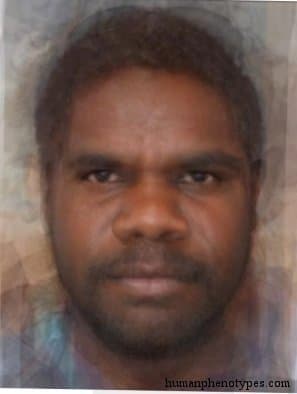
Confidence in a guessing game is built from the most noticeable cue rather than the most reliable one, and those are not the same thing. Light hair is the loudest signal the catalogue contains: simple to see, simple to recall, simple to over-read. The Desert Australid entry, describing the arid interior of Australia, records hair running from blonde through brown to black in a region nowhere near the Baltic. At the opposite corner, the Indo Nordic entry for the north-western Himalaya and Hindu Kush flags light hair and eyes as a local peculiarity inside South Asia.
The pattern is the calibration problem in miniature. A cue that raises confidence fastest tends to be one that has travelled least predictably, because what makes it striking is its contrast with its surroundings rather than any consistency across a continent. Players who learn to distrust the loudest signal outperform players who chase it, and the scoring quietly agrees with them, keeping generous partial credit for a plausible region while fining the confident wrong one. Reading a face is easy. Reading your own certainty about a face is the skill a round actually rehearses.
The answer key is a reconstruction
Nothing in the game pretends its map is current. The distributions behind the entries were reconstructed for roughly 1,500 years ago, and several entries say plainly what happened afterwards. The North Amazonid description records that European contact and disease ended the spread of the pattern, and the California Pacifid entry expects recent admixture to make the type disappear altogether. A catalogue that writes its own obsolescence into the record is telling readers how to hold it. The pin marks where a pattern was documented, not where anyone lives now, and not what any individual is.
Read that way, a round is a small exercise in historical geography, and it stays honest while two questions are kept apart. Where was a face like this reported? is a question the catalogue can answer with a name, an author, a region and a date. What is the person in front of me? is a different question the material never addresses. The gap between pin and reveal is real, and enjoying it costs nothing. What comes back across that gap is a place in a document, which is a modest thing to learn and a good enough thing to be curious about.
Frequently Asked Questions
- Does an ethnicity guessing game teach you to read faces?
- Not in the sense the phrase suggests. What the loop trains is a spatial prior: which documented appearance patterns were reported where, and which neighbouring entries in the catalogue are most easily confused. Every miss ends in an entry carrying a name, a region and its references, so the lesson attaches to a map rather than to a person. Fluency grows with repetition and can feel like skill at reading strangers, but the material is a set of composites averaged from documented patterns, never a set of individuals.
- Why does a near miss in a map game feel better than a clear miss?
- Part of the answer is scoring and part of it is biology. Distance-decay credit means a pin a few hundred kilometres off still collects most of the points, so the result arrives as nearly right. Research on gambling near misses found that outcomes one step short of a win are rated as less pleasant than outright losses yet increase the urge to continue, recruiting reward circuitry that also answers to real wins. The effect is strongest when the player made the choice, and a hand-placed pin always is.
- Is the map used in the game still accurate today?
- It is a historical reconstruction anchored to roughly 1,500 years ago, and every entry states the sources behind it. Several descriptions record their own displacement: the North Amazonid entry notes that contact and disease ended the pattern's spread, and the California Pacifid entry expects recent admixture to erase the type. A correct pin therefore means a pattern was reported in that region during the documented period. It is not a statement about where anyone lives now, nor a claim about any individual.
Related Phenotypes
Faces from the encyclopedia that appear in this article. Open any entry for its full description, distribution, and references.
Desert Australid
Australia
Australid desert variety adapted to the arid interior of Australia. Has furnished the general public idea of the typical Australian Aborigin...
Indo Nordic
South Asia
Type of the Northwestern Himalaya and the Hindu Kush. Connected to Indid, but altered by old unique elements, possibly Proto Nordic that mig...
North Amazonid
South America
Amazonid proper, the dominant type of the rainforests North of the Amazon River to the Caribbean. Common among Cariban speakers, e.g. Caribs...
California Pacifid
North America
Pacifid variety of California and South Washington. In its purest form in Northern California. Typified by the Yurok as well as Chinook grou...
Test what you learned
Put your eye for regional faces to work in the daily quiz — a composite face, a world map, and your best guess.