North Amazonid Phenotype - Face Features & Origin
Historical anthropology places the North Amazonid phenotype in South America, with a documented center near 4.8° N, 58.6° W. Amazonid proper, the dominant type of the rainforests North of the Amazon River to the Caribbean. The sections that follow unpack the North Amazonid entry in practice: the composite face, the traits it summarizes, the naming history, and the sources.
Average Face
Averaging the portraits behind North Amazonid leaves the features that repeat and erases the ones that do not. That is exactly how the North Amazonid composite below was built: individual photographs were aligned and statistically merged, exaggerating shared structure into a single reference face that no actual person looks like.
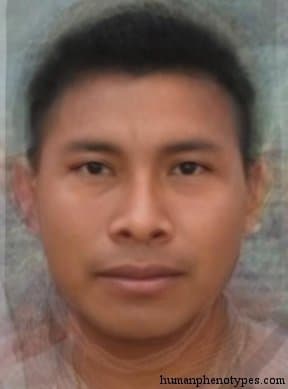
Composite source: Human Phenotypes — North Amazonid
Geographic Distribution
The reference center for North Amazonid sits near 4.8° N, 58.6° W in South America. Around that anchor, prevalence falls off gradually — the type is not confined to one valley or one modern border, and the historical map should be read as a gradient rather than a boundary.
Physical Characteristics
Yellowish-reddish medium brown skin, straight or wavy hair.
- Short, mesoskelic, ecto- to endomorph
- Meso- brachycephalic, ortho- to mildly hypsicranic
- Gracile, mesorrhine nose with dilated nostrils
- Face oval, medium-high with relatively soft features, forehead broad, slightly receding chin
- Eyes slanting, Mongolian fold rare
Historical Background
Amazonid proper, the dominant type of the rainforests North of the Amazon River to the Caribbean. Common among Cariban speakers, e.g. Caribs, Makushi, Pemón, Taurepang, Wayana, Yabarana, among others. The fearsome Caribs made the Spanish create the word "Cannibal". Originated in Guyanan savannahs and expanded to the Caribbean, where it pushed back the West Amazonids. European contact and disease dramatically ended their reign.
Research History & Naming
Every label in the historical catalogue has an author and a date, and North Amazonid has accumulated its share of competing attributions. For North Amazonid, the literature extract below shows the naming chain — from the first definition through the later revisions that shaped the current entry.
Eickstedt (1934) defined and described the type as North Brasilid. Amazonid was used synonymously instead of Brasilid ( Imbelloni, 1958 ; Biasutti, 1967 ; Kunter, 1987 ). Lundman (1967) also defined a northern Carib Amazonid subgroup. Brasilid was used by Canals Frau (1950) and Knussman (1996) , among others.
Comparison With Nearby Phenotypes
Geography, not alphabet, ordered this table: the five phenotype centers closest to North Amazonid's, with the traits most likely to be mistaken for it (South Amazonid leads at 1,926 km). In gameplay, these five account for most of the wrong-but-nearby pins against North Amazonid.
| Phenotype | Region | Distance | Distinguishing trait |
|---|---|---|---|
| South Amazonid | South America | 1,926 km | Yellowish/reddish light to medium brown skin, straight or slightly wavy hair. |
| Chocó-Motilon | South America | 1,996 km | Medium brown skin with straight or wavy hair. |
| Bororo | South America | 2,069 km | Olive medium brown skin with straight and black rarely wavy hair. |
| West Amazonid | South America | 2,121 km | Medium (yellowish/reddish) brown skin. |
| Isthmid | South America | 2,380 km | Medium (yellowish) brown skin, straight or slightly wavy hair. |
North Amazonid in the Game
In gameplay terms, North Amazonid rewards region-level recall: the score is computed from the distance between your pin and 4.8° N, 58.6° W. Players often confuse North Amazonid with South Amazonid (1,926 km out) in the comparison table above — those confusions are exactly what the distance penalty is designed to expose.
North Amazonid Phenotype FAQ
- Where does the North Amazonid phenotype come from?
- Historical sources center the North Amazonid phenotype on 4.8° N, 58.6° W (South America). Treat that as a rough anchor: the type appeared across a wider surrounding area — its nearest documented neighbors, South Amazonid and Chocó-Motilon, sit 1,926 and 1,996 km from the reference point — and its present-day distribution no longer matches the historical map.
- What does the North Amazonid phenotype look like?
- The composite emphasizes recurring traits: yellowish-reddish medium brown skin, straight or wavy hair. The full trait list for North Amazonid appears in the physical characteristics section above.
- Is the North Amazonid phenotype a race or a nationality?
- No. A phenotype is a recurring bundle of visible traits documented by historical anthropologists across a population — for North Amazonid, patterns such as yellowish-reddish medium brown skin, straight or wavy hair. The North Amazonid entry is not a genetic ancestry, not a nationality, and not a statement about any individual person. Two people from the same country can match completely different phenotypes — one resembling North Amazonid, another closer to South Amazonid — and one phenotype can span many modern borders.
- How does North Amazonid appear in the game?
- When the North Amazonid face comes up in Classic Daily or Challenge Mode, you pin the world map where you believe the type is historically most common, and the score decays with your distance to 4.8° N, 58.6° W. The nearest documented type, South Amazonid, lies 1,926 km away — an isolated reference point, so even a broad regional answer scores respectably here.
References & Literature
Primary sources for the North Amazonid entry, listed as cited in the historical literature. The naming and classification debates around North Amazonid referenced above run through these works.
- Eickstedt, E. von. 1934. Rassenkunde und Rassengeschichte der Menschheit. Ferdinand Enke. Stuttgart.
- Imbelloni, J. 1958. Nouveaux apports à la classification de l'homme américain. Miscellanea P. Rivet octogenario dicata. Mexico.
- Biasutti, R. 1967 (1941). Le Razze e i Popoli della terra. 4th Ed. Vol 1-4. U.T.E.T., Torino.
- Kunter, M. 1987. Population and racial history of Argentina, Uruguay and Paraguay. In: Schwidetzky, I. Rassengeschischte des Menschheit 12.
- Lundman, B. 1967. Geographische Anthropologie. Rassen und Völker der Erde. G. Fischer, Stuttgart
- Coon, C. S., Garn, S. M. and Birdsell, J. B. 1950. Races: a Study of Race formation in Man. Charles C. Thomas. Springfield.
- Knussmann, R. 1996. Vergleichende Biologie des Menschen: Lehrbuch der Anthropologie und Humangenetik. 2ed. Spektrum Akademischer Verlag.
Related Phenotypes
Other human phenotypes whose documented centers lie in the same part of the map as North Amazonid.
South Amazonid
South America · 1,926 km away
The most dynamic Amazonid variety, emerged in northern savannahs and spread south across Brazil to Paraguay and Argentina, pushing back olde...
Chocó-Motilon
South America · 1,996 km away
Special type found in Colombia, Venezuela, as well as Panama. Contains Brasilid elements as well as relicts of one of the first migrations t...
Bororo
South America · 2,069 km away
The northernmost Patagonid variety, often mixed with local Lagid elements, but with a variety of unique features. Native to the savannah and...
West Amazonid
South America · 2,121 km away
Amazonid subtype, the most frequent type in the Western Amazon rainforest. Common among Arawakan speakers, typical groups are Yawalapiti, As...
Isthmid
South America · 2,380 km away
Centralid subtype, that has partially adapted to the tropical forests of the Isthmus of Panama and the surrounding regions from Colombia to ...
Further Reading
Background articles from the blog that explain where the North Amazonid type fits, how these composites are built, and what a face can and cannot tell you.
Ethnicity Guesser vs hbd.gg: Two Ways to Ask a Face
Two sites ask a face to name a place. Here is what each one shows you, where breadth and provenance actually differ, and how to tell...
Ethnic Guesser: Which Facial Cues Actually Decide a Round
A round of the game turns on a handful of facial cues, and they are not equal. Here is how pigment, the epicanthic fold, nasal shape...