Isthmid Phenotype - Face Features & Origin
Centralid subtype, that has partially adapted to the tropical forests of the Isthmus of Panama and the surrounding regions from Colombia to Mexico. The entry below collects the Isthmid composite face, its documented distribution around 9.1° N, 79.8° W in South America, its physical characteristics, the research history behind the name, and the academic references that support all of it.
Average Face
The Isthmid composite below is not a photograph of a real person. Historical anthropologists aligned multiple individual portraits from the Isthmid reference population and averaged them into one image, so recurring structures — skull outline, nose form, lip thickness, brow position — dominate while individual idiosyncrasies cancel out.
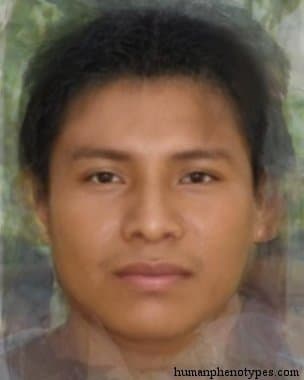
Composite source: Human Phenotypes — Isthmid
Geographic Distribution
Geographically, Isthmid anchors to 9.1° N, 79.8° W (South America). That is the point where historical anthropologists judged Isthmid most concentrated, not a hard edge; modern migration and intermarriage have long since softened whatever boundaries once existed.
Physical Characteristics
Medium (yellowish) brown skin, straight or slightly wavy hair.
- Short, sometimes very short or even pygmoid, mesoskelic, ectomorph to endomorph
- Often hyperbrachycephalic, mildly hypsicranic
- Mesorrhine button nose
- Faces small and round with infantile features
- Mouth wide, forehead narrow, eyes mildly slanting
Historical Background
Centralid subtype, that has partially adapted to the tropical forests of the Isthmus of Panama and the surrounding regions from Colombia to Mexico. Played a role in the ancient Maya civilisation. However, the most typical groups live farther South and include the Mayangna, Pech, Kuna, Naso, Ngäbe, Bokota, and related people.
Research History & Naming
Typological names were coined, contested, and renamed repeatedly across the 20th century, and Isthmid is no exception. The extract below records the researchers who defined Isthmid, the alternative labels it accumulated, and where the modern consensus settled.
The southern "brasiloid" group of Centralid was called Isthmid by Eickstedt (1934) . The term was used by many others in a similar manner ( Canals Frau, 1950 ; Imbelloni, 1952 ; Biasutti, 1967 ; Lundman, 1967 ). Sometimes the similar Maya type was included.
Comparison With Nearby Phenotypes
Ranked by great-circle distance from Isthmid's reference center, these are the five nearest documented phenotypes — the closest being Chocó-Motilon at 512 km. Overlapping distributions like these are exactly what makes the quiz hard, and the Chocó-Motilon row is where to start looking.
| Phenotype | Region | Distance | Distinguishing trait |
|---|---|---|---|
| Chocó-Motilon | South America | 512 km | Medium brown skin with straight or wavy hair. |
| Maya | North America | 1,522 km | Medium, sometimes light brown skin with straight or wavy hair. |
| West Amazonid | South America | 1,654 km | Medium (yellowish/reddish) brown skin. |
| North Amazonid | South America | 2,380 km | Yellowish-reddish medium brown skin, straight or wavy hair. |
| North Andid | South America | 2,658 km | Medium, sometimes dark olive-brown skin with straight, sometimes wavy hair. |
Isthmid in the Game
When the Isthmid composite shows up in the quiz, players who know the South America distribution pattern have the edge. The reference answer sits near 9.1° N, 79.8° W; pins on the wrong continent score close to zero, so even a rough regional instinct beats a precise but misdirected pin.
Isthmid Phenotype FAQ
- Where does the Isthmid phenotype come from?
- The reference coordinates for the Isthmid phenotype sit near 9.1° N, 79.8° W, in South America. That point marks the center of the South America distribution documented roughly 1500 years ago — actual prevalence spread well beyond it, toward entries such as Chocó-Motilon 512 km away, and modern migration has blurred those boundaries further.
- What does the Isthmid phenotype look like?
- In the historical literature, medium (yellowish) brown skin, straight or slightly wavy hair. For Isthmid these are statistical tendencies across a population, not a checklist every individual matches.
- Is the Isthmid phenotype a race or a nationality?
- No. Phenotypes like Isthmid are descriptive averages, not ancestry groups. Isthmid is one of several types documented in and around South America — see the comparison table above — and the same individual can carry traits associated with several of them at once. The Isthmid entry describes a statistical pattern, not a group of people and not a nationality.
- How does Isthmid appear in the game?
- In Classic Daily and Challenge Mode, the Isthmid composite face appears without a label. Your task is to drop a pin on the world map where you think that face is historically most common — the scoring uses the distance between your pin and the reference coordinates near 9.1° N, 79.8° W. The post-round review then shows the correct location, your distance error, and this Isthmid entry.
References & Literature
Every claim on this page traces back to the sources below — the researchers who defined, measured, and argued over the Isthmid type. The originals behind the Isthmid entry are worth consulting directly.
- Eickstedt, E. von. 1934. Rassenkunde und Rassengeschichte der Menschheit. Ferdinand Enke. Stuttgart.
- Coon, C. S., Garn, S. M. and Birdsell, J. B. 1950. Races: a Study of Race formation in Man. Charles C. Thomas. Springfield.
- Imbelloni, J. 1952. Rassentypen und Biodynamik von Amerika. In: Historia Mundi. Band 1, Munich, 188-203.
- Biasutti, R. 1967 (1941). Le Razze e i Popoli della terra. 4th Ed. Vol 1-4. U.T.E.T., Torino.
- Lundman, B. 1967. Geographische Anthropologie. Rassen und Völker der Erde. G. Fischer, Stuttgart
Related Phenotypes
More entries from the same region of the historical map as Isthmid, each with its own composite and trait profile.
Chocó-Motilon
South America · 512 km away
Special type found in Colombia, Venezuela, as well as Panama. Contains Brasilid elements as well as relicts of one of the first migrations t...
Maya
North America · 1,522 km away
Centralid subtype with a position between Pueblid and Isthmid and a variety of unique features. Was the dominant element in the ancient Maya...
West Amazonid
South America · 1,654 km away
Amazonid subtype, the most frequent type in the Western Amazon rainforest. Common among Arawakan speakers, typical groups are Yawalapiti, As...
North Amazonid
South America · 2,380 km away
Amazonid proper, the dominant type of the rainforests North of the Amazon River to the Caribbean. Common among Cariban speakers, e.g. Caribs...
North Andid
South America · 2,658 km away
The most important and numerous Andid subvariety, adapted to the high altitudes of the Peruvian and Ecuadorian Andes. Typified by Quechua. T...
Further Reading
Background articles from the blog that explain where the Isthmid type fits, how these composites are built, and what a face can and cannot tell you.
Ethnicity Guesser vs hbd.gg: Two Ways to Ask a Face
Two sites ask a face to name a place. Here is what each one shows you, where breadth and provenance actually differ, and how to tell...
Ethnic Guesser: Which Facial Cues Actually Decide a Round
A round of the game turns on a handful of facial cues, and they are not equal. Here is how pigment, the epicanthic fold, nasal shape...