Huarpid Phenotype - Face Features & Origin
Historical anthropology places the Huarpid phenotype in South America, with a documented center near 34.6° S, 58.7° W. Northern Fuegid variety that is often considered part of the Lagoid group. The sections that follow unpack the Huarpid entry in practice: the composite face, the traits it summarizes, the naming history, and the sources.
Average Face
Averaging the portraits behind Huarpid leaves the features that repeat and erases the ones that do not. That is exactly how the Huarpid composite below was built: individual photographs were aligned and statistically merged, exaggerating shared structure into a single reference face that no actual person looks like.
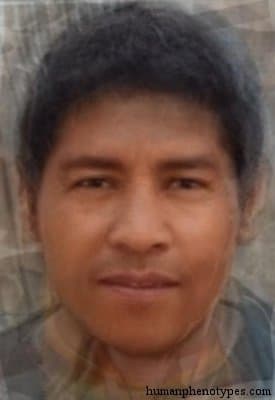
Composite source: Human Phenotypes — Huarpid
Geographic Distribution
Geographically, Huarpid anchors to 34.6° S, 58.7° W (South America). That is the point where historical anthropologists judged Huarpid most concentrated, not a hard edge; modern migration and intermarriage have long since softened whatever boundaries once existed.
Physical Characteristics
Medium, sometimes dark brown skin, often with wavy hair.
- (Rather) tall, mesoskelic, relatively ectomorph body
- Dolichocephalic, sometimes mesocephalic, large-headed, hypsicranic
- Mesorrhine
- The face is long with visible supraorbital ridges
- Sometimes mild prognathy
- Body hair is relatively strong
Historical Background
Northern Fuegid variety that is often considered part of the Lagoid group. Shows Melanesiform features and probably arrived with one of the earliest migrations to America. Native to the Argentinian Cuyo and the Bolivian savannahs. Typified by Huarpe, common in Sirionó and the almost-gone Comechingónes. More mixed in Uros. Was common in Pre-Colombian times, but numbers only a few hundred today.
Research History & Naming
The passage below traces who first defined Huarpid, which rival names competed with it, and how later authors consolidated or disputed the classification — the raw material of any serious phenotype reference.
Named and defined by Canals Frau (1950) , who had performed several studies ( 1943 , 1944 ). Eickstedt (1952b) called it Huarpid or Inland Fuegid, others ( Imbelloni, 1952 ) placed it with Lagids proper. Wegner (1931) had described similar types earlier. Linked to Drexel's (1955) Selvasids / Subandids.
Comparison With Nearby Phenotypes
Ranked by great-circle distance from Huarpid's reference center, these are the five nearest documented phenotypes — the closest being Pampid at 632 km. Overlapping distributions like these are exactly what makes the quiz hard, and the Pampid row is where to start looking.
| Phenotype | Region | Distance | Distinguishing trait |
|---|---|---|---|
| Pampid | South America | 632 km | Olive medium brown skin with straight and black rarely wavy hair. |
| South Andid | South America | 1,294 km | Light olive-brown skin, straight, rarely wavy hair. |
| Patagonid (proper) | South America | 2,081 km | Olive light brown skin, straight black, rarely wavy hair. |
| Lagoa Santa | South America | 2,207 km | Yellowish/copperish light to medium brown skin, straight or wavy hair. |
| Botocudo | South America | 2,289 km | Yellowish/copperish light brown skin with straight or wavy hair. |
Huarpid in the Game
When the Huarpid composite shows up in the quiz, players who know the South America distribution pattern have the edge. The reference answer sits near 34.6° S, 58.7° W; pins on the wrong continent score close to zero, so even a rough regional instinct beats a precise but misdirected pin.
Huarpid Phenotype FAQ
- Where does the Huarpid phenotype come from?
- Historical sources center the Huarpid phenotype on 34.6° S, 58.7° W (South America). Treat that as a rough anchor: the type appeared across a wider surrounding area — its nearest documented neighbors, Pampid and South Andid, sit 632 and 1,294 km from the reference point — and its present-day distribution no longer matches the historical map.
- What does the Huarpid phenotype look like?
- The composite emphasizes recurring traits: medium, sometimes dark brown skin, often with wavy hair. The full trait list for Huarpid appears in the physical characteristics section above.
- Is the Huarpid phenotype a race or a nationality?
- No. Phenotypes like Huarpid are descriptive averages, not ancestry groups. Huarpid is one of several types documented in and around South America — see the comparison table above — and the same individual can carry traits associated with several of them at once. The Huarpid entry describes a statistical pattern, not a group of people and not a nationality.
- How does Huarpid appear in the game?
- When the Huarpid face comes up in Classic Daily or Challenge Mode, you pin the world map where you believe the type is historically most common, and the score decays with your distance to 34.6° S, 58.7° W. The nearest documented type, Pampid, lies about 632 km away, so regional placement usually carries most of the score.
References & Literature
The Huarpid phenotype entry above is compiled from the 7 academic references. Readers are encouraged to consult the original Huarpid sources for verification and deeper context.
- Coon, C. S., Garn, S. M. and Birdsell, J. B. 1950. Races: a Study of Race formation in Man. Charles C. Thomas. Springfield.
- Canals Frau, S. 1943. La cultura de los Huarpes. Anales del Instituto de Ethnografia Americana de la Universidad Nacional de Cuyo 3. 289-322.
- Canals Frau, S. 1944. El grupo Huarpe.Comechingón. Anales del Instituto de Ethnografia Americana de la Universidad Nacional de Cuyo 5. 9-47.
- Eickstedt, E. von. 1952b. Die prioritätsgerechten Bezeichnungen der menschlichen Varitäten. In: Historia Mundi. Band 1, Munich, 223-226.
- Imbelloni, J. 1952. Rassentypen und Biodynamik von Amerika. In: Historia Mundi. Band 1, Munich, 188-203.
- Wegner, R. N. 1931. Zum Sonnentr durch altes Indianerland. Darmstadt.
- Dart, R. 1955. Three Strandloper from the Kaokoveld Coast. S. Afr. J. Sci 51. 175-179.
Related Phenotypes
If Huarpid interested you, these neighboring phenotype entries cover adjacent parts of the map with distinctly different trait bundles.
Pampid
South America · 632 km away
Slightly gracilised Patagonid variety, native to the vast plains of the Argentinian Chaco and Pampa. Sometimes mixed with Amazonid elements....
South Andid
South America · 1,294 km away
The southernmost Andid variety, somewhat influenced by Patagonid. The dominant type in Mapuche, native to Chile. More mixed in the extinct C...
Patagonid (proper)
South America · 2,081 km away
The most characteristic variety of the Patagonid group. Once dominated the cool grasslands of Patagonia. Was pushed back by Mapuche as well ...
Lagoa Santa
South America · 2,207 km away
Lagid proper, named after fossil remains of Brazil. Associated with one of the first migration waves to South America. Skulls sometimes Mela...
Botocudo
South America · 2,289 km away
Lagid subtype of the Mata Atlântica forests of Brazil, partially mixed with the Fuegid substratum (South Fuegids, Huarpids). Was the dominan...
Further Reading
Background articles from the blog that explain where the Huarpid type fits, how these composites are built, and what a face can and cannot tell you.
Ethnic Guesser: Which Facial Cues Actually Decide a Round
A round of the game turns on a handful of facial cues, and they are not equal. Here is how pigment, the epicanthic fold, nasal shape...
What Ethnicity Do I Look Like? What a Face Can and Cannot Tell
The question assumes a face carries an ethnicity label. What it carries is a set of trait distributions that overlap heavily between...