Lagoa Santa Phenotype - Face Features & Origin
Historical anthropology places the Lagoa Santa phenotype in South America, with a documented center near 19.6° S, 43.9° W. Lagid proper, named after fossil remains of Brazil. The sections that follow unpack the Lagoa Santa entry in practice: the composite face, the traits it summarizes, the naming history, and the sources.
Average Face
Averaging the portraits behind Lagoa Santa leaves the features that repeat and erases the ones that do not. That is exactly how the Lagoa Santa composite below was built: individual photographs were aligned and statistically merged, exaggerating shared structure into a single reference face that no actual person looks like.
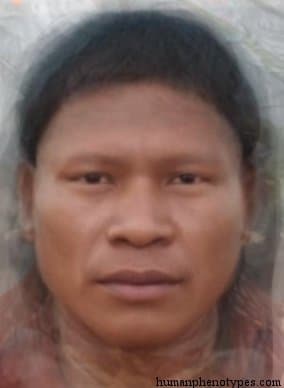
Composite source: Human Phenotypes — Lagoa Santa
Geographic Distribution
Geographically, Lagoa Santa anchors to 19.6° S, 43.9° W (South America). That is the point where historical anthropologists judged Lagoa Santa most concentrated, not a hard edge; modern migration and intermarriage have long since softened whatever boundaries once existed.
Physical Characteristics
Yellowish/copperish light to medium brown skin, straight or wavy hair.
- (Rather) short, mesoskelic, sometimes brachyskelic, meso- to endomorph
- Dolicho- mesocephalic, sometimes hyperdolichocephalic, hypsicephalic
- Meso- platyrrhine, low-rooted, sometimes concave nose
- Face is low and large with deep-set eyes and supraorbital ridges
- Strong sexual dimorphism, mild prognathy
- Cheekbones and jaw broad
- Eyelids narrow, sometimes with slanted eyes
Historical Background
Lagid proper, named after fossil remains of Brazil. Associated with one of the first migration waves to South America. Skulls sometimes Melanesiform. More widespread in prehistoric times. Still common in Jê speakers like Xavante, Xerente, Krahô, Kayapo, Apinajé, U'wa. Also in Xingu and Ayoreo and some Amazonians (e.g. Yanomani, Ye'kuana). More mixed in Bororo, even in the extinct Pericú.
Research History & Naming
Typological names were coined, contested, and renamed repeatedly across the 20th century, and Lagoa Santa is no exception. The extract below records the researchers who defined Lagoa Santa, the alternative labels it accumulated, and where the modern consensus settled.
Defined early as Lagoa Santa race by Hansen (1888) . This was kept by Vogel (1974) , also Eickstedt (1934) , who also called it "mountain cave type". Fuegid was included before Imbelloni (1937) separated it. Lundman (1967) termed it Campid, Biasutti (1967) Lagoana. Imbelloni ( 1937 , 1958 ), Kunter (1987) and Knussmann (1996) Lagid.
Comparison With Nearby Phenotypes
The five phenotypes whose documented centers lie closest to Lagoa Santa, ranked by great-circle distance. They are the types players most often confuse with Lagoa Santa in the quiz, precisely because their distributions overlap.
| Phenotype | Region | Distance | Distinguishing trait |
|---|---|---|---|
| Botocudo | South America | 126 km | Yellowish/copperish light brown skin with straight or wavy hair. |
| South Amazonid | South America | 1,496 km | Yellowish/reddish light to medium brown skin, straight or slightly wavy hair. |
| Bororo | South America | 1,996 km | Olive medium brown skin with straight and black rarely wavy hair. |
| Huarpid | South America | 2,207 km | Medium, sometimes dark brown skin, often with wavy hair. |
| Pampid | South America | 2,416 km | Olive medium brown skin with straight and black rarely wavy hair. |
Lagoa Santa in the Game
Lagoa Santa is one of the faces that can appear in Classic Daily and Challenge Mode. When it does, the winning pin lands near 19.6° S, 43.9° W in South America — and because the scoring decays with distance, recognizing the region matters more than pixel-perfect placement.
Lagoa Santa Phenotype FAQ
- Where does the Lagoa Santa phenotype come from?
- The reference coordinates for the Lagoa Santa phenotype sit near 19.6° S, 43.9° W, in South America. That point marks the center of the South America distribution documented roughly 1500 years ago — actual prevalence spread well beyond it, toward entries such as Botocudo 126 km away, and modern migration has blurred those boundaries further.
- What does the Lagoa Santa phenotype look like?
- In the historical literature, yellowish/copperish light to medium brown skin, straight or wavy hair. For Lagoa Santa these are statistical tendencies across a population, not a checklist every individual matches.
- Is the Lagoa Santa phenotype a race or a nationality?
- No. Phenotypes like Lagoa Santa are descriptive averages, not ancestry groups. Lagoa Santa is one of several types documented in and around South America — see the comparison table above — and the same individual can carry traits associated with several of them at once. The Lagoa Santa entry describes a statistical pattern, not a group of people and not a nationality.
- How does Lagoa Santa appear in the game?
- In Classic Daily and Challenge Mode, the Lagoa Santa composite face appears without a label. Your task is to drop a pin on the world map where you think that face is historically most common — the scoring uses the distance between your pin and the reference coordinates near 19.6° S, 43.9° W. The post-round review then shows the correct location, your distance error, and this Lagoa Santa entry.
References & Literature
Every claim on this page traces back to the sources below — the researchers who defined, measured, and argued over the Lagoa Santa type. The originals behind the Lagoa Santa entry are worth consulting directly.
- Hansen, S. 1888. Lagoa-Santa Racen. La race de Lagoa Santa. Samml. af Abhandl. e Museo Lundii I, 1-37. Copenhagen.
- Virchow, R. 1874. Die physische Anthropologie der Finnen. Verh. Berliner Ges. Anthr. Ethnol. Urg. VI. 185-189.
- Eickstedt, E. von. 1934. Rassenkunde und Rassengeschichte der Menschheit. Ferdinand Enke. Stuttgart.
- Imbelloni, J.. 1937. Fuéguides et Laguides. Position actuelle de la race Paleo-Américaine ou de antropologia fisica de la Patagonie austral. Zeitschrift für Rassenkunde 5, 295-315.
- Lundman, B. 1967. Geographische Anthropologie. Rassen und Völker der Erde. G. Fischer, Stuttgart
- Biasutti, R. 1967 (1941). Le Razze e i Popoli della terra. 4th Ed. Vol 1-4. U.T.E.T., Torino.
- Imbelloni, J. 1958. Nouveaux apports à la classification de l'homme américain. Miscellanea P. Rivet octogenario dicata. Mexico.
- Kunter, M. 1987. Population and racial history of Argentina, Uruguay and Paraguay. In: Schwidetzky, I. Rassengeschischte des Menschheit 12.
- Knussmann, R. 1996. Vergleichende Biologie des Menschen: Lehrbuch der Anthropologie und Humangenetik. 2ed. Spektrum Akademischer Verlag.
Related Phenotypes
More entries from the same region of the historical map as Lagoa Santa, each with its own composite and trait profile.
Botocudo
South America · 126 km away
Lagid subtype of the Mata Atlântica forests of Brazil, partially mixed with the Fuegid substratum (South Fuegids, Huarpids). Was the dominan...
South Amazonid
South America · 1,496 km away
The most dynamic Amazonid variety, emerged in northern savannahs and spread south across Brazil to Paraguay and Argentina, pushing back olde...
Bororo
South America · 1,996 km away
The northernmost Patagonid variety, often mixed with local Lagid elements, but with a variety of unique features. Native to the savannah and...
Huarpid
South America · 2,207 km away
Northern Fuegid variety that is often considered part of the Lagoid group. Shows Melanesiform features and probably arrived with one of the ...
Pampid
South America · 2,416 km away
Slightly gracilised Patagonid variety, native to the vast plains of the Argentinian Chaco and Pampa. Sometimes mixed with Amazonid elements....
Further Reading
Background articles from the blog that explain where the Lagoa Santa type fits, how these composites are built, and what a face can and cannot tell you.
Ethnicity Do I Look: A Question About Observers
The phrase is a fragment of a longer question, and its verb points at an observer, not at you. Perception research shows what observers...
Ethnic Guesser: Which Facial Cues Actually Decide a Round
A round of the game turns on a handful of facial cues, and they are not equal. Here is how pigment, the epicanthic fold, nasal shape...