Ethnicity Do I Look: A Question About Observers
The phrase is a fragment of a longer question, and its verb points at an observer, not at you. Perception research shows what observers settle in a fifth of a second, and what none of them can read off a face.
The phrase is a fragment
Search boxes collect unfinished sentences. The phrase "ethnicity do I look" is missing the opening word and the closing comparison, and putting them back changes what is being asked. Completed, it reads as: what ethnicity do I look like. The word "like" asks for a resemblance, and the verb "look" makes the whole sentence a claim about perception rather than about descent. Nobody who types it is asking to have their ancestry measured. They are asking what a stranger sees in a photograph, and that question has a real literature behind it: how quickly a face is sorted, which cues carry the sort, and how much of the answer belongs to the observer rather than to the person in the picture.
What an observer settles in 120 milliseconds
Face perception is fast, and it is faster for category than for identity. In a 2003 study published in the Journal of Personality and Social Psychology, Tiffany Ito and Geoffrey Urland recorded event-related potentials while participants viewed photographs of faces, and found that the race of a target shifted the waveform at roughly 120 milliseconds after onset, with attention to gender arriving about 50 milliseconds later (Ito & Urland 2003, 85(4):616-626). Two details matter more than the headline. The effect appeared whether participants had been instructed to sort by race or by gender, and the early response tracked coarse visual properties such as luminance and low-frequency shape rather than anything ancestral. At that latency the visual system has not yet assembled the features into a whole face.
Identity is the slower and more fragile read. Inverting a face or blurring it makes recognition collapse, yet judging whether a face is male or female survives those same disruptions (Cloutier, Mason & Macrae 2005; Macrae and colleagues 2005). The category arrives early and cheaply; the person arrives late and expensively. When somebody reports what ethnicity you look, they are reporting the cheap stage, and that stage is a summary of surface statistics. It is a real perceptual event. It is not a measurement of descent.
The prototype belongs to the observer
Faces are not stored as photographs. Norm-based accounts of face coding hold that the visual system represents a face as a set of deviations from a prototype, an average assembled from the faces a person has actually encountered (Rhodes & Jeffery 2006). Adaptation experiments show the prototype moving: after a viewer studies a distorted face for a minute, an ordinary face begins to look distorted in the opposite direction (Webster & MacLin 1999). The baseline against which your face is judged is therefore local, built from experience, and revisable within a single sitting. Two people looking at the same photograph can be running different comparisons.
The same applies to the trait judgments that come bundled with the category. Alex Todorov and colleagues found that judgments of trustworthiness and competence formed after 100 milliseconds of exposure correlate closely with judgments made with unlimited time (Willis & Todorov 2006; Todorov and colleagues 2008). The judgment is stable and it feels like recognition. It is an inference drawn from the geometry of a face, and its confidence is not evidence of its accuracy.
The label list is supplied, not perceived
Perception supplies the sort; it does not supply the names. In experiments the categories are chosen by the researchers, usually a handful of them, and participants place each face into one. When a face carries more than one documented background, the placement does not come out proportional. Arnold Ho and colleagues found that Black-White biracial targets were sorted as Black, while Asian-White targets were more often sorted as White, a pattern that tracked social rank rather than any measured proportion (Ho, Sidanius, Levin & Eberhardt 2011). Mouse-tracking work reported by Jonathan Freeman and colleagues shows the same decision behaving like a competition that resolves over several hundred milliseconds, with the hand drifting toward one label before the other (Freeman and colleagues 2010). A lookup table would not drift.
This is the part of the question that better measurement inside the viewer cannot fix. The observer is not reading a category off the face. The observer is placing the face into a set of names that came from somewhere else, often from a census form, a dataset annotation sheet, or a film. Change the list and the same face lands somewhere else.
What the catalogue records instead
The entries on this site answer a different verb. An entry does not output a label for a face. It describes a documented appearance pattern, states where the literature reports it, and lists sources. The entry for Lagoa Santa names a set associated with early remains in Brazil, notes skulls described as sometimes Melanesiform, and records that the pattern was more widespread in prehistory while still being reported among several Jê-speaking groups. Paleo Saharid is described as an ancient type of the Sahara, estimated in the source literature at roughly a fifth of Toubou communities in the Tibesti mountains, with further reports from the Dawada of Libya. Neither sentence makes a claim about a reader.
The unit of description is the distribution, not the person. A catalogue can say that a pattern was reported across a region and rarely outside it, and it can name the paper that said so. It cannot say which pattern a given face is. That gap is not a missing feature waiting on a better model. It follows from what the entries are: a record of how earlier researchers grouped what they saw.
The map was drawn before the movement
The entries carry a baseline of roughly 1500 years ago, and several of them exist precisely because populations moved. Athabaskid is described as a northern Pacifid variety shaped by later migrations from Asia into an older Pacifid population, reported from Alaska through Yukon, the Northwest Territories and British Columbia. Andronovo-Turanid is described as having been more widespread before the expansions associated with Hunnic, Avar and Khazar movement, and as being reported today mainly among Volga groups such as the Kazan Tatars. Both entries are records of movement rather than of stasis.
Modern movement runs on a different clock. The United Nations estimated that 281 million people were living outside their country of birth in 2020, up from 173 million in 2000, and that those migrants made up 3.6% of the world population. A city whose residents arrived from four continents within two generations cannot be read with a map assembled from regional patterns in late antiquity. The useful way to hold the catalogue is as a dated description: here is what was reported, here is where, here is the source, and here is the uncertainty the source carried.
How to ask a version with an answer
The phrase can be repaired. Ask about a named population and a defined period, and a documented answer may exist. Ask which cues observers actually rely on when they guess, and there is a large experimental literature. Ask what your own ethnicity is, and the question stops being perceptual, because the term covers language, religion, community and self-description, none of which a face carries. The version of the question this site answers is the narrow one: which appearance patterns were catalogued, where were they reported, by whom, and how much did those authors claim.
Frequently Asked Questions
- Does my face show my ethnicity?
- No, and the sentence is doing more work than it can carry. A face carries visible variation, and observers sort faces into categories quickly, but that sort is a perceptual act performed with a local prototype and a supplied list of names. The patterns catalogued here are statistical descriptions of historic samples, each with a stated region and a citation. None of them is a key that turns a photograph into a statement about descent or personal identity.
- Why do people keep guessing the same thing about me?
- Consensus is not accuracy. Observers converge because they share a prototype built from the faces they have seen and a small set of labels they have been handed. Where a face sits near a boundary, the competition between labels is close, and small changes in light, angle or surrounding context can flip the result. Agreement tells you that the observer's reference set is shared, not that the guess was read off your genome.
- What can a phenotype catalogue tell me about my own face?
- It can tell you what has been documented: which appearance patterns the older literature described, the regions and communities they were reported among, roughly when, and with which sources. It can also show you how it was assembled and where it stops. It cannot tell you which entry you are, because the entries describe distributions across historic samples rather than properties of individuals.
Related Phenotypes
Faces from the encyclopedia that appear in this article. Open any entry for its full description, distribution, and references.
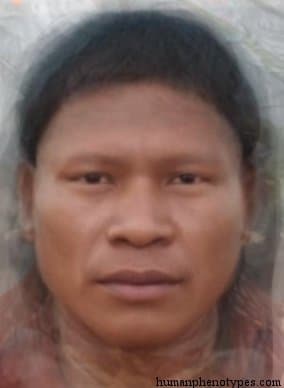
Lagoa Santa
South America
Lagid proper, named after fossil remains of Brazil. Associated with one of the first migration waves to South America. Skulls sometimes Mela...
Paleo Saharid
South Africa
Very ancient type native to the Sahara Desert. Related to Proto Ethiopid, but possibly also shows traces of ancient Khoisanids who were more...
Athabaskid
North America
Northern Pacifid variety, heavily influenced by Sibirid and Eskimid admixture. Developed by relatively late migrations from Asia some millen...
Andronovo-Turanid
Central Asia
Northern Turanid variant, has probably been more widespread prior to the Tungid expansion of Hunnic, Avar, and Chasar tribes. Influenced by ...
Test what you learned
Put your eye for regional faces to work in the daily quiz — a composite face, a world map, and your best guess.