Athabaskid Phenotype - Face Features & Origin
Northern Pacifid variety, heavily influenced by Sibirid and Eskimid admixture. Its reference coordinates sit near 63.0° N, 136.0° W in North America. Rather than a single portrait, the Athabaskid composite below is a statistical average, and the surrounding sections — traits, distribution, research history, references — give that average its context.
Average Face
What you see below is a statistical construction of the Athabaskid reference population. Faces recorded from the Athabaskid sample were overlaid and merged; the result keeps the features most members shared and discards personal variation. It reads like a Athabaskid portrait, but it works like a histogram.
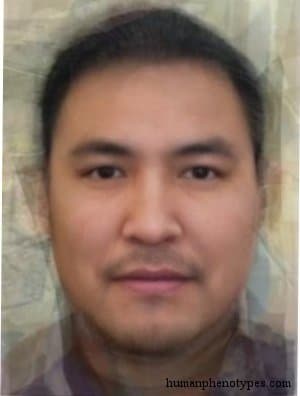
Composite source: Human Phenotypes — Athabaskid
Geographic Distribution
Geographically, Athabaskid anchors to 63.0° N, 136.0° W (North America). That is the point where historical anthropologists judged Athabaskid most concentrated, not a hard edge; modern migration and intermarriage have long since softened whatever boundaries once existed.
Physical Characteristics
Light yellowish-brown skin, straight, sometimes wavy dark brown, occasionally lighter hair.
- Medium height, mesoskelic, endomorph, sometimes mesomorph with long arms
- Meso- brachycephalic, orthocranic
- Leptorrhine, pronounced, usually straight nose
- Face not as angular as in more southern varieties
- Jaw massive, cheek bones weak, body hair moderate, slanted eyes common
Historical Background
Northern Pacifid variety, heavily influenced by Sibirid and Eskimid admixture. Developed by relatively late migrations from Asia some millennia ago that swept into Proto Pacifid populations. Typical from Alaska to the Canadian states of Yukon, the Northwest Territories, and British Columbia. Common in Athabaskan speakers like Ahtna, Carrier Chilcotin, Dogrib, Sacree, Tanana, Telah, Tutchone, and others. Eskimid-admixed in Chipewyan and Gwich'in.
Research History & Naming
The passage below traces who first defined Athabaskid, which rival names competed with it, and how later authors consolidated or disputed the classification — the raw material of any serious phenotype reference.
Named by Eickstedt (1934) as a Pacifid subtype after works of Hrdlicka (1930) . Corresponds to Drexel's (1955) Subarktid. Part of Knussmann's (1996) Pacifids and Lundman's (1967) Deneids. Has a strong North-East Asian genetic influence (c.p. Arnaiz-Villena et al. 2010 ).
Comparison With Nearby Phenotypes
The five phenotypes whose documented centers lie closest to Athabaskid, ranked by great-circle distance. They are the types players most often confuse with Athabaskid in the quiz, precisely because their distributions overlap.
| Phenotype | Region | Distance | Distinguishing trait |
|---|---|---|---|
| Pacifid (proper) | North America | 1,087 km | Light yellowish-brown skin, straight or wavy, dark brown, occasionally lighter hair. |
| Bering Sea | Siberia | 1,613 km | Light yellowish/reddish-brown skin with light or wavy black hair. |
| Chukchid | Siberia | 2,546 km | Light yellowish/reddish-brown skin with straight or wavy black, sometimes lighter hair. |
| California Pacifid | North America | 2,649 km | Light, sometimes medium yellowish-brown skin with straight or wavy, dark brown hair. |
| Californid | North America | 3,151 km | Medium brown skin with straight hair. |
Athabaskid in the Game
Athabaskid is one of the faces that can appear in Classic Daily and Challenge Mode. When it does, the winning pin lands near 63.0° N, 136.0° W in North America — and because the scoring decays with distance, recognizing the region matters more than pixel-perfect placement.
Athabaskid Phenotype FAQ
- Where does the Athabaskid phenotype come from?
- The reference coordinates for the Athabaskid phenotype sit near 63.0° N, 136.0° W, in North America. That point marks the center of the North America distribution documented roughly 1500 years ago — actual prevalence spread well beyond it, toward entries such as Pacifid (proper) 1,087 km away, and modern migration has blurred those boundaries further.
- What does the Athabaskid phenotype look like?
- In the historical literature, light yellowish-brown skin, straight, sometimes wavy dark brown, occasionally lighter hair. For Athabaskid these are statistical tendencies across a population, not a checklist every individual matches.
- Is the Athabaskid phenotype a race or a nationality?
- No — and the Athabaskid naming history above shows why. Athabaskid was defined, renamed, and regrouped repeatedly by different researchers, which is the opposite of how a fixed racial category would behave. A phenotype is a recurring bundle of visible traits recorded across a population; the Athabaskid label says nothing about where any individual's ancestors were born.
- How does Athabaskid appear in the game?
- In Classic Daily and Challenge Mode, the Athabaskid composite face appears without a label. Your task is to drop a pin on the world map where you think that face is historically most common — the scoring uses the distance between your pin and the reference coordinates near 63.0° N, 136.0° W. The post-round review then shows the correct location, your distance error, and this Athabaskid entry.
References & Literature
The Athabaskid phenotype entry above is compiled from the 6 academic references. Readers are encouraged to consult the original Athabaskid sources for verification and deeper context.
- Eickstedt, E. von. 1934. Rassenkunde und Rassengeschichte der Menschheit. Ferdinand Enke. Stuttgart.
- Hrdlicka, A. 1930. Anthropological Survey in Alaska. Ann. Report Bur. Am. Ethnol. 46. 19-374.
- Drexel, A. 1955. Die Völker der Erde. 2nd Ed. Akademie Verlag. Zürich.
- Knussmann, R. 1996. Vergleichende Biologie des Menschen: Lehrbuch der Anthropologie und Humangenetik. 2ed. Spektrum Akademischer Verlag.
- Lundman, B. 1967. Geographische Anthropologie. Rassen und Völker der Erde. G. Fischer, Stuttgart
- Arnaiz-Villena et al. 2010. The Origin of Amerindians and the Peopling of the Americas According to HLA Genes. Curr Genomics 11(2): 103-114.
Related Phenotypes
More entries from the same region of the historical map as Athabaskid, each with its own composite and trait profile.
Pacifid (proper)
North America · 1,087 km away
American type, native to the moist forests of the North Pacific coast, from Aleuts across South Alaska, British Columbia to Oregon. Purest i...
Bering Sea
Siberia · 1,613 km away
Western Eskimid variety common in Alaska and along the Bering Strait, esp. St. Lawrence Island. The result of a relatively late migration to...
Chukchid
Siberia · 2,546 km away
Far Eastern Sibirid variety, influenced by Eskimid, adapted to one of the coldest inhabitable places on Earth: the Arctic tundra of Chukotka...
California Pacifid
North America · 2,649 km away
Pacifid variety of California and South Washington. In its purest form in Northern California. Typified by the Yurok as well as Chinook grou...
Californid
North America · 3,151 km away
Ancient Margid subtype, probably arrived with one of the oldest migrations to America. Shares some features with Ainuids. During the last ce...
Further Reading
Background articles from the blog that explain where the Athabaskid type fits, how these composites are built, and what a face can and cannot tell you.
Ethnicity Do I Look: A Question About Observers
The phrase is a fragment of a longer question, and its verb points at an observer, not at you. Perception research shows what observers...
Geography Games Like GeoGuessr: Six Kinds of Clue
Street panoramas, country outlines and average faces all answer one question. Here are six geography games sorted by the clue they hand...