Pacifid (proper) Phenotype - Face Features & Origin
Historical anthropology places the Pacifid (proper) phenotype in North America, with a documented center near 55.0° N, 125.0° W. American type, native to the moist forests of the North Pacific coast, from Aleuts across South Alaska, British Columbia to Oregon. The sections that follow unpack the Pacifid (proper) entry in practice: the composite face, the traits it summarizes, the naming history, and the sources.
Average Face
Averaging the portraits behind Pacifid (proper) leaves the features that repeat and erases the ones that do not. That is exactly how the Pacifid (proper) composite below was built: individual photographs were aligned and statistically merged, exaggerating shared structure into a single reference face that no actual person looks like.
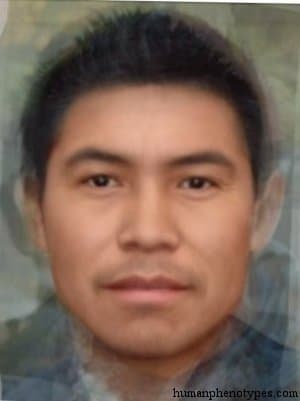
Composite source: Human Phenotypes — Pacifid (proper)
Geographic Distribution
Pacifid (proper) is documented across North America, with its historical reference center near 55.0° N, 125.0° W. The coordinates mark where the type was most characteristic roughly 1500 years ago; population movements since then have scattered and blended the distribution far beyond that point.
Physical Characteristics
Light yellowish-brown skin, straight or wavy, dark brown, occasionally lighter hair.
- Medium height to tall, macroskelic, sometimes mesoskelic, endomorph to mesomorph, relatively long arms
- Brachycephalic, ortho- chamaecranic, large-headed
- Mildly leptorrhine, prominent, straight or slightly convex nose
- Angular facial features, massive, not very strong chin
- Eyes weakly slanted
Historical Background
American type, native to the moist forests of the North Pacific coast, from Aleuts across South Alaska, British Columbia to Oregon. Purest in Wakashan and many Salishan speakers, especially Kwakiutl and Nez Perce, also Flatheads, Tlinkit, Haida, Coeur d'Alene, Shuswap, Yakama, and many related groups. Weak influences range from Labrador to Texas and even Hawaii. In its centre a Northern, Kwakiutl, Thompson River, and Harrison Lake subtype exist.
Research History & Naming
Every label in the historical catalogue has an author and a date, and Pacifid (proper) has accumulated its share of competing attributions. For Pacifid (proper), the literature extract below shows the naming chain — from the first definition through the later revisions that shaped the current entry.
Named by Eickstedt (1934) as a Pacifid subtype after various local varieties had been identified by Boas (1905) . This was adopted by Vogel (1974) , Knussmann (1996) and others. Neumann ( 1952 , 1966 ) and Lundman (1967) called it Deneid. Imbelloni's (1952) Columbids and Biasutti's (1967) Aleutina race are similar.
Comparison With Nearby Phenotypes
The five phenotypes whose documented centers lie closest to Pacifid (proper), ranked by great-circle distance. They are the types players most often confuse with Pacifid (proper) in the quiz, precisely because their distributions overlap.
| Phenotype | Region | Distance | Distinguishing trait |
|---|---|---|---|
| Athabaskid | North America | 1,087 km | Light yellowish-brown skin, straight, sometimes wavy dark brown, occasionally lighter hair. |
| California Pacifid | North America | 1,614 km | Light, sometimes medium yellowish-brown skin with straight or wavy, dark brown hair. |
| Californid | North America | 2,090 km | Medium brown skin with straight hair. |
| Planid | North America | 2,469 km | Yellowish/reddish light brown skin, but the name "red skin" came from war paint. |
| Arizonid | North America | 2,509 km | Light yellowish/reddish-brown skin with straight or wavy, dark brown or black hair. |
Pacifid (proper) in the Game
Pacifid (proper) is one of the faces that can appear in Classic Daily and Challenge Mode. When it does, the winning pin lands near 55.0° N, 125.0° W in North America — and because the scoring decays with distance, recognizing the region matters more than pixel-perfect placement.
Pacifid (proper) Phenotype FAQ
- Where does the Pacifid (proper) phenotype come from?
- Historical sources center the Pacifid (proper) phenotype on 55.0° N, 125.0° W (North America). Treat that as a rough anchor: the type appeared across a wider surrounding area — its nearest documented neighbors, Athabaskid and California Pacifid, sit 1,087 and 1,614 km from the reference point — and its present-day distribution no longer matches the historical map.
- What does the Pacifid (proper) phenotype look like?
- The composite emphasizes recurring traits: light yellowish-brown skin, straight or wavy, dark brown, occasionally lighter hair. The full trait list for Pacifid (proper) appears in the physical characteristics section above.
- Is the Pacifid (proper) phenotype a race or a nationality?
- No — and the Pacifid (proper) naming history above shows why. Pacifid (proper) was defined, renamed, and regrouped repeatedly by different researchers, which is the opposite of how a fixed racial category would behave. A phenotype is a recurring bundle of visible traits recorded across a population; the Pacifid (proper) label says nothing about where any individual's ancestors were born.
- How does Pacifid (proper) appear in the game?
- When the Pacifid (proper) face comes up in Classic Daily or Challenge Mode, you pin the world map where you believe the type is historically most common, and the score decays with your distance to 55.0° N, 125.0° W. The nearest documented type, Athabaskid, lies about 1,087 km away, so regional placement usually carries most of the score.
References & Literature
Primary sources for the Pacifid (proper) entry, listed as cited in the historical literature. The naming and classification debates around Pacifid (proper) referenced above run through these works.
- Eickstedt, E. von. 1934. Rassenkunde und Rassengeschichte der Menschheit. Ferdinand Enke. Stuttgart.
- Boas, F. 1905. Physical types of the Indians of Canada. Ann. Arch. Rep. (App. Rep. Minister of Education). 84-88. Toronto.
- Virchow, R. 1874. Die physische Anthropologie der Finnen. Verh. Berliner Ges. Anthr. Ethnol. Urg. VI. 185-189.
- Knussmann, R. 1996. Vergleichende Biologie des Menschen: Lehrbuch der Anthropologie und Humangenetik. 2ed. Spektrum Akademischer Verlag.
- Neumann, G.. 1952. Archeology and Race in the American Indian.13-34. In: Griffin, J. Archeology of Eastern United States. Chicago and London.
- Neumann, G.. 1966. Racial History of the Indians. 505-518. In: Lindsey, A. Natural Features of Indiana. Indiana Sesquicentennial Vol., Indiana A. of Sci.
- Lundman, B. 1967. Geographische Anthropologie. Rassen und Völker der Erde. G. Fischer, Stuttgart
- Imbelloni, J. 1952. Rassentypen und Biodynamik von Amerika. In: Historia Mundi. Band 1, Munich, 188-203.
- Biasutti, R. 1967 (1941). Le Razze e i Popoli della terra. 4th Ed. Vol 1-4. U.T.E.T., Torino.
Related Phenotypes
If Pacifid (proper) interested you, these neighboring phenotype entries cover adjacent parts of the map with distinctly different trait bundles.
Athabaskid
North America · 1,087 km away
Northern Pacifid variety, heavily influenced by Sibirid and Eskimid admixture. Developed by relatively late migrations from Asia some millen...
California Pacifid
North America · 1,614 km away
Pacifid variety of California and South Washington. In its purest form in Northern California. Typified by the Yurok as well as Chinook grou...
Californid
North America · 2,090 km away
Ancient Margid subtype, probably arrived with one of the oldest migrations to America. Shares some features with Ainuids. During the last ce...
Planid
North America · 2,469 km away
Native American type, named after the Great Plains of North America. In pre-Colombian times concentrated in the Central Canadian forests fro...
Arizonid
North America · 2,509 km away
Relatively recent North American contact type. Started to develop as Athabaskan speakers of Canada migrated South during late Pre-Columbian ...
Further Reading
Background articles from the blog that explain where the Pacifid (proper) type fits, how these composites are built, and what a face can and cannot tell you.
Free Ethnicity Guesser: What Free Actually Costs
The phrase covers a quiz, a photo classifier and a reference library. What separates them is not the price but how each is funded, and...
Ethnicity Do I Look: A Question About Observers
The phrase is a fragment of a longer question, and its verb points at an observer, not at you. Perception research shows what observers...