Aetid Phenotype - Face Features & Origin
Ancient type found in the mountains of the Philippine islands of Luzon, Mindandao and Palawan. The entry below collects the Aetid composite face, its documented distribution around 15.6° N, 120.7° E in Southeast Asia, its physical characteristics, the research history behind the name, and the academic references that support all of it.
Average Face
The Aetid composite below is not a photograph of a real person. Historical anthropologists aligned multiple individual portraits from the Aetid reference population and averaged them into one image, so recurring structures — skull outline, nose form, lip thickness, brow position — dominate while individual idiosyncrasies cancel out.
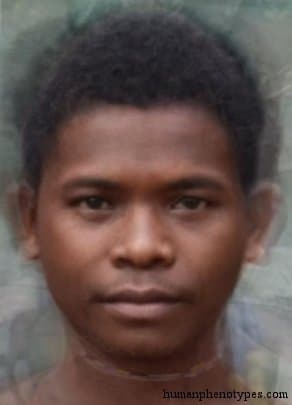
Composite source: Human Phenotypes — Aetid
Geographic Distribution
Geographically, Aetid anchors to 15.6° N, 120.7° E (Southeast Asia). That is the point where historical anthropologists judged Aetid most concentrated, not a hard edge; modern migration and intermarriage have long since softened whatever boundaries once existed.
Physical Characteristics
Dark brown skin and kinky hair.
- Very short, ectomorph, mesoskelic
- Meso- brachycephalic, mildly hypsicranic, small-headed with a flattened, mesorrhine nose
- The face is wide and boxy, the lips concave and relatively thick, cheekbones prominent, chin weak, bodies often hairy, the forehead relatively steep, especially in women
- Prognathism is usually absent
Historical Background
Ancient type found in the mountains of the Philippine islands of Luzon, Mindandao and Palawan. Probably developed during the Paleolithic. Similar to Semangid. Rare today, usually mixed. Only a few thousand typical individuals remain. Dominant in the original people of Aeta, Ati, Batak and Mamanwa. Occasionally on the Lesser Sunda Islands (esp. East Flores). Loss of culture and forest destruction may wipe out this unique type soon.
Research History & Naming
Typological names were coined, contested, and renamed repeatedly across the 20th century, and Aetid is no exception. The extract below records the researchers who defined Aetid, the alternative labels it accumulated, and where the modern consensus settled.
Detailed investigations by Reed (1904) and Wastl (1957) . The type was defined by Giuffrida-Ruggeri (1912) and named Aetid/Aëtid by Eickstedt ( 1937, 1952 ) and Knussmann (1996) or Negrito Philippine by Alexeev, 1979 . Biasutti (1967) grouped them in Semang-Aeta, others ( Cole, 1965 ; Lundman, 1967 ) simply as Negritid.
Comparison With Nearby Phenotypes
The five phenotypes whose documented centers lie closest to Aetid, ranked by great-circle distance. They are the types players most often confuse with Aetid in the quiz, precisely because their distributions overlap.
| Phenotype | Region | Distance | Distinguishing trait |
|---|---|---|---|
| Chukiangid | East Asia | 1,146 km | Yellow to olive- or coppery brown skin with straight hair. |
| Annamid | Southeast Asia | 1,410 km | Yellowish light brown skin, often slightly darker than in other South Sinids. |
| Tonkinesid | Southeast Asia | 1,594 km | Yellowish light brown skin with coarse straight to slightly wavy hair. |
| Dayakid | Southeast Asia | 1,749 km | Medium brown skin with straight or wavy hair. |
| Changkiangid | East Asia | 1,794 km | Light to brownish yellow, sometimes fair skin with coarse straight hair. |
Aetid in the Game
Aetid is one of the faces that can appear in Classic Daily and Challenge Mode. When it does, the winning pin lands near 15.6° N, 120.7° E in Southeast Asia — and because the scoring decays with distance, recognizing the region matters more than pixel-perfect placement.
Aetid Phenotype FAQ
- Where does the Aetid phenotype come from?
- Historical sources center the Aetid phenotype on 15.6° N, 120.7° E (Southeast Asia). Treat that as a rough anchor: the type appeared across a wider surrounding area — its nearest documented neighbors, Chukiangid and Annamid, sit 1,146 and 1,410 km from the reference point — and its present-day distribution no longer matches the historical map.
- What does the Aetid phenotype look like?
- The composite emphasizes recurring traits: dark brown skin and kinky hair. The full trait list for Aetid appears in the physical characteristics section above.
- Is the Aetid phenotype a race or a nationality?
- No. Phenotypes like Aetid are descriptive averages, not ancestry groups. Aetid is one of several types documented in and around Southeast Asia — see the comparison table above — and the same individual can carry traits associated with several of them at once. The Aetid entry describes a statistical pattern, not a group of people and not a nationality.
- How does Aetid appear in the game?
- When the Aetid face comes up in Classic Daily or Challenge Mode, you pin the world map where you believe the type is historically most common, and the score decays with your distance to 15.6° N, 120.7° E. The nearest documented type, Chukiangid, lies about 1,146 km away, so regional placement usually carries most of the score.
References & Literature
Every claim on this page traces back to the sources below — the researchers who defined, measured, and argued over the Aetid type. The originals behind the Aetid entry are worth consulting directly.
- Reed, W. A. 1904. Negritos of Zambales. Bureau of Public Printing. Manila.
- Wastl, J. 1957. Beitrag zur Anthropologie der Negrito von Ost-Luzon. Anthropos 52, 5/6, 769-812.
- Giuffrida-Ruggeri, V. 1912. Schema di Classificazione degli hominidae attuali. Arch. per l'A. e l'Etn. XLII.
- Eickstedt, E. von. 1937. Geschichte der anthropologischen Namengebung und Klassifikation. In: Zeitschrift für Rassenkunde. Band 5, 209-282, Band 6, 36-96, 151-210.
- Eickstedt, E. von. 1952. Biodynamik der Europiden. In: Historia Mundi. Band 1, Munich, 115-134.
- Knussmann, R. 1996. Vergleichende Biologie des Menschen: Lehrbuch der Anthropologie und Humangenetik. 2ed. Spektrum Akademischer Verlag.
- Alexeev, V. P. 1979. The Differential Geography of Races. In: Stini, W. A. Physiological and Morphological Adaptation and Evolution. De Gruyter.
- Biasutti, R. 1967 (1941). Le Razze e i Popoli della terra. 4th Ed. Vol 1-4. U.T.E.T., Torino.
- Cole, S. 1965. Races of Man. Butler & Tanner Ltd. Frome and London.
- Lundman, B. 1967. Geographische Anthropologie. Rassen und Völker der Erde. G. Fischer, Stuttgart
Related Phenotypes
Other human phenotypes whose documented centers lie in the same part of the map as Aetid.
Chukiangid
East Asia · 1,146 km away
South Sinid proper subvariety, named after the Chu Khang (Xi) river in South China. Developed in the fishing and gatherer populations of sou...
Annamid
Southeast Asia · 1,410 km away
South Sinid subvariety with less pronounced Sinid features that often tend to be very gracile. Typical for the old province of Annam in Viet...
Tonkinesid
Southeast Asia · 1,594 km away
South Sinid subvariety, typical for the plains of the Red River in Northern Vietnam. Named after the old Tonkin protectorate / Ðông Kinh reg...
Dayakid
Southeast Asia · 1,749 km away
Proto Malayid subtype, the insular counterpart of Palaungids, predates the arrival of Deutero Malayids. Has thus developed a stronger tropic...
Changkiangid
East Asia · 1,794 km away
Sinid subtype, named after the Chang Kiang (Yangtze) river in Central China. Today the most populous human variety in the world. Developed f...
Further Reading
Background articles from the blog that explain where the Aetid type fits, how these composites are built, and what a face can and cannot tell you.
Ethno Guessr Explained: The Daily Face-Mapping Game
Ethno guessr is the loose nickname for a family of quiz games in which a face is the only clue. Here is how one round is built, what the...
Ethnicity Guesser Game: How the Answer Space Shapes a Round
A face-mapping game scores an answer three ways: a point on the map, a named catalogue entry, or a modern country.