Dayakid Phenotype - Face Features & Origin
Historical anthropology places the Dayakid phenotype in Southeast Asia, with a documented center near 1.4° N, 113.7° E. Proto Malayid subtype, the insular counterpart of Palaungids, predates the arrival of Deutero Malayids. The sections that follow unpack the Dayakid entry in practice: the composite face, the traits it summarizes, the naming history, and the sources.
Average Face
Averaging the portraits behind Dayakid leaves the features that repeat and erases the ones that do not. That is exactly how the Dayakid composite below was built: individual photographs were aligned and statistically merged, exaggerating shared structure into a single reference face that no actual person looks like.
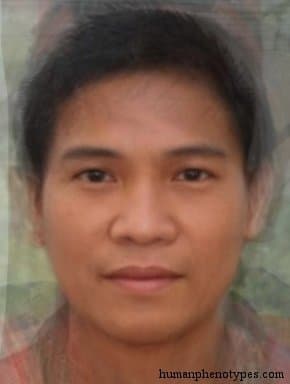
Composite source: Human Phenotypes — Dayakid
Geographic Distribution
Dayakid is documented across Southeast Asia, with its historical reference center near 1.4° N, 113.7° E. The coordinates mark where the type was most characteristic roughly 1500 years ago; population movements since then have scattered and blended the distribution far beyond that point.
Physical Characteristics
Medium brown skin with straight or wavy hair.
- Short, meso- brachyskelic, endomorph to ectomorph
- Mesocephalic, mildly hypsicranic with a mildly platyrrhine, concave nose
- Lips relatively thick, brow ridges marked, face broad, angular and low, chin weak, prognathy weak and Mongolian folds rare
Historical Background
Proto Malayid subtype, the insular counterpart of Palaungids, predates the arrival of Deutero Malayids. Has thus developed a stronger tropical adaption, showing Brasiliform features. Usually found in the interior of larger Sunda and Philippine islands. Purest in Dayaks of Borneo, also common in Batak, Kubu, Toradja, Bugi, Bontoc, Ibaloi, Isnag, Nabaloi, Kankani, Bonto, Kalinga, Ifuago, Jakun, sometimes Taiwanese, Malagasy, Polynesians, and others.
Research History & Naming
Every label in the historical catalogue has an author and a date, and Dayakid has accumulated its share of competing attributions. For Dayakid, the literature extract below shows the naming chain — from the first definition through the later revisions that shaped the current entry.
Named and described as Dayakid by Lundman (1967) and linka ( 1978 , 1981 , 1987 ), Glinka et al. (2010) . Biasutti (1967) called it Punan. Earlier classifications combined it with other types in Proto Malayid ( Sarasin, 1905 ; Eickstedt, 1934 ; Weinert, 1965 ), Indonesian ( Hooton, 1946 ; Cole, 1965 ) or East Veddid ( Eickstedt, 1944 ).
Comparison With Nearby Phenotypes
Ranked by great-circle distance from Dayakid's reference center, these are the five nearest documented phenotypes — the closest being Proto Malayid at 562 km. Overlapping distributions like these are exactly what makes the quiz hard, and the Proto Malayid row is where to start looking.
| Phenotype | Region | Distance | Distinguishing trait |
|---|---|---|---|
| Proto Malayid | Southeast Asia | 562 km | Medium, sometimes dark brown skin, wavy or curly hair. |
| Toalid | Southeast Asia | 824 km | Medium to dark brown skin, usually wavy, sometimes curly hair. |
| Deutero Malayid | Southeast Asia | 1,075 km | Yellowish light to medium brown skin with straight or wavy hair. |
| Khmerid | Southeast Asia | 1,318 km | Reddish medium brown skin with straight or wavy hair. |
| Semangid | Southeast Asia | 1,342 km | Dark (copper) brown skin and kinky hair. |
Dayakid in the Game
When the Dayakid composite shows up in the quiz, players who know the Southeast Asia distribution pattern have the edge. The reference answer sits near 1.4° N, 113.7° E; pins on the wrong continent score close to zero, so even a rough regional instinct beats a precise but misdirected pin.
Dayakid Phenotype FAQ
- Where does the Dayakid phenotype come from?
- Historical sources center the Dayakid phenotype on 1.4° N, 113.7° E (Southeast Asia). Treat that as a rough anchor: the type appeared across a wider surrounding area — its nearest documented neighbors, Proto Malayid and Toalid, sit 562 and 824 km from the reference point — and its present-day distribution no longer matches the historical map.
- What does the Dayakid phenotype look like?
- The composite emphasizes recurring traits: medium brown skin with straight or wavy hair. The full trait list for Dayakid appears in the physical characteristics section above.
- Is the Dayakid phenotype a race or a nationality?
- No. A phenotype is a recurring bundle of visible traits documented by historical anthropologists across a population — for Dayakid, patterns such as medium brown skin with straight or wavy hair. The Dayakid entry is not a genetic ancestry, not a nationality, and not a statement about any individual person. Two people from the same country can match completely different phenotypes — one resembling Dayakid, another closer to Proto Malayid — and one phenotype can span many modern borders.
- How does Dayakid appear in the game?
- When the Dayakid face comes up in Classic Daily or Challenge Mode, you pin the world map where you believe the type is historically most common, and the score decays with your distance to 1.4° N, 113.7° E. The nearest documented type, Proto Malayid, lies about 562 km away, so regional placement usually carries most of the score.
References & Literature
Primary sources for the Dayakid entry, listed as cited in the historical literature. The naming and classification debates around Dayakid referenced above run through these works.
- Lundman, B. 1967. Geographische Anthropologie. Rassen und Völker der Erde. G. Fischer, Stuttgart
- Glinka, J. 1978. Gestalt und Herkunft. Beitrag zur anthropologischen Gliederung Indonesiens. Stud. Inst. Anthropos 25. St. Augustin.
- Glinka, J. 1981. Racial history of Indonesia. In: Schwidetzky, I.: Rassengeschichte der Menschheit, Asien In: Japan, Indonesien, Ozeanien. R. Odenbourg. München. Wien.
- Glinka, J. 1987. Antropologi Ragawi Handout Mahasiswa. Surabaya: FISIP Universitas Airlangga.
- G10
- Biasutti, R. 1967 (1941). Le Razze e i Popoli della terra. 4th Ed. Vol 1-4. U.T.E.T., Torino.
- Sarasin, P. 1905. Versuch einer Anthropologie der Insel Celebes II. Wiesbaden.
- Eickstedt, E. von. 1934. Rassenkunde und Rassengeschichte der Menschheit. Ferdinand Enke. Stuttgart.
- Weinert, H. 1965. Die heutigen Rassen der Menschheit. In: Lundwig, B. and H. Plank. Handbuch der Biologie. Vol 9 (2).
- Hooton, E.A. 1946. Up from the Ape. Rev. ed. Macmillan Company . New York.
- Cole, S. 1965. Races of Man. Butler & Tanner Ltd. Frome and London.
- Eickstedt, E. von. 1944. Rassendynamik von Ostasien. Walter de Gruyter. Berlin.
Related Phenotypes
If Dayakid interested you, these neighboring phenotype entries cover adjacent parts of the map with distinctly different trait bundles.
Proto Malayid
Southeast Asia · 562 km away
Proto Malayid proper type. Relatively old element that probably arrived in the Sunda Archipelago during the period of land bridges in the la...
Toalid
Southeast Asia · 824 km away
The easternmost Veddid type, usually shorter-skulled. The oldest living type of the Sunda Islands. More widespread in historic times and pro...
Deutero Malayid
Southeast Asia · 1,075 km away
The insular counterpart of Shanids. Several components gave rise to this type in mainland Asia: Proto Malayid and Proto Sinid consumed other...
Khmerid
Southeast Asia · 1,318 km away
Intermediate type between South Mongolid and Senoid native to Southern Indochina. The type is the result of intermixture followed by cultura...
Semangid
Southeast Asia · 1,342 km away
Paleolithic, Negriform phenotype found in the forests of the Malay Peninsula, similar to Aetid. Even older and rarer than the cohabitant Sen...
Further Reading
Background articles from the blog that explain where the Dayakid type fits, how these composites are built, and what a face can and cannot tell you.
Ethnoguessr: The Spelling, the Sites, and the Game
Ethnoguessr is a compressed spelling of "ethnicity guesser", and more than one site answers to it. Here is how to tell what you are...
Ethnicity Guesser Game: How the Answer Space Shapes a Round
A face-mapping game scores an answer three ways: a point on the map, a named catalogue entry, or a modern country.