North Gondid Phenotype - Face Features & Origin
Historical anthropology places the North Gondid phenotype in South Asia, with a documented center near 21.7° N, 81.8° E. Ancient phenotype native to North Central India, found up to the Himalaya. The sections that follow unpack the North Gondid entry in practice: the composite face, the traits it summarizes, the naming history, and the sources.
Average Face
Averaging the portraits behind North Gondid leaves the features that repeat and erases the ones that do not. That is exactly how the North Gondid composite below was built: individual photographs were aligned and statistically merged, exaggerating shared structure into a single reference face that no actual person looks like.
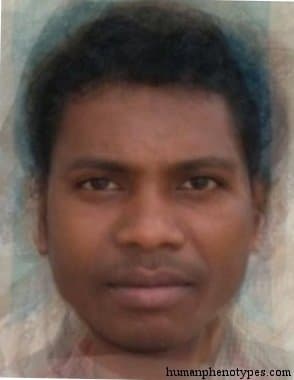
Composite source: Human Phenotypes — North Gondid
Geographic Distribution
The reference center for North Gondid sits near 21.7° N, 81.8° E in South Asia. Around that anchor, prevalence falls off gradually — the type is not confined to one valley or one modern border, and the historical map should be read as a gradient rather than a boundary.
Physical Characteristics
Dark brown skin, wavy, sometimes curly hair.
- Short, brachyskelic, endomorph to ectomorph
- Dolicho- mesocephalic, mildly hypsicranic, small-headed
- Meso- platyrrhine nose
- The face tends to be low and round, although it is longer than in other Veddids
- From those, Gondids also differ by a higher nasal roots and taller bodies
- Mild prognathy is common, the chin slightly receding
Historical Background
Ancient phenotype native to North Central India, found up to the Himalaya. Gondid proper type, the robust counterpart of South Gondids. Common in Gond, Kurukh, Bhil, Juang, Baiga. More mixed in Chota Nagpur and in Munda (with Kolids) and Mardia (with South Gondids). A frequent type, much more populous than other Veddids.
Research History & Naming
Every label in the historical catalogue has an author and a date, and North Gondid has accumulated its share of competing attributions. For North Gondid, the literature extract below shows the naming chain — from the first definition through the later revisions that shaped the current entry.
Eickstedt ( 1931 , 1937 ) defined North Gondid as its proper variety. Lundman (1967) and Biasutti, 1967 kept the name. Haddon's (1925) Pre-Dravidian is similar. Sarkar (1961) included it in Australoid. Genetics indicate links to Australids ( Pugacha et al. 2013 ).
Comparison With Nearby Phenotypes
Geography, not alphabet, ordered this table: the five phenotype centers closest to North Gondid's, with the traits most likely to be mistaken for it (Kolid leads at 403 km). In gameplay, these five account for most of the wrong-but-nearby pins against North Gondid.
| Phenotype | Region | Distance | Distinguishing trait |
|---|---|---|---|
| Kolid | South Asia | 403 km | Black-brown skin, often darker than Veddoids except for Malids. |
| South Gondid | South Asia | 502 km | Medium to dark brown skin, wavy, sometimes curly hair, short, brachyskelic, ectomorph. |
| Gracile Indid | South Asia | 555 km | Light to medium brown skin, straight to wavy hair. |
| East Brachid | South Asia | 778 km | Light brown skin, usually straight hair. |
| Karnatid | South Asia | 1,199 km | Dark brown skin, darker than Veddids, except for Malids. |
North Gondid in the Game
In gameplay terms, North Gondid rewards region-level recall: the score is computed from the distance between your pin and 21.7° N, 81.8° E. Players often confuse North Gondid with Kolid (403 km out) in the comparison table above — those confusions are exactly what the distance penalty is designed to expose.
North Gondid Phenotype FAQ
- Where does the North Gondid phenotype come from?
- Historical sources center the North Gondid phenotype on 21.7° N, 81.8° E (South Asia). Treat that as a rough anchor: the type appeared across a wider surrounding area — its nearest documented neighbors, Kolid and South Gondid, sit 403 and 502 km from the reference point — and its present-day distribution no longer matches the historical map.
- What does the North Gondid phenotype look like?
- The composite emphasizes recurring traits: dark brown skin, wavy, sometimes curly hair. The full trait list for North Gondid appears in the physical characteristics section above.
- Is the North Gondid phenotype a race or a nationality?
- No. A phenotype is a recurring bundle of visible traits documented by historical anthropologists across a population — for North Gondid, patterns such as dark brown skin, wavy, sometimes curly hair. The North Gondid entry is not a genetic ancestry, not a nationality, and not a statement about any individual person. Two people from the same country can match completely different phenotypes — one resembling North Gondid, another closer to Kolid — and one phenotype can span many modern borders.
- How does North Gondid appear in the game?
- When the North Gondid face comes up in Classic Daily or Challenge Mode, you pin the world map where you believe the type is historically most common, and the score decays with your distance to 21.7° N, 81.8° E. The nearest documented type, Kolid, lies about 403 km away, so regional placement usually carries most of the score.
References & Literature
Primary sources for the North Gondid entry, listed as cited in the historical literature. The naming and classification debates around North Gondid referenced above run through these works.
- Eickstedt, E. von. 1931. Die nordindischen Dschungelstämme. In: Anthropologischer Anzeiger (7), 266-285.
- Eickstedt, E. von. 1937. Geschichte der anthropologischen Namengebung und Klassifikation. In: Zeitschrift für Rassenkunde. Band 5, 209-282, Band 6, 36-96, 151-210.
- Lundman, B. 1967. Geographische Anthropologie. Rassen und Völker der Erde. G. Fischer, Stuttgart
- Biasutti, R. 1967 (1941). Le Razze e i Popoli della terra. 4th Ed. Vol 1-4. U.T.E.T., Torino.
- Haddon, A.C.. 1925. The Races of Man and their distribution. Cambridge at the University Press. London.
- Sarkar, S. S. 1961. A racial classification of India. Bulletin of the Anthropological Survey of India 10, 27-34.
- P13
Related Phenotypes
If North Gondid interested you, these neighboring phenotype entries cover adjacent parts of the map with distinctly different trait bundles.
Kolid
South Asia · 403 km away
North Dravidian type, related to Melanids but with stronger Gondid influence. An important population element in India. Purest in Jharkhand ...
South Gondid
South Asia · 502 km away
Gracile Gondid variety of Central India that shares many similarities with Gondids proper, except for a variety of features that puts them m...
Gracile Indid
South Asia · 555 km away
The most widespread and frequent Indid subtype, one of the most populous phenotypes in the world. Common along the Ganges river and Deccan, ...
East Brachid
South Asia · 778 km away
Relatively recent contact type intermediate between Indids and South Mongolids. Widespread, reaching from Western Himalaya / Nepal to Bhutan...
Karnatid
South Asia · 1,199 km away
South Indian type, found in its purest form in Tamil Nadu and Northern Sri Lanka, called Melanid according to its dark skin tone (melanin). ...
Further Reading
Background articles from the blog that explain where the North Gondid type fits, how these composites are built, and what a face can and cannot tell you.
Ethnic Guesser: Which Facial Cues Actually Decide a Round
A round of the game turns on a handful of facial cues, and they are not equal. Here is how pigment, the epicanthic fold, nasal shape...
Guess My Ethnicity: What One Guess Can Carry
When someone types guess my ethnicity, they are asking a stranger to place a bet, and the odds depend far more on the list of labels...