South Gondid Phenotype - Face Features & Origin
Historical anthropology places the South Gondid phenotype in South Asia, with a documented center near 23.8° N, 77.5° E. Gracile Gondid variety of Central India that shares many similarities with Gondids proper, except for a variety of features that puts them morphologically closer to Gracile Indids, possibly a result of convergent evolution. The sections that follow unpack the South Gondid entry in practice: the composite face, the traits it summarizes, the naming history, and the sources.
Average Face
Averaging the portraits behind South Gondid leaves the features that repeat and erases the ones that do not. That is exactly how the South Gondid composite below was built: individual photographs were aligned and statistically merged, exaggerating shared structure into a single reference face that no actual person looks like.
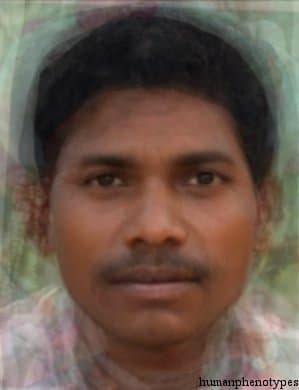
Composite source: Human Phenotypes — South Gondid
Geographic Distribution
Geographically, South Gondid anchors to 23.8° N, 77.5° E (South Asia). That is the point where historical anthropologists judged South Gondid most concentrated, not a hard edge; modern migration and intermarriage have long since softened whatever boundaries once existed.
Physical Characteristics
Medium to dark brown skin, wavy, sometimes curly hair, short, brachyskelic, ectomorph.
- Mesocephalic, mildly hypsicranic, small-headed
- Mesorrhine
- Similar to North Gondids, but more gracile with a thinner body, longer face, even weaker prognathy, and less infantile features
Historical Background
Gracile Gondid variety of Central India that shares many similarities with Gondids proper, except for a variety of features that puts them morphologically closer to Gracile Indids, possibly a result of convergent evolution. Found in its purest form among Muria people. Also frequent in Mardia, Koyi, and the tribes of Bastar. More mixed in Baiga and related Gond people.
Research History & Naming
Typological names were coined, contested, and renamed repeatedly across the 20th century, and South Gondid is no exception. The extract below records the researchers who defined South Gondid, the alternative labels it accumulated, and where the modern consensus settled.
Eickstedt (1931) defined the Gracile / South Gondid type. In later publications he regarded it as a Gondid subtype as well: the Central Gondid ( Eickstedt, 1937 ). Haddon's (1925) Pre-Dravidian is similar. Sarkar (1961) included in Australoid.
Comparison With Nearby Phenotypes
The five phenotypes whose documented centers lie closest to South Gondid, ranked by great-circle distance. They are the types players most often confuse with South Gondid in the quiz, precisely because their distributions overlap.
| Phenotype | Region | Distance | Distinguishing trait |
|---|---|---|---|
| Gracile Indid | South Asia | 407 km | Light to medium brown skin, straight to wavy hair. |
| North Gondid | South Asia | 502 km | Dark brown skin, wavy, sometimes curly hair. |
| Kolid | South Asia | 787 km | Black-brown skin, often darker than Veddoids except for Malids. |
| North Indid | South Asia | 816 km | Light to medium brown skin, straight or wavy, brown or black hair. |
| East Brachid | South Asia | 821 km | Light brown skin, usually straight hair. |
South Gondid in the Game
South Gondid is one of the faces that can appear in Classic Daily and Challenge Mode. When it does, the winning pin lands near 23.8° N, 77.5° E in South Asia — and because the scoring decays with distance, recognizing the region matters more than pixel-perfect placement.
South Gondid Phenotype FAQ
- Where does the South Gondid phenotype come from?
- Historical sources center the South Gondid phenotype on 23.8° N, 77.5° E (South Asia). Treat that as a rough anchor: the type appeared across a wider surrounding area — its nearest documented neighbors, Gracile Indid and North Gondid, sit 407 and 502 km from the reference point — and its present-day distribution no longer matches the historical map.
- What does the South Gondid phenotype look like?
- The composite emphasizes recurring traits: medium to dark brown skin, wavy, sometimes curly hair, short, brachyskelic, ectomorph. The full trait list for South Gondid appears in the physical characteristics section above.
- Is the South Gondid phenotype a race or a nationality?
- No — and the South Gondid naming history above shows why. South Gondid was defined, renamed, and regrouped repeatedly by different researchers, which is the opposite of how a fixed racial category would behave. A phenotype is a recurring bundle of visible traits recorded across a population; the South Gondid label says nothing about where any individual's ancestors were born.
- How does South Gondid appear in the game?
- When the South Gondid face comes up in Classic Daily or Challenge Mode, you pin the world map where you believe the type is historically most common, and the score decays with your distance to 23.8° N, 77.5° E. The nearest documented type, Gracile Indid, lies about 407 km away, so regional placement usually carries most of the score.
References & Literature
Every claim on this page traces back to the sources below — the researchers who defined, measured, and argued over the South Gondid type. The originals behind the South Gondid entry are worth consulting directly.
- Eickstedt, E. von. 1931. Die nordindischen Dschungelstämme. In: Anthropologischer Anzeiger (7), 266-285.
- Eickstedt, E. von. 1937. Geschichte der anthropologischen Namengebung und Klassifikation. In: Zeitschrift für Rassenkunde. Band 5, 209-282, Band 6, 36-96, 151-210.
- Haddon, A.C.. 1925. The Races of Man and their distribution. Cambridge at the University Press. London.
- Sarkar, S. S. 1961. A racial classification of India. Bulletin of the Anthropological Survey of India 10, 27-34.
Related Phenotypes
More entries from the same region of the historical map as South Gondid, each with its own composite and trait profile.
Gracile Indid
South Asia · 407 km away
The most widespread and frequent Indid subtype, one of the most populous phenotypes in the world. Common along the Ganges river and Deccan, ...
North Gondid
South Asia · 502 km away
Ancient phenotype native to North Central India, found up to the Himalaya. Gondid proper type, the robust counterpart of South Gondids. Comm...
Kolid
South Asia · 787 km away
North Dravidian type, related to Melanids but with stronger Gondid influence. An important population element in India. Purest in Jharkhand ...
North Indid
South Asia · 816 km away
Indid subtype of Pakistan and Northwestern India, often associated with ancient Indo-Aryan migrations from the North. Common in Punjab, wher...
East Brachid
South Asia · 821 km away
Relatively recent contact type intermediate between Indids and South Mongolids. Widespread, reaching from Western Himalaya / Nepal to Bhutan...
Further Reading
Background articles from the blog that explain where the South Gondid type fits, how these composites are built, and what a face can and cannot tell you.
Guess Ethnicity From a Photo: What Gets Measured First
Before a face model names anything, it measures. Here is the geometry stage: the landmark schemes tools rely on, the photo standards...
Ethnic Guesser: Which Facial Cues Actually Decide a Round
A round of the game turns on a handful of facial cues, and they are not equal. Here is how pigment, the epicanthic fold, nasal shape...