North Indid Phenotype - Face Features & Origin
Indid subtype of Pakistan and Northwestern India, often associated with ancient Indo-Aryan migrations from the North. The entry below collects the North Indid composite face, its documented distribution around 30.9° N, 75.5° E in South Asia, its physical characteristics, the research history behind the name, and the academic references that support all of it.
Average Face
The North Indid composite below is not a photograph of a real person. Historical anthropologists aligned multiple individual portraits from the North Indid reference population and averaged them into one image, so recurring structures — skull outline, nose form, lip thickness, brow position — dominate while individual idiosyncrasies cancel out.
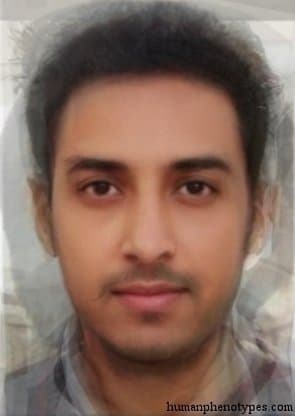
Composite source: Human Phenotypes — North Indid
Geographic Distribution
The reference center for North Indid sits near 30.9° N, 75.5° E in South Asia. Around that anchor, prevalence falls off gradually — the type is not confined to one valley or one modern border, and the historical map should be read as a gradient rather than a boundary.
Physical Characteristics
Light to medium brown skin, straight or wavy, brown or black hair.
- Tall, mesoskelic, ectomorph
- Dolichocephalic, mildly hypsicranic, rather large-headed
- Leptorrhine, long and often convex nose
- Face high and narrow, lips relatively thick compared to other Indids, beard and body hair is stronger
- The chin is weak
Historical Background
Indid subtype of Pakistan and Northwestern India, often associated with ancient Indo-Aryan migrations from the North. Common in Punjab, where it is typified by the Sikh and Punjabi and upper/warrior castes of the Doab. Also in Rajputs, Patharns, in Kashmir and the Hindu Kush. Extends to Southern India, where a similar Toda variety exists. In the North it is transitional to Indo Nordic.
Research History & Naming
Every label in the historical catalogue has an author and a date, and North Indid has accumulated its share of competing attributions. For North Indid, the literature extract below shows the naming chain — from the first definition through the later revisions that shaped the current entry.
Eickstedt ( 1920 , 1934 ) defined it as Type 2 / North Indid (German: Nordindid) . Lundman (1967) , Bernhard (1993) and Knussmann (1996) kept the name. Deniker (1900) and Vallois (1971) called it Indo-Afghan, Risley (1915) and Sarkar (1961) Indo-Aryan. Biasutti (1967) defined it as Indid proper, Hooton (1946) as a darker variant of Indo-Nordic. Some combined it with Iranid ( Cole, 1965 and Vogel, 1974 : Irano-Afghan; Cheboksarov, 1951 : Indo-Pamirian).
Comparison With Nearby Phenotypes
Geography, not alphabet, ordered this table: the five phenotype centers closest to North Indid's, with the traits most likely to be mistaken for it (Mountain Indid leads at 195 km). In gameplay, these five account for most of the wrong-but-nearby pins against North Indid.
| Phenotype | Region | Distance | Distinguishing trait |
|---|---|---|---|
| Mountain Indid | South Asia | 195 km | Light brown skin, straight or wavy hair. |
| Gracile Indid | South Asia | 684 km | Light to medium brown skin, straight to wavy hair. |
| Indo Nordic | South Asia | 686 km | Rosy to light brown skin, blonde to black wavy hair. |
| South Gondid | South Asia | 816 km | Medium to dark brown skin, wavy, sometimes curly hair, short, brachyskelic, ectomorph. |
| East Pamirid | Central Asia | 860 km | Light brown skin, straight or wavy, often brown hair, and mixed eyes. |
North Indid in the Game
In gameplay terms, North Indid rewards region-level recall: the score is computed from the distance between your pin and 30.9° N, 75.5° E. Players often confuse North Indid with Mountain Indid (195 km out) in the comparison table above — those confusions are exactly what the distance penalty is designed to expose.
North Indid Phenotype FAQ
- Where does the North Indid phenotype come from?
- The reference coordinates for the North Indid phenotype sit near 30.9° N, 75.5° E, in South Asia. That point marks the center of the South Asia distribution documented roughly 1500 years ago — actual prevalence spread well beyond it, toward entries such as Mountain Indid 195 km away, and modern migration has blurred those boundaries further.
- What does the North Indid phenotype look like?
- In the historical literature, light to medium brown skin, straight or wavy, brown or black hair. For North Indid these are statistical tendencies across a population, not a checklist every individual matches.
- Is the North Indid phenotype a race or a nationality?
- No — and the North Indid naming history above shows why. North Indid was defined, renamed, and regrouped repeatedly by different researchers, which is the opposite of how a fixed racial category would behave. A phenotype is a recurring bundle of visible traits recorded across a population; the North Indid label says nothing about where any individual's ancestors were born.
- How does North Indid appear in the game?
- In Classic Daily and Challenge Mode, the North Indid composite face appears without a label. Your task is to drop a pin on the world map where you think that face is historically most common — the scoring uses the distance between your pin and the reference coordinates near 30.9° N, 75.5° E. The post-round review then shows the correct location, your distance error, and this North Indid entry.
References & Literature
Primary sources for the North Indid entry, listed as cited in the historical literature. The naming and classification debates around North Indid referenced above run through these works.
- Eickstedt, E. von. 1920. Rassenelemente der Sikh. Ztschr. Ethnol. 52/53. 317-394.
- Eickstedt, E. von. 1934. Rassenkunde und Rassengeschichte der Menschheit. Ferdinand Enke. Stuttgart.
- Lundman, B. 1967. Geographische Anthropologie. Rassen und Völker der Erde. G. Fischer, Stuttgart
- Bernhard, W. 1993. Anthropologie von Südwestasien. In.: Schwidetzky, I.: Rassengeschichte der Menschheit 14, Asien 4. Oldenbourg.
- Knussmann, R. 1996. Vergleichende Biologie des Menschen: Lehrbuch der Anthropologie und Humangenetik. 2ed. Spektrum Akademischer Verlag.
- D00
- Vallois, H. V. 1971. Las races humaines. 8 Ed. Grammont.
- Risley, H. Sir. 1915. The People of India. Thacker, Spink & Co. Calcutta.
- Sarkar, S. S. 1961. A racial classification of India. Bulletin of the Anthropological Survey of India 10, 27-34.
- Biasutti, R. 1967 (1941). Le Razze e i Popoli della terra. 4th Ed. Vol 1-4. U.T.E.T., Torino.
- Hooton, E.A. 1946. Up from the Ape. Rev. ed. Macmillan Company . New York.
- Cole, S. 1965. Races of Man. Butler & Tanner Ltd. Frome and London.
- Virchow, R. 1874. Die physische Anthropologie der Finnen. Verh. Berliner Ges. Anthr. Ethnol. Urg. VI. 185-189.
- Cheboksarov, N.N.. 1951. Osnovnyje printsipy antropologicheskikh klassifikatsij. TIE. 16.
Related Phenotypes
If North Indid interested you, these neighboring phenotype entries cover adjacent parts of the map with distinctly different trait bundles.
Mountain Indid
South Asia · 195 km away
(Gracile) Indid variety native to the valleys south of the Western Himalaya and in the Hindu Kush. Once the principal element of the Khas an...
Gracile Indid
South Asia · 684 km away
The most widespread and frequent Indid subtype, one of the most populous phenotypes in the world. Common along the Ganges river and Deccan, ...
Indo Nordic
South Asia · 686 km away
Type of the Northwestern Himalaya and the Hindu Kush. Connected to Indid, but altered by old unique elements, possibly Proto Nordic that mig...
South Gondid
South Asia · 816 km away
Gracile Gondid variety of Central India that shares many similarities with Gondids proper, except for a variety of features that puts them m...
East Pamirid
Central Asia · 860 km away
The most Europoid Pamirid subtype. Most common in Pamiri speakers of the Pamir Mountains in Eastern Tajikistan and Northern Afghanistan, esp...
Further Reading
Background articles from the blog that explain where the North Indid type fits, how these composites are built, and what a face can and cannot tell you.
Guess Ethnicity From a Photo: What Gets Measured First
Before a face model names anything, it measures. Here is the geometry stage: the landmark schemes tools rely on, the photo standards...
Ethnic Guesser: Which Facial Cues Actually Decide a Round
A round of the game turns on a handful of facial cues, and they are not equal. Here is how pigment, the epicanthic fold, nasal shape...