Mountain Indid Phenotype - Face Features & Origin
Historical anthropology places the Mountain Indid phenotype in South Asia, with a documented center near 31.9° N, 77.2° E. (Gracile) Indid variety native to the valleys south of the Western Himalaya and in the Hindu Kush. The sections that follow unpack the Mountain Indid entry in practice: the composite face, the traits it summarizes, the naming history, and the sources.
Average Face
Averaging the portraits behind Mountain Indid leaves the features that repeat and erases the ones that do not. That is exactly how the Mountain Indid composite below was built: individual photographs were aligned and statistically merged, exaggerating shared structure into a single reference face that no actual person looks like.
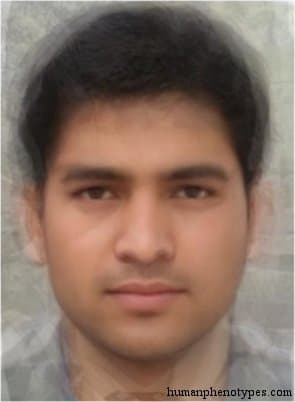
Composite source: Human Phenotypes — Mountain Indid
Geographic Distribution
The reference center for Mountain Indid sits near 31.9° N, 77.2° E in South Asia. Around that anchor, prevalence falls off gradually — the type is not confined to one valley or one modern border, and the historical map should be read as a gradient rather than a boundary.
Physical Characteristics
Light brown skin, straight or wavy hair.
- Rather short, mesoskelic, endomorph, sometimes ectomorph
- Dolicho- mesocephalic, ortho- hypsicranic, relatively large head
- Meso- or mildly leptorrhine, large, straight nose with a depressed root
- Deep eyelids, usually significant supraorbital arches, slightly receding chin
- The broad face seems rhomboid due to the narrow forehead and wide jaw
Historical Background
(Gracile) Indid variety native to the valleys south of the Western Himalaya and in the Hindu Kush. Once the principal element of the Khas and widespread in the North Indian Plains. Today common in Garhwali of Uttarakhand and Pahari, but also in Purigi, Kanets, Rajputs, Himachal Pradesh, Kashmir, Nepal, Eastern Afghanistan, even Tajikistan. Occasionally in Sikh, Turkmenistan, Uzbekistan, and Iran.
Research History & Naming
The passage below traces who first defined Mountain Indid, which rival names competed with it, and how later authors consolidated or disputed the classification — the raw material of any serious phenotype reference.
Eickstedt ( 1926 , 1926b , 1934 , 1937 ) named it Mountain Indid or Garwahli / Himalaya race. Herrlich (1937) identified it as "Type A" in the Hindu Kush, Schwidetzky (1950) reports low frequencies in Turkic people of Central Asia, Janetschek (1990) in Pathans of Nepal.
Comparison With Nearby Phenotypes
The five phenotypes whose documented centers lie closest to Mountain Indid, ranked by great-circle distance. They are the types players most often confuse with Mountain Indid in the quiz, precisely because their distributions overlap.
| Phenotype | Region | Distance | Distinguishing trait |
|---|---|---|---|
| North Indid | South Asia | 195 km | Light to medium brown skin, straight or wavy, brown or black hair. |
| Gracile Indid | South Asia | 680 km | Light to medium brown skin, straight to wavy hair. |
| Indo Nordic | South Asia | 693 km | Rosy to light brown skin, blonde to black wavy hair. |
| East Brachid | South Asia | 765 km | Light brown skin, usually straight hair. |
| East Pamirid | Central Asia | 842 km | Light brown skin, straight or wavy, often brown hair, and mixed eyes. |
Mountain Indid in the Game
Mountain Indid is one of the faces that can appear in Classic Daily and Challenge Mode. When it does, the winning pin lands near 31.9° N, 77.2° E in South Asia — and because the scoring decays with distance, recognizing the region matters more than pixel-perfect placement.
Mountain Indid Phenotype FAQ
- Where does the Mountain Indid phenotype come from?
- The reference coordinates for the Mountain Indid phenotype sit near 31.9° N, 77.2° E, in South Asia. That point marks the center of the South Asia distribution documented roughly 1500 years ago — actual prevalence spread well beyond it, toward entries such as North Indid 195 km away, and modern migration has blurred those boundaries further.
- What does the Mountain Indid phenotype look like?
- In the historical literature, light brown skin, straight or wavy hair. For Mountain Indid these are statistical tendencies across a population, not a checklist every individual matches.
- Is the Mountain Indid phenotype a race or a nationality?
- No — and the Mountain Indid naming history above shows why. Mountain Indid was defined, renamed, and regrouped repeatedly by different researchers, which is the opposite of how a fixed racial category would behave. A phenotype is a recurring bundle of visible traits recorded across a population; the Mountain Indid label says nothing about where any individual's ancestors were born.
- How does Mountain Indid appear in the game?
- In Classic Daily and Challenge Mode, the Mountain Indid composite face appears without a label. Your task is to drop a pin on the world map where you think that face is historically most common — the scoring uses the distance between your pin and the reference coordinates near 31.9° N, 77.2° E. The post-round review then shows the correct location, your distance error, and this Mountain Indid entry.
References & Literature
The Mountain Indid phenotype entry above is compiled from the 7 academic references. Readers are encouraged to consult the original Mountain Indid sources for verification and deeper context.
- Eickstedt, E. von. 1926. Zur Anthropologie der Garhwali im Himalaya. Mitt. Anthr. Ges. Wien LVI. 173-183.
- Eickstedt, E. von. 1926b. The races and types of the western and central Himalayas. Man in India 6 (4).
- Eickstedt, E. von. 1934. Rassenkunde und Rassengeschichte der Menschheit. Ferdinand Enke. Stuttgart.
- Eickstedt, E. von. 1937. Geschichte der anthropologischen Namengebung und Klassifikation. In: Zeitschrift für Rassenkunde. Band 5, 209-282, Band 6, 36-96, 151-210.
- Herrlich, A. 1937. Beitrag zur Rassen- und Stammeskunde der Hindukush-Kafiren. In: Bericht der deutschen Hindukush-Expedition 1935 der Deutschen Forschungsgemeinschaft. 168-246. Berlin.
- Schwidetzky, I. 1950. Turaniden-Studien. Verl. d. Akademie d. Wissenschaften u.d. Literatur.
- Janetschek, H. 1990. Als Zoologe am Dach der Welt. Universitätsverlag Wagner. Innsbruck.
Related Phenotypes
Other human phenotypes whose documented centers lie in the same part of the map as Mountain Indid.
North Indid
South Asia · 195 km away
Indid subtype of Pakistan and Northwestern India, often associated with ancient Indo-Aryan migrations from the North. Common in Punjab, wher...
Gracile Indid
South Asia · 680 km away
The most widespread and frequent Indid subtype, one of the most populous phenotypes in the world. Common along the Ganges river and Deccan, ...
Indo Nordic
South Asia · 693 km away
Type of the Northwestern Himalaya and the Hindu Kush. Connected to Indid, but altered by old unique elements, possibly Proto Nordic that mig...
East Brachid
South Asia · 765 km away
Relatively recent contact type intermediate between Indids and South Mongolids. Widespread, reaching from Western Himalaya / Nepal to Bhutan...
East Pamirid
Central Asia · 842 km away
The most Europoid Pamirid subtype. Most common in Pamiri speakers of the Pamir Mountains in Eastern Tajikistan and Northern Afghanistan, esp...
Further Reading
Background articles from the blog that explain where the Mountain Indid type fits, how these composites are built, and what a face can and cannot tell you.
Guess My Ethnicity: What One Guess Can Carry
When someone types guess my ethnicity, they are asking a stranger to place a bet, and the odds depend far more on the list of labels...
Geography Games Like GeoGuessr: Six Kinds of Clue
Street panoramas, country outlines and average faces all answer one question. Here are six geography games sorted by the clue they hand...