Gracile Indid Phenotype - Face Features & Origin
The most widespread and frequent Indid subtype, one of the most populous phenotypes in the world. Its reference coordinates sit near 26.5° N, 80.3° E in South Asia. Rather than a single portrait, the Gracile Indid composite below is a statistical average, and the surrounding sections — traits, distribution, research history, references — give that average its context.
Average Face
What you see below is a statistical construction of the Gracile Indid reference population. Faces recorded from the Gracile Indid sample were overlaid and merged; the result keeps the features most members shared and discards personal variation. It reads like a Gracile Indid portrait, but it works like a histogram.
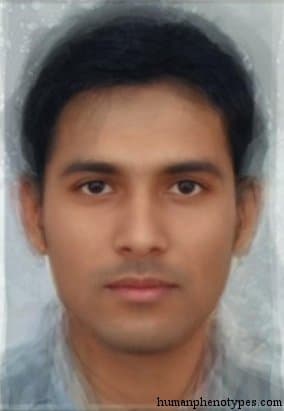
Composite source: Human Phenotypes — Gracile Indid
Geographic Distribution
Gracile Indid is documented across South Asia, with its historical reference center near 26.5° N, 80.3° E. The coordinates mark where the type was most characteristic roughly 1500 years ago; population movements since then have scattered and blended the distribution far beyond that point.
Physical Characteristics
Light to medium brown skin, straight to wavy hair.
- Rather short, meso- brachyskelic, ectomorph, females occasionally endomorph, symmetrical body
- Dolicho-mesocephalic, ortho- hypsicranic, small-headed
- Mildly leptorrhine, triangular nose
- Overall very gracile and soft features (esp
- in women)
- Face oval, lips comparatively thin, but thicker than in Mediterranids
- Eyes large, sometimes almond-shaped
Historical Background
The most widespread and frequent Indid subtype, one of the most populous phenotypes in the world. Common along the Ganges river and Deccan, but practically found all over India. Various ancient migrations brought it to Thailand, Arabia, Madagascar, Indonesia, and Europe. Shows anthropometric similarities to Mediterranid, although lips, nose, forehead, and eyelids differ significantly.
Research History & Naming
Every label in the historical catalogue has an author and a date, and Gracile Indid has accumulated its share of competing attributions. For Gracile Indid, the literature extract below shows the naming chain — from the first definition through the later revisions that shaped the current entry.
First identified as Homo indicus by Bory (1825) . Risley (1916) named it Indo-Scythian, Eickstedt ( 1929 , 1934 ), Bernhard (1983) and Knussmann (1996) Gracile Indid. Lundman ( 1967 , 1988 ) regarded them an East Mediterranid subtype Gangid, Biasutti (1967) called them Peninsular Indian, Hooton (1946) included them in Indo-Dravidian, some even in Mediterranean ( Cole, 1965 ).
Comparison With Nearby Phenotypes
Geography, not alphabet, ordered this table: the five phenotype centers closest to Gracile Indid's, with the traits most likely to be mistaken for it (South Gondid leads at 407 km). In gameplay, these five account for most of the wrong-but-nearby pins against Gracile Indid.
| Phenotype | Region | Distance | Distinguishing trait |
|---|---|---|---|
| South Gondid | South Asia | 407 km | Medium to dark brown skin, wavy, sometimes curly hair, short, brachyskelic, ectomorph. |
| East Brachid | South Asia | 421 km | Light brown skin, usually straight hair. |
| North Gondid | South Asia | 555 km | Dark brown skin, wavy, sometimes curly hair. |
| Kolid | South Asia | 599 km | Black-brown skin, often darker than Veddoids except for Malids. |
| Mountain Indid | South Asia | 680 km | Light brown skin, straight or wavy hair. |
Gracile Indid in the Game
In gameplay terms, Gracile Indid rewards region-level recall: the score is computed from the distance between your pin and 26.5° N, 80.3° E. Players often confuse Gracile Indid with South Gondid (407 km out) in the comparison table above — those confusions are exactly what the distance penalty is designed to expose.
Gracile Indid Phenotype FAQ
- Where does the Gracile Indid phenotype come from?
- The reference coordinates for the Gracile Indid phenotype sit near 26.5° N, 80.3° E, in South Asia. That point marks the center of the South Asia distribution documented roughly 1500 years ago — actual prevalence spread well beyond it, toward entries such as South Gondid 407 km away, and modern migration has blurred those boundaries further.
- What does the Gracile Indid phenotype look like?
- In the historical literature, light to medium brown skin, straight to wavy hair. For Gracile Indid these are statistical tendencies across a population, not a checklist every individual matches.
- Is the Gracile Indid phenotype a race or a nationality?
- No — and the Gracile Indid naming history above shows why. Gracile Indid was defined, renamed, and regrouped repeatedly by different researchers, which is the opposite of how a fixed racial category would behave. A phenotype is a recurring bundle of visible traits recorded across a population; the Gracile Indid label says nothing about where any individual's ancestors were born.
- How does Gracile Indid appear in the game?
- In Classic Daily and Challenge Mode, the Gracile Indid composite face appears without a label. Your task is to drop a pin on the world map where you think that face is historically most common — the scoring uses the distance between your pin and the reference coordinates near 26.5° N, 80.3° E. The post-round review then shows the correct location, your distance error, and this Gracile Indid entry.
References & Literature
Primary sources for the Gracile Indid entry, listed as cited in the historical literature. The naming and classification debates around Gracile Indid referenced above run through these works.
- Bory, de S.1825. Homme. Féruss. Bull. Sc. nat. Tom. VI.
- Risley, H. Sir. 1915. The People of India. Thacker, Spink & Co. Calcutta.
- Eickstedt, E. von. 1929. Anthropologische Forschungen in Südindien . In: Anthropologischer Anzeiger (6), 64-85.
- Eickstedt, E. von. 1934. Rassenkunde und Rassengeschichte der Menschheit. Ferdinand Enke. Stuttgart.
- Bernhard, W. 1983. Ethnogenesis of South Asia with special reference to India. Anthropologischer Anzeiger 41, 2, 93-110.
- Knussmann, R. 1996. Vergleichende Biologie des Menschen: Lehrbuch der Anthropologie und Humangenetik. 2ed. Spektrum Akademischer Verlag.
- Lundman, B. 1967. Geographische Anthropologie. Rassen und Völker der Erde. G. Fischer, Stuttgart
- Biasutti, R. 1967 (1941). Le Razze e i Popoli della terra. 4th Ed. Vol 1-4. U.T.E.T., Torino.
- Hooton, E.A. 1946. Up from the Ape. Rev. ed. Macmillan Company . New York.
- Cole, S. 1965. Races of Man. Butler & Tanner Ltd. Frome and London.
Related Phenotypes
Other human phenotypes whose documented centers lie in the same part of the map as Gracile Indid.
South Gondid
South Asia · 407 km away
Gracile Gondid variety of Central India that shares many similarities with Gondids proper, except for a variety of features that puts them m...
East Brachid
South Asia · 421 km away
Relatively recent contact type intermediate between Indids and South Mongolids. Widespread, reaching from Western Himalaya / Nepal to Bhutan...
North Gondid
South Asia · 555 km away
Ancient phenotype native to North Central India, found up to the Himalaya. Gondid proper type, the robust counterpart of South Gondids. Comm...
Kolid
South Asia · 599 km away
North Dravidian type, related to Melanids but with stronger Gondid influence. An important population element in India. Purest in Jharkhand ...
Mountain Indid
South Asia · 680 km away
(Gracile) Indid variety native to the valleys south of the Western Himalaya and in the Hindu Kush. Once the principal element of the Khas an...
Further Reading
Background articles from the blog that explain where the Gracile Indid type fits, how these composites are built, and what a face can and cannot tell you.
Guess Ethnicity From a Photo: What Gets Measured First
Before a face model names anything, it measures. Here is the geometry stage: the landmark schemes tools rely on, the photo standards...
Guess My Ethnicity: What One Guess Can Carry
When someone types guess my ethnicity, they are asking a stranger to place a bet, and the odds depend far more on the list of labels...