Indo Nordic Phenotype - Face Features & Origin
Type of the Northwestern Himalaya and the Hindu Kush. Its reference coordinates sit near 36.3° N, 71.8° E in South Asia. Rather than a single portrait, the Indo Nordic composite below is a statistical average, and the surrounding sections — traits, distribution, research history, references — give that average its context.
Average Face
What you see below is a statistical construction of the Indo Nordic reference population. Faces recorded from the Indo Nordic sample were overlaid and merged; the result keeps the features most members shared and discards personal variation. It reads like a Indo Nordic portrait, but it works like a histogram.
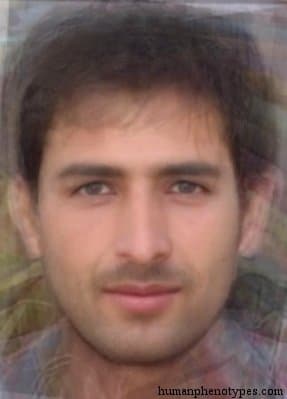
Composite source: Human Phenotypes — Indo Nordic
Geographic Distribution
The reference center for Indo Nordic sits near 36.3° N, 71.8° E in South Asia. Around that anchor, prevalence falls off gradually — the type is not confined to one valley or one modern border, and the historical map should be read as a gradient rather than a boundary.
Physical Characteristics
Rosy to light brown skin, blonde to black wavy hair.
- Eyes and hair can be light, which is unique in the region
- Medium height, mesoskelic, ectomorph or mildly mesomorph
- Dolicho- mesocephalic, orthocranic with a leptorrhine, long, often aquiline and prominent nose
- Significant supraorbital ridges with deep-set eyes, strong eye brows, thin lips
Historical Background
Type of the Northwestern Himalaya and the Hindu Kush. Connected to Indid, but altered by old unique elements, possibly Proto Nordic that might stem from ancient Aryans. Common in Pathan, Nuristani, occasionally Dards, Brokpa of Ladak, Kashmiri, Pamiri, Tajik, Uyghurs, and especially the last Pagans of the region: the Kalash.
Research History & Naming
Every label in the historical catalogue has an author and a date, and Indo Nordic has accumulated its share of competing attributions. For Indo Nordic, the literature extract below shows the naming chain — from the first definition through the later revisions that shaped the current entry.
Hooton (1946) described the Indo Nordic typical for Pathan and Kafirs (Nuristani) and included the (North Indid) Sikh as a southern subvariety. Eickstedt ( 1926b , 1934 ) and Biasutti ( 1925 , 1967 ) regard it as the Dardic type. Genetic evidence shows a distinctiveness of Nuristani, especially of Kalash ( Rosenberg et al., 2006 ).
Comparison With Nearby Phenotypes
Ranked by great-circle distance from Indo Nordic's reference center, these are the five nearest documented phenotypes — the closest being East Pamirid at 187 km. Overlapping distributions like these are exactly what makes the quiz hard, and the East Pamirid row is where to start looking.
| Phenotype | Region | Distance | Distinguishing trait |
|---|---|---|---|
| East Pamirid | Central Asia | 187 km | Light brown skin, straight or wavy, often brown hair, and mixed eyes. |
| Central Pamirid | Central Asia | 372 km | Light brown skin, straight or wavy, brown-black hair. |
| Plains Pamirid | Central Asia | 498 km | Light brown skin, often straight, brown or black hair, eyes sometimes mixed. |
| North Indid | South Asia | 686 km | Light to medium brown skin, straight or wavy, brown or black hair. |
| Mountain Indid | South Asia | 693 km | Light brown skin, straight or wavy hair. |
Indo Nordic in the Game
When the Indo Nordic composite shows up in the quiz, players who know the South Asia distribution pattern have the edge. The reference answer sits near 36.3° N, 71.8° E; pins on the wrong continent score close to zero, so even a rough regional instinct beats a precise but misdirected pin.
Indo Nordic Phenotype FAQ
- Where does the Indo Nordic phenotype come from?
- The reference coordinates for the Indo Nordic phenotype sit near 36.3° N, 71.8° E, in South Asia. That point marks the center of the South Asia distribution documented roughly 1500 years ago — actual prevalence spread well beyond it, toward entries such as East Pamirid 187 km away, and modern migration has blurred those boundaries further.
- What does the Indo Nordic phenotype look like?
- In the historical literature, rosy to light brown skin, blonde to black wavy hair. For Indo Nordic these are statistical tendencies across a population, not a checklist every individual matches.
- Is the Indo Nordic phenotype a race or a nationality?
- No. Phenotypes like Indo Nordic are descriptive averages, not ancestry groups. Indo Nordic is one of several types documented in and around South Asia — see the comparison table above — and the same individual can carry traits associated with several of them at once. The Indo Nordic entry describes a statistical pattern, not a group of people and not a nationality.
- How does Indo Nordic appear in the game?
- In Classic Daily and Challenge Mode, the Indo Nordic composite face appears without a label. Your task is to drop a pin on the world map where you think that face is historically most common — the scoring uses the distance between your pin and the reference coordinates near 36.3° N, 71.8° E. The post-round review then shows the correct location, your distance error, and this Indo Nordic entry.
References & Literature
Primary sources for the Indo Nordic entry, listed as cited in the historical literature. The naming and classification debates around Indo Nordic referenced above run through these works.
- Hooton, E.A. 1946. Up from the Ape. Rev. ed. Macmillan Company . New York.
- Eickstedt, E. von. 1934. Rassenkunde und Rassengeschichte der Menschheit. Ferdinand Enke. Stuttgart.
- Bory, de S.1825. Homme. Féruss. Bull. Sc. nat. Tom. VI.
- Biasutti, R. 1967 (1941). Le Razze e i Popoli della terra. 4th Ed. Vol 1-4. U.T.E.T., Torino.
- Rosenberg et al. 2006. Low levels of genetic divergence across geographically and linguistically diverse populations from India. PLoS Genet. 2 (12)
Related Phenotypes
If Indo Nordic interested you, these neighboring phenotype entries cover adjacent parts of the map with distinctly different trait bundles.
East Pamirid
Central Asia · 187 km away
The most Europoid Pamirid subtype. Most common in Pamiri speakers of the Pamir Mountains in Eastern Tajikistan and Northern Afghanistan, esp...
Central Pamirid
Central Asia · 372 km away
The most typical Pamirid variety, also called Mountain Pamirid. Often considered the most typical Turanid. Most common in highland Tajiks, w...
Plains Pamirid
Central Asia · 498 km away
The most widespread Pamirid variety, typical for the steppes and lowlands from Uzbekistan to Xinjiang and the Ferghana Valley. Somewhat infl...
North Indid
South Asia · 686 km away
Indid subtype of Pakistan and Northwestern India, often associated with ancient Indo-Aryan migrations from the North. Common in Punjab, wher...
Mountain Indid
South Asia · 693 km away
(Gracile) Indid variety native to the valleys south of the Western Himalaya and in the Hindu Kush. Once the principal element of the Khas an...
Further Reading
Background articles from the blog that explain where the Indo Nordic type fits, how these composites are built, and what a face can and cannot tell you.
Guess My Ethnicity: What One Guess Can Carry
When someone types guess my ethnicity, they are asking a stranger to place a bet, and the odds depend far more on the list of labels...
Geography Games Like GeoGuessr: Six Kinds of Clue
Street panoramas, country outlines and average faces all answer one question. Here are six geography games sorted by the clue they hand...