Indo Iranid Phenotype - Face Features & Origin
Relatively recent contact type with a position intermediate between Indo Brachid and Iranid. The entry below collects the Indo Iranid composite face, its documented distribution around 28.0° N, 66.0° E in South Asia, its physical characteristics, the research history behind the name, and the academic references that support all of it.
Average Face
The Indo Iranid composite below is not a photograph of a real person. Historical anthropologists aligned multiple individual portraits from the Indo Iranid reference population and averaged them into one image, so recurring structures — skull outline, nose form, lip thickness, brow position — dominate while individual idiosyncrasies cancel out.
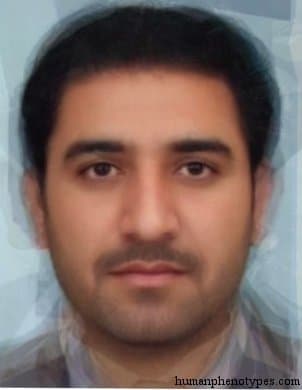
Composite source: Human Phenotypes — Indo Iranid
Geographic Distribution
The reference center for Indo Iranid sits near 28.0° N, 66.0° E in South Asia. Around that anchor, prevalence falls off gradually — the type is not confined to one valley or one modern border, and the historical map should be read as a gradient rather than a boundary.
Physical Characteristics
Light to medium brown skin, straight or wavy, brown-black, plentiful hair.
- Rather tall, mesoskelic, endomorph to ectomorph
- Meso- brachycephalic, mildly orthocranic, rather small-headed
- Leptorrhine, prominent and long nose
- Faces relatively wide and high
- Not as high-skulled as Indids and Iranids proper
Historical Background
Relatively recent contact type with a position intermediate between Indo Brachid and Iranid. Widespread in Pakistan, Iran, and Afghanistan, reaching to Northern India in the East and Turkey in the West. Highest concentrations are found among the Baluchis, Brahuis, Pathans, Tarin, Dehwar, Pashto, and Yaghnobi, occasionally in Persians and Kurds, Bedouins and Samaritans. Not stabilised yet.
Research History & Naming
Every label in the historical catalogue has an author and a date, and Indo Iranid has accumulated its share of competing attributions. For Indo Iranid, the literature extract below shows the naming chain — from the first definition through the later revisions that shaped the current entry.
Named as defined Indo Iranus by Giuffrida-Ruggeri (1921) as well as Haddon (1925) and regarded as the major brachycephalic element of the Iranian population by Field (1939) . Risley (1915) named it Turko Iranian. In a statistical analysis Bernhard (1993) identified it as the short-skulled western Indid element, placing it close to Eickstedt's (1937) Indo Brachids. Detailed analysis by Field (1959) .
Comparison With Nearby Phenotypes
Geography, not alphabet, ordered this table: the five phenotype centers closest to Indo Iranid's, with the traits most likely to be mistaken for it (Indo Brachid leads at 407 km). In gameplay, these five account for most of the wrong-but-nearby pins against Indo Iranid.
| Phenotype | Region | Distance | Distinguishing trait |
|---|---|---|---|
| Indo Brachid | South Asia | 407 km | Light to medium brown skin, straight or wavy hair. |
| North Indid | South Asia | 975 km | Light to medium brown skin, straight or wavy, brown or black hair. |
| Iranid | Middle East | 1,025 km | Light brown skin, straight or wavy, brown or black hair. |
| Indo Nordic | South Asia | 1,068 km | Rosy to light brown skin, blonde to black wavy hair. |
| Mountain Indid | South Asia | 1,162 km | Light brown skin, straight or wavy hair. |
Indo Iranid in the Game
In gameplay terms, Indo Iranid rewards region-level recall: the score is computed from the distance between your pin and 28.0° N, 66.0° E. Players often confuse Indo Iranid with Indo Brachid (407 km out) in the comparison table above — those confusions are exactly what the distance penalty is designed to expose.
Indo Iranid Phenotype FAQ
- Where does the Indo Iranid phenotype come from?
- The reference coordinates for the Indo Iranid phenotype sit near 28.0° N, 66.0° E, in South Asia. That point marks the center of the South Asia distribution documented roughly 1500 years ago — actual prevalence spread well beyond it, toward entries such as Indo Brachid 407 km away, and modern migration has blurred those boundaries further.
- What does the Indo Iranid phenotype look like?
- In the historical literature, light to medium brown skin, straight or wavy, brown-black, plentiful hair. For Indo Iranid these are statistical tendencies across a population, not a checklist every individual matches.
- Is the Indo Iranid phenotype a race or a nationality?
- No — and the Indo Iranid naming history above shows why. Indo Iranid was defined, renamed, and regrouped repeatedly by different researchers, which is the opposite of how a fixed racial category would behave. A phenotype is a recurring bundle of visible traits recorded across a population; the Indo Iranid label says nothing about where any individual's ancestors were born.
- How does Indo Iranid appear in the game?
- In Classic Daily and Challenge Mode, the Indo Iranid composite face appears without a label. Your task is to drop a pin on the world map where you think that face is historically most common — the scoring uses the distance between your pin and the reference coordinates near 28.0° N, 66.0° E. The post-round review then shows the correct location, your distance error, and this Indo Iranid entry.
References & Literature
Primary sources for the Indo Iranid entry, listed as cited in the historical literature. The naming and classification debates around Indo Iranid referenced above run through these works.
- g21
- Haddon, A.C.. 1925. The Races of Man and their distribution. Cambridge at the University Press. London.
- Field, H. 1939. Contributions to the anthropology of Iran. Field Museum of National History, 29(1).
- Risley, H. Sir. 1915. The People of India. Thacker, Spink & Co. Calcutta.
- Bernhard, W. 1993. Anthropologie von Südwestasien. In.: Schwidetzky, I.: Rassengeschichte der Menschheit 14, Asien 4. Oldenbourg.
- Eickstedt, E. von. 1937. Geschichte der anthropologischen Namengebung und Klassifikation. In: Zeitschrift für Rassenkunde. Band 5, 209-282, Band 6, 36-96, 151-210.
- Field, H. 1959. An anthropological reconnaissance in West Pakistan. Peabody Museum Cambridge, Massachusetts, USA.
Related Phenotypes
Other human phenotypes whose documented centers lie in the same part of the map as Indo Iranid.
Indo Brachid
South Asia · 407 km away
Indo Brachid proper, relatively recent Indid-Turano-Armenid contact type, probably the result of old Pashto, Saka, and Scythian migrations. ...
North Indid
South Asia · 975 km away
Indid subtype of Pakistan and Northwestern India, often associated with ancient Indo-Aryan migrations from the North. Common in Punjab, wher...
Iranid
Middle East · 1,025 km away
Distinctive type of the Iranian Plateau. One of the main elements in Persians, especially in Southwestern Iran. An important element in Kurd...
Indo Nordic
South Asia · 1,068 km away
Type of the Northwestern Himalaya and the Hindu Kush. Connected to Indid, but altered by old unique elements, possibly Proto Nordic that mig...
Mountain Indid
South Asia · 1,162 km away
(Gracile) Indid variety native to the valleys south of the Western Himalaya and in the Hindu Kush. Once the principal element of the Khas an...
Further Reading
Background articles from the blog that explain where the Indo Iranid type fits, how these composites are built, and what a face can and cannot tell you.
Geography Games Like GeoGuessr: Six Kinds of Clue
Street panoramas, country outlines and average faces all answer one question. Here are six geography games sorted by the clue they hand...
Guess My Ethnicity: What One Guess Can Carry
When someone types guess my ethnicity, they are asking a stranger to place a bet, and the odds depend far more on the list of labels...