Iranid Phenotype - Face Features & Origin
Distinctive type of the Iranian Plateau. The entry below collects the Iranid composite face, its documented distribution around 33.0° N, 57.0° E in Middle East, its physical characteristics, the research history behind the name, and the academic references that support all of it.
Average Face
The Iranid composite below is not a photograph of a real person. Historical anthropologists aligned multiple individual portraits from the Iranid reference population and averaged them into one image, so recurring structures — skull outline, nose form, lip thickness, brow position — dominate while individual idiosyncrasies cancel out.
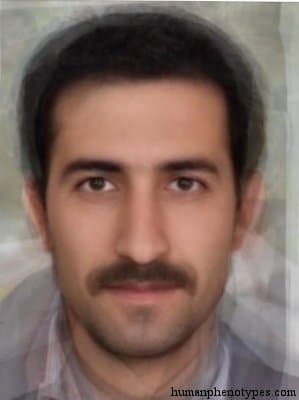
Composite source: Human Phenotypes — Iranid
Geographic Distribution
The reference center for Iranid sits near 33.0° N, 57.0° E in Middle East. Around that anchor, prevalence falls off gradually — the type is not confined to one valley or one modern border, and the historical map should be read as a gradient rather than a boundary.
Physical Characteristics
Light brown skin, straight or wavy, brown or black hair.
- Medium height to tall, meso- brachyskelic, ectomorph
- (Hyper-) dolichocephalic, mildly hypsicranic
- Long, hyperleptorrhine, convex / hooked nose
- Full lips, sturdy chin with marked facial features, sometimes almond-shaped eyes
- Beard and body hair usually heavy
Historical Background
Distinctive type of the Iranian Plateau. One of the main elements in Persians, especially in Southwestern Iran. An important element in Kurds, Talysh, Gilakis, Luris. Extends to Afghanistan and India where it can be found in West Tajik, Darts, Nuristani, Azerbaijani, and even Balti. Shows elements of Mediterranids as well as Arabids.
Research History & Naming
Every label in the historical catalogue has an author and a date, and Iranid has accumulated its share of competing attributions. For Iranid, the literature extract below shows the naming chain — from the first definition through the later revisions that shaped the current entry.
Field (1939) and Hooton (1946) call it Iranian Plateau type, Coon (1939) and Cole (1965) Irano Afghan, Bunak's (1960) Caspian is similar, like Oshanin's (1964) Khurasan race. Eickstedt ( 1952 , 1961 ), Bernhard (1993) and Knussmann (1996) define Iranid as an Orientalid subrace, Biasutti (1967) even its the main variety "Iraniana", Lundman (1967) describes Iranid as an East Mediterranid influenced by Arabid.
Comparison With Nearby Phenotypes
Geography, not alphabet, ordered this table: the five phenotype centers closest to Iranid's, with the traits most likely to be mistaken for it (Proto Iranid leads at 231 km). In gameplay, these five account for most of the wrong-but-nearby pins against Iranid.
| Phenotype | Region | Distance | Distinguishing trait |
|---|---|---|---|
| Proto Iranid | Middle East | 231 km | Fair to light brown skin, straight or wavy, light brown to black hair. |
| Transcaspian | Central Asia | 741 km | Light brown skin, straight dark hair. |
| Indo Iranid | South Asia | 1,025 km | Light to medium brown skin, straight or wavy, brown-black, plentiful hair. |
| Assyroid | Middle East | 1,176 km | Light brown, sometimes fair skin, straight or wavy, usually dark brown, sometimes blonde curly-wavy hair. |
| East Alpinid | Middle East | 1,331 km | Light brown skin, straight or wavy, light brown to black hair. |
Iranid in the Game
In gameplay terms, Iranid rewards region-level recall: the score is computed from the distance between your pin and 33.0° N, 57.0° E. Players often confuse Iranid with Proto Iranid (231 km out) in the comparison table above — those confusions are exactly what the distance penalty is designed to expose.
Iranid Phenotype FAQ
- Where does the Iranid phenotype come from?
- Historical sources center the Iranid phenotype on 33.0° N, 57.0° E (Middle East). Treat that as a rough anchor: the type appeared across a wider surrounding area — its nearest documented neighbors, Proto Iranid and Transcaspian, sit 231 and 741 km from the reference point — and its present-day distribution no longer matches the historical map.
- What does the Iranid phenotype look like?
- The composite emphasizes recurring traits: light brown skin, straight or wavy, brown or black hair. The full trait list for Iranid appears in the physical characteristics section above.
- Is the Iranid phenotype a race or a nationality?
- No. A phenotype is a recurring bundle of visible traits documented by historical anthropologists across a population — for Iranid, patterns such as light brown skin, straight or wavy, brown or black hair. The Iranid entry is not a genetic ancestry, not a nationality, and not a statement about any individual person. Two people from the same country can match completely different phenotypes — one resembling Iranid, another closer to Proto Iranid — and one phenotype can span many modern borders.
- How does Iranid appear in the game?
- When the Iranid face comes up in Classic Daily or Challenge Mode, you pin the world map where you believe the type is historically most common, and the score decays with your distance to 33.0° N, 57.0° E. Fair warning: the nearest other entry in our dataset, Proto Iranid, sits just 231 km away, so this face rewards precise placement — the right country alone is not always enough.
References & Literature
Primary sources for the Iranid entry, listed as cited in the historical literature. The naming and classification debates around Iranid referenced above run through these works.
- Field, H. 1939. Contributions to the anthropology of Iran. Field Museum of National History, 29(1).
- Hooton, E.A. 1946. Up from the Ape. Rev. ed. Macmillan Company . New York.
- Coon, C.S.. 1939.. The Races of Europe. The Macmillan Company. New York.
- Cole, S. 1965. Races of Man. Butler & Tanner Ltd. Frome and London.
- Bunak, V.V. 1960. Anthropological Composition of the Population of the Caucasus. Contributions to the Physical Anlhropology of the Soviet Union. Russian Translation Series.
- Oshanin, L. V. 1964. Anthropological Composition of the Population of Central Asia, and the ethnogenesis of its Peoples. Vol 1-3.
- Eickstedt, E. von. 1952. Biodynamik der Europiden. In: Historia Mundi. Band 1, Munich, 115-134.
- Eickstedt, E. von. 1961. Türken, Kurden und Iraner seit dem Altertum: Probleme einer anthropologischen Reise. Gustav Fischer Verlag, Stuttgart.
- Bernhard, W. 1993. Anthropologie von Südwestasien. In.: Schwidetzky, I.: Rassengeschichte der Menschheit 14, Asien 4. Oldenbourg.
- Knussmann, R. 1996. Vergleichende Biologie des Menschen: Lehrbuch der Anthropologie und Humangenetik. 2ed. Spektrum Akademischer Verlag.
- Biasutti, R. 1967 (1941). Le Razze e i Popoli della terra. 4th Ed. Vol 1-4. U.T.E.T., Torino.
- Lundman, B. 1967. Geographische Anthropologie. Rassen und Völker der Erde. G. Fischer, Stuttgart
Related Phenotypes
Other human phenotypes whose documented centers lie in the same part of the map as Iranid.
Proto Iranid
Middle East · 231 km away
Coarse type of Iran and Asia Minor, that can be considered an eastern Eurafricanid variety. More ancient than the more gracile Iranids and P...
Transcaspian
Central Asia · 741 km away
West-Central Asian Orientalid with Aralid admixture, particularly common in Turkmens. Significantly differs from other Central Asians by lon...
Indo Iranid
South Asia · 1,025 km away
Relatively recent contact type with a position intermediate between Indo Brachid and Iranid. Widespread in Pakistan, Iran, and Afghanistan, ...
Assyroid
Middle East · 1,176 km away
Semitic type that unites Armenoid with Arabid features. Historically important in the ancient Hittite Kingdom and the Assyrian civilisation....
East Alpinid
Middle East · 1,331 km away
West Asian type that is anthropometrically and morphologically very similar to European Alpinids. Most common in the mountain zones of Anato...
Further Reading
Background articles from the blog that explain where the Iranid type fits, how these composites are built, and what a face can and cannot tell you.
Can You Really Guess Ethnicity From a Face? What the Research Says
Humans beat chance at coarse region-guessing from faces - but fall apart at anything finer. The other-race effect, confusable neighbors...
Ethnicity Guesser Tools: Three Methods, Three Answers
One search term covers three unrelated tools: genetic ancestry estimation, photo classifiers, and documented phenotype catalogues.