Arabid Phenotype - Face Features & Origin
Orientalid proper, the most common type of the Arabian Peninsula, often found with Semitic languages. Its reference coordinates sit near 22.4° N, 49.5° E in Middle East. Rather than a single portrait, the Arabid composite below is a statistical average, and the surrounding sections — traits, distribution, research history, references — give that average its context.
Average Face
What you see below is a statistical construction of the Arabid reference population. Faces recorded from the Arabid sample were overlaid and merged; the result keeps the features most members shared and discards personal variation. It reads like a Arabid portrait, but it works like a histogram.
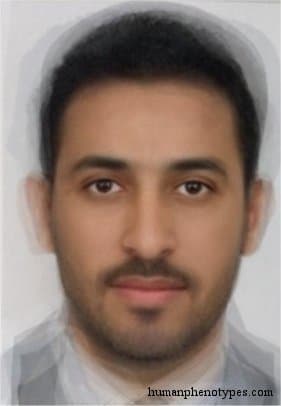
Composite source: Human Phenotypes — Arabid
Geographic Distribution
Geographically, Arabid anchors to 22.4° N, 49.5° E (Middle East). That is the point where historical anthropologists judged Arabid most concentrated, not a hard edge; modern migration and intermarriage have long since softened whatever boundaries once existed.
Physical Characteristics
Light, sometimes medium brown skin.
- Wavy or curly, black-brown hair
- Medium height, mesoskelic, ectomorph
- Dolicho- mesocephalic, chamaecranic, rather small, rhomboid head, protruding occiput
- Slightly convex, hyperleptorrhine nose
- Large almond-shaped eyes, prominent midface, and full lips
- Body hair abundant
Historical Background
Orientalid proper, the most common type of the Arabian Peninsula, often found with Semitic languages. Originally restricted to Arabia, ancient migrations and the Islamic expansion brought it to North Africa, where it is heavily mixed (e.g. Berber Arabs). Conquerors and Arab tradesmen spread it across the Mediterranean, parts of East Africa, India, and Indonesia, Jews to Europe. Since it differs from Mediterranid mainly by soft issue, some include it in Mediterranid.
Research History & Naming
Typological names were coined, contested, and renamed repeatedly across the 20th century, and Arabid is no exception. The extract below records the researchers who defined Arabid, the alternative labels it accumulated, and where the modern consensus settled.
Eickstedt (1952c) , Biasutti (1941) and Knussmann (1996) described Arabid as the most typical Orientalid (c.p. Luschan, 1911 ) subtype. Lundman (1967) used Arabid, Vallois (1971) South Oriental, Saller (1949) Araboid / Semitic. Many noted similarity to Mediterranid, Hooton (1939) called it Arabo-Mediterranean. Cole (1965) and Coon (1939) even as the Mediterranid nucleus or Cappadocian.
Comparison With Nearby Phenotypes
Ranked by great-circle distance from Arabid's reference center, these are the five nearest documented phenotypes — the closest being Arabian Veddoid at 663 km. Overlapping distributions like these are exactly what makes the quiz hard, and the Arabian Veddoid row is where to start looking.
| Phenotype | Region | Distance | Distinguishing trait |
|---|---|---|---|
| Arabian Veddoid | Middle East | 663 km | Dark brown skin, curly (ringlet) black hair, rather short, macroskelic, endomorph to ectomorph. |
| Yemenid | Middle East | 690 km | Medium brown skin, wavy, sometimes curly, black hair. |
| Proto Iranid | Middle East | 1,247 km | Fair to light brown skin, straight or wavy, light brown to black hair. |
| Assyroid | Middle East | 1,318 km | Light brown, sometimes fair skin, straight or wavy, usually dark brown, sometimes blonde curly-wavy hair. |
| Danakil | East Africa | 1,322 km | Very dark reddish-brown skin, tight-curly to kinky-curly hair. |
Arabid in the Game
When the Arabid composite shows up in the quiz, players who know the Middle East distribution pattern have the edge. The reference answer sits near 22.4° N, 49.5° E; pins on the wrong continent score close to zero, so even a rough regional instinct beats a precise but misdirected pin.
Arabid Phenotype FAQ
- Where does the Arabid phenotype come from?
- Historical sources center the Arabid phenotype on 22.4° N, 49.5° E (Middle East). Treat that as a rough anchor: the type appeared across a wider surrounding area — its nearest documented neighbors, Arabian Veddoid and Yemenid, sit 663 and 690 km from the reference point — and its present-day distribution no longer matches the historical map.
- What does the Arabid phenotype look like?
- The composite emphasizes recurring traits: light, sometimes medium brown skin. The full trait list for Arabid appears in the physical characteristics section above.
- Is the Arabid phenotype a race or a nationality?
- No. A phenotype is a recurring bundle of visible traits documented by historical anthropologists across a population — for Arabid, patterns such as light, sometimes medium brown skin. The Arabid entry is not a genetic ancestry, not a nationality, and not a statement about any individual person. Two people from the same country can match completely different phenotypes — one resembling Arabid, another closer to Arabian Veddoid — and one phenotype can span many modern borders.
- How does Arabid appear in the game?
- When the Arabid face comes up in Classic Daily or Challenge Mode, you pin the world map where you believe the type is historically most common, and the score decays with your distance to 22.4° N, 49.5° E. The nearest documented type, Arabian Veddoid, lies about 663 km away, so regional placement usually carries most of the score.
References & Literature
Every claim on this page traces back to the sources below — the researchers who defined, measured, and argued over the Arabid type. The originals behind the Arabid entry are worth consulting directly.
- Eickstedt, E. von. 1952c. Rassentypen und Typendynamik von Asien In: Historia Mundi. Band 1, Munich, 147-166.
- Biasutti, R. 1967 (1941). Le Razze e i Popoli della terra. 4th Ed. Vol 1-4. U.T.E.T., Torino.
- Knussmann, R. 1996. Vergleichende Biologie des Menschen: Lehrbuch der Anthropologie und Humangenetik. 2ed. Spektrum Akademischer Verlag.
- Luschan, F. 1911. The early inhabitants of Western Asia. Journ. Anthro. Inst. 42, 221-244.
- Lundman, B. 1967. Geographische Anthropologie. Rassen und Völker der Erde. G. Fischer, Stuttgart
- Vallois, H. V. 1971. Las races humaines. 8 Ed. Grammont.
- Saller, K. 1949. Art- und Rassenlehre des Menschen. Curt E. Schwab. Stuttgart.
- Hooton, E.A. 1939. The Twilight of Man. Putnam's Sons, New York.
- Cole, S. 1965. Races of Man. Butler & Tanner Ltd. Frome and London.
- Coon, C.S.. 1939.. The Races of Europe. The Macmillan Company. New York.
Related Phenotypes
More entries from the same region of the historical map as Arabid, each with its own composite and trait profile.
Arabian Veddoid
Middle East · 663 km away
Ancient Vedda-like type of the Arabian Peninsula and South Iran, often heavily mixed. Found in the Mehri of South Oman, around Hadramaut in ...
Yemenid
Middle East · 690 km away
Orientalid subtype that deviates in an Armenoid direction. Most common in South and Central Yemeni. Also in Oman, UAE, Socotra, and parts of...
Proto Iranid
Middle East · 1,247 km away
Coarse type of Iran and Asia Minor, that can be considered an eastern Eurafricanid variety. More ancient than the more gracile Iranids and P...
Assyroid
Middle East · 1,318 km away
Semitic type that unites Armenoid with Arabid features. Historically important in the ancient Hittite Kingdom and the Assyrian civilisation....
Danakil
East Africa · 1,322 km away
Specialised Ethiopid type living in the hottest region of the world: the Danakil depression of Eritrea and Northern Ethiopia, with an annual...
Further Reading
Background articles from the blog that explain where the Arabid type fits, how these composites are built, and what a face can and cannot tell you.
Is AI Ethnicity Guessing Accurate? Separating the Marketing From the Measurements
Published accuracies for AI face-based ancestry classification range from 80 to 99 percent - under lab conditions that real faces never...
Ethnicity Guesser Tools: Three Methods, Three Answers
One search term covers three unrelated tools: genetic ancestry estimation, photo classifiers, and documented phenotype catalogues.