Phenotype vs Ethnicity: Which Word Named the Sample
In 79 of the 209 entries a pattern is introduced by naming the peoples among whom observers saw it, which makes the people the sample, not the answer.
Two words with different jobs
Phenotype and ethnicity get used as if they were two settings on one dial. They answer different questions. A phenotype, in the sense this catalogue uses, is a description of observable traits recorded in a stated sample, at a stated place, by named observers. An ethnicity is a name for a people, and the name holds because the people concerned claim it and their neighbours grant it. One is settled by measuring, the other by membership, and nothing in the first process settles the second.
The confusion is old and it is built into the sources. In the typological literature this catalogue draws on, a pattern is usually introduced by naming the peoples among whom the observer saw it, which turns a group of people into the sampling frame for a description of bodies. That arrangement is workable as documentation. It becomes an error when a reader runs the arrow backwards.
The peoples arrive as the evidence
Seventy nine of the 209 entries state where a pattern is common using an explicit phrase of this kind. Twenty six say typified by, twenty two say most common in, twenty seven say common in, and eight say typical in. The phrase is followed by a list, and the list mixes places with peoples. Sudano Guinesid runs through Senegal, Mali, Ivory Coast, Benin, Nigeria and western Cameroon, then names Mandinka, Mandjak, Fon, Dyula, Ekoi, Gurma, Balanta, Baga, Mankanya and Yoruba. Geography and ethnonyms arrive in one clause, doing the same grammatical work.
The entry is not claiming that the pattern equals any of those groups. It is claiming that observers reported the pattern among them, which is a statement about a sample. A sample can be listed, and a list can be checked against an archive of the observers' field notes. A membership cannot be listed in the same way, because a name is held by the people who answer to it rather than by the people who counted them, and the entry does not attempt that second move.
One pattern can outnumber its names
Sudano Guinesid describes itself as a contact type between Sudanid and Guinesid, which is an odd thing for a type to be. A contact type is a pattern produced where two others meet, so it has no separate origin of its own. The entry then notes that it is sometimes separated anyway, because it is very numerous and the dominant element in many ethnic groups. A form generated by contact became the most common element inside groups that carry separate names, so the tally of names attached to the pattern exceeds the number of patterns.
East Ethiopid shows the other edge of the same problem. The entry records that Eickstedt fixed the definition across publications in 1943, 1949 and 1952, then states that some authors do not see a separate subrace at all and treat the group as Mediterranid and Sudanid blends. A label whose status is disputed by its own sources cannot function as an answer to a question about a person.
The frame could be a class or a mountain
Because the sampling frame was whatever an observer could name, it was not always a people. Chikuzen, recorded for northern Kyushu, notes that the type was often found among Samurai, a status group rather than an ethnicity. Gorid takes its name from the Polish word for mountain and is described as important among Czechs, Slovaks, Serbs, Albanians, northern Bulgarians, Hungarians and Romanians, a range defined by terrain rather than by any one of those names. Twelve entries in the catalogue are named after a place, a river or a province.
The naming convention is the tell, because a label has to come from somewhere. A category named after a mountain range cannot be coextensive with an ethnicity, since the label was borrowed from landscape before it was applied to people, and the people living in those mountains now are a different set from the ones the observers met. Whatever the entry describes, it is not a people with a rule for who belongs.
The arrow runs from sample to pattern
An entry says that a described pattern was common among certain peoples. It does not say that those peoples look like the pattern, and the difference is not pedantry. Chopi-Tswana makes the mechanism explicit: the type developed as a result of the Bantu expansion, when Bantu speakers assimilated older Khoisanid elements, and it is typified by the Chopi and Tswana. A historical process produced a distribution of appearances, and the peoples are where observers later found that distribution.
Run the arrow the other way and the sentence becomes a prediction, that a person's appearance will resemble the description attached to their name. Nothing in the record supports that, because the record was assembled from group tendencies and stated as a range within a region. An average is a property of the sample, and it does not travel back down to a member of it.
The peoples moved, the entries stayed put
Arabid records its own displacement. The entry says the type was originally restricted to Arabia, that ancient migrations and the Islamic expansion carried it to North Africa where it is heavily mixed, and that conquerors and tradesmen spread it across the Mediterranean, parts of East Africa, India and Indonesia, with Jewish communities carrying it into Europe. A distribution that mobile cannot answer a question about where a family lives now. The catalogue's baseline is a map reconstructed for roughly 1,500 years ago, and the entries describing movement are describing what happened after it.
Migration separates the two words in the other direction as well. A people can keep a name across a move while the appearance of its members shifts through mixture, and an appearance can spread across names with no movement of peoples at all. The pairing that felt stable a century ago was a coincidence of sampling rather than a rule.
Answering the question the record can answer
If the question is what a face shows, the honest answer is a list of visible traits, and the catalogue is a reasonable place to read what observers once recorded about such lists in a given region. If the question is what ethnicity someone is, the catalogue has nothing to say, because ethnicity is a membership claim rather than a measurement, decided by the people involved and by the institutions that record them. The two answers are not competing estimates of one quantity.
What the entries do offer is provenance. Each carries an author, a year, a region and a set of references, so a reader can check who said a thing and when. That is more than most tools supply, and it is why a historical description stays usable after its categories have been contested. It also means the catalogue can be read as a record of observation rather than as a portrait of the present, which is the only reading its own dates allow.
Frequently Asked Questions
- Is ethnicity the same thing as phenotype?
- No. A phenotype is a description of observable traits recorded in a sample, with an author, a date and a region attached to it. Ethnicity is a name for a people, held by the claim of members and the recognition of others. One is produced by measuring and describing, the other by membership. A pattern can be common among a people without defining them, and a people can contain many patterns.
- Why do catalogue entries name ethnic groups at all?
- Because the observers needed a sampling frame, and a named people was the one available. Seventy nine of the 209 entries use a phrase such as common in or typified by, followed by a list that mixes places with group names. The list records where a pattern was reported, not what its members are. The group name belongs to the sampling method rather than to the finding.
- Can appearance tell you someone's ethnicity?
- Not reliably, and the attempt reverses the direction of the record. Catalogue entries were built by observing groups and describing patterns within them, so the pattern sits downstream of the group. Reading a body back into a name treats a group tendency as a personal prediction, and it assumes the name and the distribution have stayed fixed, which the entries on migration and mixture contradict.
Related Phenotypes
Faces from the encyclopedia that appear in this article. Open any entry for its full description, distribution, and references.
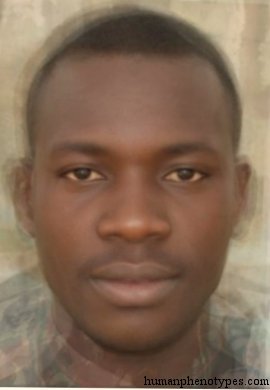
Sudano Guinesid
West Africa
Transitional type between Sudanid and Guinesid, common in West Africa. Although it is just a contact type, it is sometimes separated from th...
East Ethiopid
East Africa
Ethiopid proper, showing the most pronounced Ethiopid characters of all. Common around the Horn of Africa, in its purest form in the inland ...
Chopi-Tswana
Sub-Saharan Africa
Bantuid variety, overall similar to Central Bantuid, but with weak Khoisan influence, placing it closer to Xhosaid. Developed as a result of...
Arabid
Middle East
Orientalid proper, the most common type of the Arabian Peninsula, often found with Semitic languages. Originally restricted to Arabia, ancie...
Test what you learned
Put your eye for regional faces to work in the daily quiz — a composite face, a world map, and your best guess.