East Ethiopid Phenotype - Face Features & Origin
Ethiopid proper, showing the most pronounced Ethiopid characters of all. The entry below collects the East Ethiopid composite face, its documented distribution around 8.4° N, 49.1° E in East Africa, its physical characteristics, the research history behind the name, and the academic references that support all of it.
Average Face
The East Ethiopid composite below is not a photograph of a real person. Historical anthropologists aligned multiple individual portraits from the East Ethiopid reference population and averaged them into one image, so recurring structures — skull outline, nose form, lip thickness, brow position — dominate while individual idiosyncrasies cancel out.
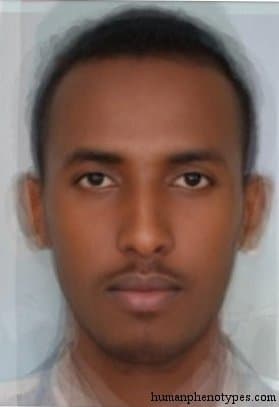
Composite source: Human Phenotypes — East Ethiopid
Geographic Distribution
The reference center for East Ethiopid sits near 8.4° N, 49.1° E in East Africa. Around that anchor, prevalence falls off gradually — the type is not confined to one valley or one modern border, and the historical map should be read as a gradient rather than a boundary.
Physical Characteristics
Dark reddish-brown skin, curly to tight-curly hair.
- (Rather) tall, brachyskelic, ectomorph
- Dolichocephalic, orthocranic
- (Hyper-)leptorrhine and high, straight or convex nose - the narrowest of Sub-Saharan Africa
- Face long and oval with gracile, soft features, jaw very narrow, large eyes with full lips
- Body hair is scarce, the occiput round, prognathism is absent
Historical Background
Ethiopid proper, showing the most pronounced Ethiopid characters of all. Common around the Horn of Africa, in its purest form in the inland areas of Somalia and Eastern Ethiopia. Typical groups include Hawiye, Darod, Dir, but also common in Tigray-Tigrinya, Agaw, and Eastern Oromo. Sometimes in Gurage, Gonga, Amhara, Digil, and Rahanweyn, the latter groups have Bantuid admixture.
Research History & Naming
Every label in the historical catalogue has an author and a date, and East Ethiopid has accumulated its share of competing attributions. For East Ethiopid, the literature extract below shows the naming chain — from the first definition through the later revisions that shaped the current entry.
The ancient Greco-Egyptian writer Ptolemy described them as "the most beautiful humans in the world". The exact definition of East Ethiopid was eventually given by Eickstedt ( 1943 , 1949 , 1952b ) and adopted by Baumann (1952) and Heberer et al. (1969) . In other systems simply regarded as Ethiopid proper ( Biasutti, 1967; Knussmann, 1996) . Some don't see a separate subrace, for them they are Mediterranid-Sudanid blends ( Hooton, 1946 ; Lundman, 1967 ).
Comparison With Nearby Phenotypes
Ranked by great-circle distance from East Ethiopid's reference center, these are the five nearest documented phenotypes — the closest being Yemenid at 897 km. Overlapping distributions like these are exactly what makes the quiz hard, and the Yemenid row is where to start looking.
| Phenotype | Region | Distance | Distinguishing trait |
|---|---|---|---|
| Yemenid | Middle East | 897 km | Medium brown skin, wavy, sometimes curly, black hair. |
| Danakil | East Africa | 1,111 km | Very dark reddish-brown skin, tight-curly to kinky-curly hair. |
| Arabian Veddoid | Middle East | 1,246 km | Dark brown skin, curly (ringlet) black hair, rather short, macroskelic, endomorph to ectomorph. |
| Central Ethiopid | East Africa | 1,286 km | Medium to dark reddish-brown skin, often tight-curly hair. |
| Omotic | East Africa | 1,411 km | Dark brown skin and kinky-curly hair. |
East Ethiopid in the Game
When the East Ethiopid composite shows up in the quiz, players who know the East Africa distribution pattern have the edge. The reference answer sits near 8.4° N, 49.1° E; pins on the wrong continent score close to zero, so even a rough regional instinct beats a precise but misdirected pin.
East Ethiopid Phenotype FAQ
- Where does the East Ethiopid phenotype come from?
- The reference coordinates for the East Ethiopid phenotype sit near 8.4° N, 49.1° E, in East Africa. That point marks the center of the East Africa distribution documented roughly 1500 years ago — actual prevalence spread well beyond it, toward entries such as Yemenid 897 km away, and modern migration has blurred those boundaries further.
- What does the East Ethiopid phenotype look like?
- In the historical literature, dark reddish-brown skin, curly to tight-curly hair. For East Ethiopid these are statistical tendencies across a population, not a checklist every individual matches.
- Is the East Ethiopid phenotype a race or a nationality?
- No. Phenotypes like East Ethiopid are descriptive averages, not ancestry groups. East Ethiopid is one of several types documented in and around East Africa — see the comparison table above — and the same individual can carry traits associated with several of them at once. The East Ethiopid entry describes a statistical pattern, not a group of people and not a nationality.
- How does East Ethiopid appear in the game?
- In Classic Daily and Challenge Mode, the East Ethiopid composite face appears without a label. Your task is to drop a pin on the world map where you think that face is historically most common — the scoring uses the distance between your pin and the reference coordinates near 8.4° N, 49.1° E. The post-round review then shows the correct location, your distance error, and this East Ethiopid entry.
References & Literature
Primary sources for the East Ethiopid entry, listed as cited in the historical literature. The naming and classification debates around East Ethiopid referenced above run through these works.
- Eickstedt, E. von. 1943. Völkerbiologische Probleme der Sahara. In: Beiträge zur Kolonialforschung. Tagungsband I, 169-240.
- Eickstedt, E. von. 1949. Das Hamitenproblem. Homo 1. Göttingen.
- Eickstedt, E. von. 1952b. Die prioritätsgerechten Bezeichnungen der menschlichen Varitäten. In: Historia Mundi. Band 1, Munich, 223-226.
- Baumann, H.. 1952. Die Rassen Afrikas. In: Historia Mundi. Band 1, Munich, 167-174.
- Biasutti, R. 1967 (1941). Le Razze e i Popoli della terra. 4th Ed. Vol 1-4. U.T.E.T., Torino.
- Knussmann, R. 1996. Vergleichende Biologie des Menschen: Lehrbuch der Anthropologie und Humangenetik. 2ed. Spektrum Akademischer Verlag.
- Hooton, E.A. 1946. Up from the Ape. Rev. ed. Macmillan Company . New York.
- Lundman, B. 1967. Geographische Anthropologie. Rassen und Völker der Erde. G. Fischer, Stuttgart
Related Phenotypes
More entries from the same region of the historical map as East Ethiopid, each with its own composite and trait profile.
Yemenid
Middle East · 897 km away
Orientalid subtype that deviates in an Armenoid direction. Most common in South and Central Yemeni. Also in Oman, UAE, Socotra, and parts of...
Danakil
East Africa · 1,111 km away
Specialised Ethiopid type living in the hottest region of the world: the Danakil depression of Eritrea and Northern Ethiopia, with an annual...
Arabian Veddoid
Middle East · 1,246 km away
Ancient Vedda-like type of the Arabian Peninsula and South Iran, often heavily mixed. Found in the Mehri of South Oman, around Hadramaut in ...
Central Ethiopid
East Africa · 1,286 km away
Ethiopid subtype of the central Ethiopian highlands and their surroundings. Found in its purest form among Oromos. Also in other Cushitic sp...
Omotic
East Africa · 1,411 km away
Isolated type of Southwestern Ethiopia and Northern Kenya, probably belonging to a group of ancient Ethiopids. Probably a relict of Pre-Neol...
Further Reading
Background articles from the blog that explain where the East Ethiopid type fits, how these composites are built, and what a face can and cannot tell you.
AI Ethnicity Guesser: What the Tools Really Return
An AI ethnicity guesser returns a label from a fixed list rather than a measurement of ancestry. Here is what the models are trained on...
Guess My Ethnicity: What One Guess Can Carry
When someone types guess my ethnicity, they are asking a stranger to place a bet, and the odds depend far more on the list of labels...