Omotic Phenotype - Face Features & Origin
Historical anthropology places the Omotic phenotype in East Africa, with a documented center near 5.8° N, 36.6° E. Isolated type of Southwestern Ethiopia and Northern Kenya, probably belonging to a group of ancient Ethiopids. The sections that follow unpack the Omotic entry in practice: the composite face, the traits it summarizes, the naming history, and the sources.
Average Face
Averaging the portraits behind Omotic leaves the features that repeat and erases the ones that do not. That is exactly how the Omotic composite below was built: individual photographs were aligned and statistically merged, exaggerating shared structure into a single reference face that no actual person looks like.
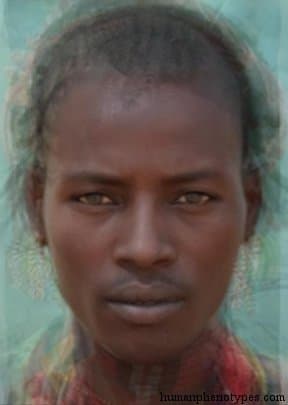
Composite source: Human Phenotypes — Omotic
Geographic Distribution
Omotic is documented across East Africa, with its historical reference center near 5.8° N, 36.6° E. The coordinates mark where the type was most characteristic roughly 1500 years ago; population movements since then have scattered and blended the distribution far beyond that point.
Physical Characteristics
Dark brown skin and kinky-curly hair.
- Ectomorph to mesomorph, brachyskelic, medium to rather tall height
- Usually dolichocephalic, orthocranic, and relatively long faced
- Mildly platyrrhine nose
- The lips are full and cheek bones often prominent
- Body hair is scant
Historical Background
Isolated type of Southwestern Ethiopia and Northern Kenya, probably belonging to a group of ancient Ethiopids. Probably a relict of Pre-Neolithic periods. Most common in speakers of the Omotic languages, e.g. Ari/Aari, Banna, Hamer, Karo, Turmi, and Erbore. The name derives from the Omo Valley of Southern Ethiopia.
Research History & Naming
Every label in the historical catalogue has an author and a date, and Omotic has accumulated its share of competing attributions. For Omotic, the literature extract below shows the naming chain — from the first definition through the later revisions that shaped the current entry.
Pagani et al. 2012 found Omotics to have a great distinctiveness and their own genetic cluster, e.g. the Aari Blacksmith. The groups were hardly classified by early anthropologists. The first who studied them was Montandon (1913) , who measured the Bench. Schulz-Weidner (1952) reports metrics of the Changama and Male. Biasutti (1967) regarded them a basal group, distantly linked to Ethiopid and Nilotid.
Comparison With Nearby Phenotypes
The five phenotypes whose documented centers lie closest to Omotic, ranked by great-circle distance. They are the types players most often confuse with Omotic in the quiz, precisely because their distributions overlap.
| Phenotype | Region | Distance | Distinguishing trait |
|---|---|---|---|
| Maasai | East Africa | 257 km | Dark brown skin, kinky or tight-curly hair. |
| Shillukid | East Africa | 531 km | Black skin, usually kinky, sometimes tight-curly hair. |
| North Bantuid | Sub-Saharan Africa | 621 km | Dark brown skin, usually kinky, sometimes peppercorn hair. |
| Pre Nilotid | East Africa | 668 km | Black skin and kinky, sometimes tight-curly hair. |
| Dinkaid | East Africa | 699 km | Black skin and kinky hair. |
Omotic in the Game
Omotic is one of the faces that can appear in Classic Daily and Challenge Mode. When it does, the winning pin lands near 5.8° N, 36.6° E in East Africa — and because the scoring decays with distance, recognizing the region matters more than pixel-perfect placement.
Omotic Phenotype FAQ
- Where does the Omotic phenotype come from?
- Historical sources center the Omotic phenotype on 5.8° N, 36.6° E (East Africa). Treat that as a rough anchor: the type appeared across a wider surrounding area — its nearest documented neighbors, Maasai and Shillukid, sit 257 and 531 km from the reference point — and its present-day distribution no longer matches the historical map.
- What does the Omotic phenotype look like?
- The composite emphasizes recurring traits: dark brown skin and kinky-curly hair. The full trait list for Omotic appears in the physical characteristics section above.
- Is the Omotic phenotype a race or a nationality?
- No. Phenotypes like Omotic are descriptive averages, not ancestry groups. Omotic is one of several types documented in and around East Africa — see the comparison table above — and the same individual can carry traits associated with several of them at once. The Omotic entry describes a statistical pattern, not a group of people and not a nationality.
- How does Omotic appear in the game?
- When the Omotic face comes up in Classic Daily or Challenge Mode, you pin the world map where you believe the type is historically most common, and the score decays with your distance to 5.8° N, 36.6° E. Fair warning: the nearest other entry in our dataset, Maasai, sits just 257 km away, so this face rewards precise placement — the right country alone is not always enough.
References & Literature
Primary sources for the Omotic entry, listed as cited in the historical literature. The naming and classification debates around Omotic referenced above run through these works.
- Pagani et al. 2012. Ethiopian Genetic Diversity Reveals Linguistic Stratification and Complex Influences on the Ethiopian Gene Pool. The American Journal of Human Genetics 91, 1, 83-96.
- Montandon, G.. 1913. Au pays Ghimirra, Bull. Soc. Neuchâteloise de Géogr XXII.
- Schulz-Weidner , W. 1952. Vorläufiger Bericht uber die anthropolgischen Ergebnisse der Deutschen Frobenius-Expedition 1950/51 nach SW. Abessinien. Homo 3. 162-167.
- Biasutti, R. 1967 (1941). Le Razze e i Popoli della terra. 4th Ed. Vol 1-4. U.T.E.T., Torino.
Related Phenotypes
More entries from the same region of the historical map as Omotic, each with its own composite and trait profile.
Maasai
East Africa · 257 km away
Ancient South Ethiopid subtype, influenced by Nilo Hamitic and possibly Sandawe. Has probably been isolated in a remote region west of Lake ...
Shillukid
East Africa · 531 km away
Nilotid variety similar to Dinkaid, but with slightly modified features. Typically found in the savannahs of the Upper Nile of South Sudan. ...
North Bantuid
Sub-Saharan Africa · 621 km away
Widespread Bantuid variety of East Africa with relatively narrow noses, possibly due to Ethiopid influence. Found from South Somalia to Keny...
Pre Nilotid
East Africa · 668 km away
Ancient type with Proto Nilotid traits, today still found in the border region of Sudan and Ethiopia. Common in Kwama, Uduk, Gumuz, Mao, and...
Dinkaid
East Africa · 699 km away
Nilotid proper that shows the most pronounced Nilotic features: the tallest, most long-legged and one of the darkest phenotypes in the world...
Further Reading
Background articles from the blog that explain where the Omotic type fits, how these composites are built, and what a face can and cannot tell you.
Guess Ethnicity From a Photo: What Gets Measured First
Before a face model names anything, it measures. Here is the geometry stage: the landmark schemes tools rely on, the photo standards...
Guess My Ethnicity: What One Guess Can Carry
When someone types guess my ethnicity, they are asking a stranger to place a bet, and the odds depend far more on the list of labels...