Dinkaid Phenotype - Face Features & Origin
Historical anthropology places the Dinkaid phenotype in East Africa, with a documented center near 7.9° N, 30.6° E. Nilotid proper that shows the most pronounced Nilotic features: the tallest, most long-legged and one of the darkest phenotypes in the world. The sections that follow unpack the Dinkaid entry in practice: the composite face, the traits it summarizes, the naming history, and the sources.
Average Face
Averaging the portraits behind Dinkaid leaves the features that repeat and erases the ones that do not. That is exactly how the Dinkaid composite below was built: individual photographs were aligned and statistically merged, exaggerating shared structure into a single reference face that no actual person looks like.
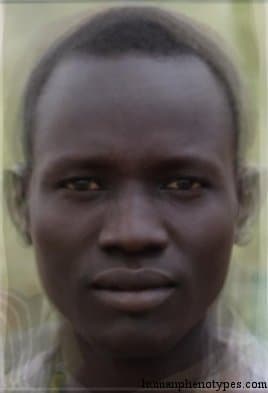
Composite source: Human Phenotypes — Dinkaid
Geographic Distribution
Dinkaid is documented across East Africa, with its historical reference center near 7.9° N, 30.6° E. The coordinates mark where the type was most characteristic roughly 1500 years ago; population movements since then have scattered and blended the distribution far beyond that point.
Physical Characteristics
Black skin and kinky hair.
- Very tall, the tallest of all modern phenotypes
- Hyperbrachyskelic, extremely ectomorph with thin hips and rather gracile upper bodies
- (Hyper-)dolichocephalic, mildly hypsicranic
- Wider faces than Shillukid
- Mildly platyrrhine, the forehead steep, the lips full and the chin sturdy
- In some individuals, pseudo-Mongoloid eyes can appear
- Prognathy is weak or absent
Historical Background
Nilotid proper that shows the most pronounced Nilotic features: the tallest, most long-legged and one of the darkest phenotypes in the world. Typically found in the swamp areas of the Upper Nile in South Sudan. Most common in Dinka and Nuer, but also Atuot, Atwot, Agar, Bor, more mixed in Lotuko and Karamojong.
Research History & Naming
Typological names were coined, contested, and renamed repeatedly across the 20th century, and Dinkaid is no exception. The extract below records the researchers who defined Dinkaid, the alternative labels it accumulated, and where the modern consensus settled.
The Dinkaid was named by Lundman (1967) as the main Nil(ot)id variety. Physical traits were already assessed by Girard (1900) . More detailed descriptions by Seligman (1932) . Eickstedt (1934) , Baker (1981) and Knussmann (1996) regarded them as the typical Nilotids, so did Biasutti (1967) who called them Nilotica.
Comparison With Nearby Phenotypes
Ranked by great-circle distance from Dinkaid's reference center, these are the five nearest documented phenotypes — the closest being Nilo Hamitic at 104 km. Overlapping distributions like these are exactly what makes the quiz hard, and the Nilo Hamitic row is where to start looking.
| Phenotype | Region | Distance | Distinguishing trait |
|---|---|---|---|
| Nilo Hamitic | East Africa | 104 km | Dark brown to black skin, usually kinky, sometimes tight-curly hair. |
| Shillukid | East Africa | 289 km | Black skin, usually kinky, sometimes tight-curly hair. |
| East Sudanid | East Africa | 454 km | Dark brown, sometimes black skin, usually kinky hair. |
| Pre Nilotid | East Africa | 529 km | Black skin and kinky, sometimes tight-curly hair. |
| Mundu Mangbeto | Sub-Saharan Africa | 661 km | Dark, sometimes medium reddish-brown skin, kinky hair. |
Dinkaid in the Game
When the Dinkaid composite shows up in the quiz, players who know the East Africa distribution pattern have the edge. The reference answer sits near 7.9° N, 30.6° E; pins on the wrong continent score close to zero, so even a rough regional instinct beats a precise but misdirected pin.
Dinkaid Phenotype FAQ
- Where does the Dinkaid phenotype come from?
- The reference coordinates for the Dinkaid phenotype sit near 7.9° N, 30.6° E, in East Africa. That point marks the center of the East Africa distribution documented roughly 1500 years ago — actual prevalence spread well beyond it, toward entries such as Nilo Hamitic 104 km away, and modern migration has blurred those boundaries further.
- What does the Dinkaid phenotype look like?
- In the historical literature, black skin and kinky hair. For Dinkaid these are statistical tendencies across a population, not a checklist every individual matches.
- Is the Dinkaid phenotype a race or a nationality?
- No. Phenotypes like Dinkaid are descriptive averages, not ancestry groups. Dinkaid is one of several types documented in and around East Africa — see the comparison table above — and the same individual can carry traits associated with several of them at once. The Dinkaid entry describes a statistical pattern, not a group of people and not a nationality.
- How does Dinkaid appear in the game?
- In Classic Daily and Challenge Mode, the Dinkaid composite face appears without a label. Your task is to drop a pin on the world map where you think that face is historically most common — the scoring uses the distance between your pin and the reference coordinates near 7.9° N, 30.6° E. The post-round review then shows the correct location, your distance error, and this Dinkaid entry.
References & Literature
Every claim on this page traces back to the sources below — the researchers who defined, measured, and argued over the Dinkaid type. The originals behind the Dinkaid entry are worth consulting directly.
- Lundman, B. 1967. Geographische Anthropologie. Rassen und Völker der Erde. G. Fischer, Stuttgart
- Girard, H. 1900. Les Dinkas nilotiques. L'Anthr. XI. 409-429.
- Seligman, C.G. and B. Seligman. 1932. Pagan Tribes of the Nilotic Sudan. George Routledge & Sons Ltd. London
- Eickstedt, E. von. 1934. Rassenkunde und Rassengeschichte der Menschheit. Ferdinand Enke. Stuttgart.
- Baker, J.R.. 1981. Race. Oxford Univ. Press. London.
- E96
- Biasutti, R. 1967 (1941). Le Razze e i Popoli della terra. 4th Ed. Vol 1-4. U.T.E.T., Torino.
Related Phenotypes
More entries from the same region of the historical map as Dinkaid, each with its own composite and trait profile.
Nilo Hamitic
East Africa · 104 km away
Intermediate type between Nilotid and Ethiopid that is associated with the Nilo Hamites or Half Hamites. Similar to Maasai. Should not be co...
Shillukid
East Africa · 289 km away
Nilotid variety similar to Dinkaid, but with slightly modified features. Typically found in the savannahs of the Upper Nile of South Sudan. ...
East Sudanid
East Africa · 454 km away
Isolated Sudanid variety of the Nuba mountains in Kurdufan / Sudan, native to the region at least since the Neolithic. Has resisted historic...
Pre Nilotid
East Africa · 529 km away
Ancient type with Proto Nilotid traits, today still found in the border region of Sudan and Ethiopia. Common in Kwama, Uduk, Gumuz, Mao, and...
Mundu Mangbeto
Sub-Saharan Africa · 661 km away
Intermediate type of the Northeastern Congo forest. Unique in connecting elements of the tallest (Nilo-Hamitic) and shortest (Bambutid) phen...
Further Reading
Background articles from the blog that explain where the Dinkaid type fits, how these composites are built, and what a face can and cannot tell you.
Ethno Guessr Explained: The Daily Face-Mapping Game
Ethno guessr is the loose nickname for a family of quiz games in which a face is the only clue. Here is how one round is built, what the...
Ethnoguessr: The Spelling, the Sites, and the Game
Ethnoguessr is a compressed spelling of "ethnicity guesser", and more than one site answers to it. Here is how to tell what you are...