East Sudanid Phenotype - Face Features & Origin
Historical anthropology places the East Sudanid phenotype in East Africa, with a documented center near 12.0° N, 30.8° E. Isolated Sudanid variety of the Nuba mountains in Kurdufan / Sudan, native to the region at least since the Neolithic. The sections that follow unpack the East Sudanid entry in practice: the composite face, the traits it summarizes, the naming history, and the sources.
Average Face
Averaging the portraits behind East Sudanid leaves the features that repeat and erases the ones that do not. That is exactly how the East Sudanid composite below was built: individual photographs were aligned and statistically merged, exaggerating shared structure into a single reference face that no actual person looks like.
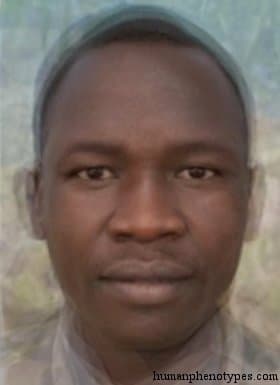
Composite source: Human Phenotypes — East Sudanid
Geographic Distribution
The reference center for East Sudanid sits near 12.0° N, 30.8° E in East Africa. Around that anchor, prevalence falls off gradually — the type is not confined to one valley or one modern border, and the historical map should be read as a gradient rather than a boundary.
Physical Characteristics
Dark brown, sometimes black skin, usually kinky hair.
- Tall, long-legged and mesomorph
- Mesocephalic, sometimes dolichocephalic, mildly hypsicranic
- (Hyper-)platyrrhine nose
- The face is large with relatively narrow eyelids and bulging lips
- The frontoparietal region is flattened
- Prognathy is moderate, body hair weak
Historical Background
Isolated Sudanid variety of the Nuba mountains in Kurdufan / Sudan, native to the region at least since the Neolithic. Has resisted historic invasions of neighbouring types over a long time. However, even in isolated villages, Nilotid, Congolid, and Orientalid admixture is common. A minority type in Fur, Kresh, Yulu, Nara, Kunama, and even Southern Egyptians.
Research History & Naming
Every label in the historical catalogue has an author and a date, and East Sudanid has accumulated its share of competing attributions. For East Sudanid, the literature extract below shows the naming chain — from the first definition through the later revisions that shaped the current entry.
Biasutti (1967) described the type as a "Northern variety of Sudanid". Eickstedt (1943) noted very defragmented eastern Sudanid elements in the region. Represented by Stuck's (1920) Kurdufan type A. Detailed analyses were also conducted by Seligman ( 1910b , 1932 ).
Comparison With Nearby Phenotypes
Ranked by great-circle distance from East Sudanid's reference center, these are the five nearest documented phenotypes — the closest being Pre Nilotid at 369 km. Overlapping distributions like these are exactly what makes the quiz hard, and the Pre Nilotid row is where to start looking.
| Phenotype | Region | Distance | Distinguishing trait |
|---|---|---|---|
| Pre Nilotid | East Africa | 369 km | Black skin and kinky, sometimes tight-curly hair. |
| Shillukid | East Africa | 414 km | Black skin, usually kinky, sometimes tight-curly hair. |
| Dinkaid | East Africa | 454 km | Black skin and kinky hair. |
| Nilo Hamitic | East Africa | 474 km | Dark brown to black skin, usually kinky, sometimes tight-curly hair. |
| Middle Nile | East Africa | 782 km | Medium to dark brown skin, relatively fair for the region - a result of Orientalid admixture. |
East Sudanid in the Game
When the East Sudanid composite shows up in the quiz, players who know the East Africa distribution pattern have the edge. The reference answer sits near 12.0° N, 30.8° E; pins on the wrong continent score close to zero, so even a rough regional instinct beats a precise but misdirected pin.
East Sudanid Phenotype FAQ
- Where does the East Sudanid phenotype come from?
- The reference coordinates for the East Sudanid phenotype sit near 12.0° N, 30.8° E, in East Africa. That point marks the center of the East Africa distribution documented roughly 1500 years ago — actual prevalence spread well beyond it, toward entries such as Pre Nilotid 369 km away, and modern migration has blurred those boundaries further.
- What does the East Sudanid phenotype look like?
- In the historical literature, dark brown, sometimes black skin, usually kinky hair. For East Sudanid these are statistical tendencies across a population, not a checklist every individual matches.
- Is the East Sudanid phenotype a race or a nationality?
- No. Phenotypes like East Sudanid are descriptive averages, not ancestry groups. East Sudanid is one of several types documented in and around East Africa — see the comparison table above — and the same individual can carry traits associated with several of them at once. The East Sudanid entry describes a statistical pattern, not a group of people and not a nationality.
- How does East Sudanid appear in the game?
- In Classic Daily and Challenge Mode, the East Sudanid composite face appears without a label. Your task is to drop a pin on the world map where you think that face is historically most common — the scoring uses the distance between your pin and the reference coordinates near 12.0° N, 30.8° E. The post-round review then shows the correct location, your distance error, and this East Sudanid entry.
References & Literature
Primary sources for the East Sudanid entry, listed as cited in the historical literature. The naming and classification debates around East Sudanid referenced above run through these works.
- Biasutti, R. 1967 (1941). Le Razze e i Popoli della terra. 4th Ed. Vol 1-4. U.T.E.T., Torino.
- Eickstedt, E. von. 1934. Rassenkunde und Rassengeschichte der Menschheit. Ferdinand Enke. Stuttgart.
- Struck, B. 1920. Somatische Typen und Sprachgruppen in Kordofan. Ein Beitrag zur Methodik der Typenanalyse. Ztschr. Ethnol. LII/LIII. 120-173.
- Seligman, C.G. 1910b. The Physcial Characters of the Nuba of Kordofan. JRAI, xl.
- Seligman, C.G. and B. Seligman. 1932. Pagan Tribes of the Nilotic Sudan. George Routledge & Sons Ltd. London
Related Phenotypes
If East Sudanid interested you, these neighboring phenotype entries cover adjacent parts of the map with distinctly different trait bundles.
Pre Nilotid
East Africa · 369 km away
Ancient type with Proto Nilotid traits, today still found in the border region of Sudan and Ethiopia. Common in Kwama, Uduk, Gumuz, Mao, and...
Shillukid
East Africa · 414 km away
Nilotid variety similar to Dinkaid, but with slightly modified features. Typically found in the savannahs of the Upper Nile of South Sudan. ...
Dinkaid
East Africa · 454 km away
Nilotid proper that shows the most pronounced Nilotic features: the tallest, most long-legged and one of the darkest phenotypes in the world...
Nilo Hamitic
East Africa · 474 km away
Intermediate type between Nilotid and Ethiopid that is associated with the Nilo Hamites or Half Hamites. Similar to Maasai. Should not be co...
Middle Nile
East Africa · 782 km away
The Middle Nile type is a contact type of the Nile Valley located in Northern Sudan. Features are variable, although North African, West Asi...
Further Reading
Background articles from the blog that explain where the East Sudanid type fits, how these composites are built, and what a face can and cannot tell you.
AI Ethnicity Analyzer: Four Instruments, One Name
An analyzer implies parts, but four quite different machines trade under that name: a label classifier, a geometry tool, an embedding...
AI Phenotype Scanner: What a Scanner Cannot Do for a Face
The phrase names a face classifier, not a device that reads a stored record. What the scanner metaphor hides, what the 209-entry...