Casamance Phenotype - Face Features & Origin
Type of the Sudanid-Guinesid contact belt with a variety of unique features that set it apart from other groups. Its reference coordinates sit near 12.9° N, 15.2° W in West Africa. Rather than a single portrait, the Casamance composite below is a statistical average, and the surrounding sections — traits, distribution, research history, references — give that average its context.
Average Face
What you see below is a statistical construction of the Casamance reference population. Faces recorded from the Casamance sample were overlaid and merged; the result keeps the features most members shared and discards personal variation. It reads like a Casamance portrait, but it works like a histogram.
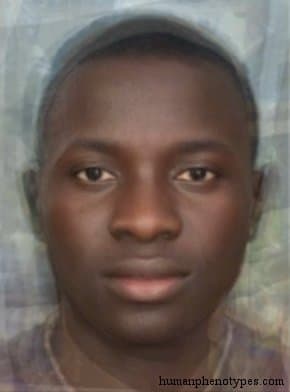
Composite source: Human Phenotypes — Casamance
Geographic Distribution
The reference center for Casamance sits near 12.9° N, 15.2° W in West Africa. Around that anchor, prevalence falls off gradually — the type is not confined to one valley or one modern border, and the historical map should be read as a gradient rather than a boundary.
Physical Characteristics
Dark brown, sometimes black skin, usually kinky hair.
- Medium height or rather tall, (hyper-)brachyskelic, mesomorph
- Mesocephalic, orthocranic
- Platyrrhine nose
- The face is large with big eyes and bulging lips
- Prognathy is usually significant
- Body hair weak
Historical Background
Type of the Sudanid-Guinesid contact belt with a variety of unique features that set it apart from other groups. Most common in the lower Casamance region of West Africa in South Senegal, Gambia, and Guinea-Bissau, where it is found in Jola, Jola-Felupe, Diamate, and related groups. In low frequencies across West Africa in Ashanti, Bayot, Dyula, Dagomba, Bolon, Tiefo, and others.
Research History & Naming
The passage below traces who first defined Casamance, which rival names competed with it, and how later authors consolidated or disputed the classification — the raw material of any serious phenotype reference.
The type was identified within the "atypical groups" of the Sudano-Guinean region by Pales and St-Péreuse (1953) as the "Western" type. Also described by Chabeuf (1959) , who studied relationships to types farther East.
Comparison With Nearby Phenotypes
Geography, not alphabet, ordered this table: the five phenotype centers closest to Casamance's, with the traits most likely to be mistaken for it (Senegalid leads at 192 km). In gameplay, these five account for most of the wrong-but-nearby pins against Casamance.
| Phenotype | Region | Distance | Distinguishing trait |
|---|---|---|---|
| Senegalid | West Africa | 192 km | Black skin, even darker than other Sudanids. |
| West Ethiopid | West Africa | 372 km | Reddish medium to dark brown skin, wavy to tight-curly hair. |
| Moorish | North Africa | 1,035 km | Bronze brown skin, wavy to tight-curly hair. |
| Guineo Camerunian | West Africa | 1,190 km | Usually dark, sometimes medium brown skin. |
| Bobo | West Africa | 1,205 km | Dark brown, sometimes black skin, usually kinky hair. |
Casamance in the Game
In gameplay terms, Casamance rewards region-level recall: the score is computed from the distance between your pin and 12.9° N, 15.2° W. Players often confuse Casamance with Senegalid (192 km out) in the comparison table above — those confusions are exactly what the distance penalty is designed to expose.
Casamance Phenotype FAQ
- Where does the Casamance phenotype come from?
- The reference coordinates for the Casamance phenotype sit near 12.9° N, 15.2° W, in West Africa. That point marks the center of the West Africa distribution documented roughly 1500 years ago — actual prevalence spread well beyond it, toward entries such as Senegalid 192 km away, and modern migration has blurred those boundaries further.
- What does the Casamance phenotype look like?
- In the historical literature, dark brown, sometimes black skin, usually kinky hair. For Casamance these are statistical tendencies across a population, not a checklist every individual matches.
- Is the Casamance phenotype a race or a nationality?
- No — and the Casamance naming history above shows why. Casamance was defined, renamed, and regrouped repeatedly by different researchers, which is the opposite of how a fixed racial category would behave. A phenotype is a recurring bundle of visible traits recorded across a population; the Casamance label says nothing about where any individual's ancestors were born.
- How does Casamance appear in the game?
- In Classic Daily and Challenge Mode, the Casamance composite face appears without a label. Your task is to drop a pin on the world map where you think that face is historically most common — the scoring uses the distance between your pin and the reference coordinates near 12.9° N, 15.2° W. The post-round review then shows the correct location, your distance error, and this Casamance entry.
References & Literature
The Casamance phenotype entry above is compiled from the 2 academic references. Readers are encouraged to consult the original Casamance sources for verification and deeper context.
- Pales, L. and T. de St-Péreuse. 1953. Raciologie comparative des populations de l'Afrique occidentale.Bull. et Mém. de la Société d'anthropologie de Paris X. 185-497.
- Chabeuf, M. 1959. Anthropologie physique du Moyen-Congo et du Gabon méridional. Bull- et Mém- de la Société d'anthr- de Paris. 10, 2, 97-185.
Related Phenotypes
Other human phenotypes whose documented centers lie in the same part of the map as Casamance.
Senegalid
West Africa · 192 km away
Gracile Sudanid variety, named after the country of Senegal, where it is found in its purest form among Wolof, more mixed in Serer. Occasion...
West Ethiopid
West Africa · 372 km away
Ethiopid subtype that was more widespread across the Western Saharan regions during the Neolithic when the area was still a green savannah. ...
Moorish
North Africa · 1,035 km away
Relatively recent contact type of the Western Sahara. Probably formed during Antiquity when aboriginal Berber populations mixed with older W...
Guineo Camerunian
West Africa · 1,190 km away
West African type, the shorter-skulled counterpart of Guinesids. May constitute the transition to Congolesids. Common in forest regions of C...
Bobo
West Africa · 1,205 km away
Sudanid variety with shorter skulls than Sudanids proper, and several other unique features that set it apart from other neighbouring groups...
Further Reading
Background articles from the blog that explain where the Casamance type fits, how these composites are built, and what a face can and cannot tell you.
What Nationality Do I Look Like? A Legal Status, Not a Face
Nationality is a status that states assign and reassign. A face can resemble a documented regional pattern; it cannot resemble a...
Ethnicity Guesser Photo: What Happens to the File First
A photo handed to a face tool stops being a photograph almost at once: the file is decoded, rotated, colour-converted and resized before...