Ethno Guessr Explained: The Daily Face-Mapping Game
Ethno guessr is the loose nickname for a family of quiz games in which a face is the only clue. Here is how one round is built, what the catalogue behind the faces contains, and where the format stops working.
What the name refers to
Ethno guessr is a compound of ethnicity and guesser, coined by analogy with GeoGuessr, the game that drops a player into a street panorama and asks for a location. The face version swaps the photograph of a road for a portrait, and keeps the map pin. Nothing about the phrase is ownable in any practical sense, which is why it now covers several unrelated products. The best known is hbd.gg, a daily quiz site that brands one of its game modes EthnoGuessr and builds rounds from the humanphenotypes.net typology.
Because the phrase is loose, search results for it mix four different readings: a brand name, a genre label, a request for a free tool, and a question about whether the game can say anything true about the person looking at it. Those four readings want different pages. A player who wants the daily puzzle needs rules and a scoring explanation. Someone who arrives from a result screen wants to know how the answer was produced. This article covers the format itself, which is the part that stays constant across every site wearing the name.
How a single round is built
A round is short by design. The screen shows one face, the player commits to a place on a map or to a named region, and the distance between the guess and the recorded origin becomes the score. Most implementations run ten rounds to a set, and the set is generated once per day from a fixed seed, so two people playing on the same calendar date answer the same ten faces. That determinism is what makes the game shareable. A leaderboard only means something if the puzzle cannot be rerolled until an easy draw appears.
Scoring usually rewards proximity rather than a correct label, which matters more than it looks. If a player places a pin 300 kilometres from the recorded region, the game can call that a good round without asserting that the player identified an ethnicity, a nationality, or a person. On this site the daily set is drawn from the catalogue described below and the scoring is deterministic: ten faces a day, the same ten for every player, which is also why practising on past sets is worth the effort.
Why a face carries any signal at all
Skin pigmentation is the trait that makes the format playable, and it is genuinely clinal. Nina Jablonski and George Chaplin argued in 2000 that pigmentation tracks ultraviolet radiation, with dark, eumelanin-rich skin near the equator and lighter skin at high latitudes where UV is scarce and vitamin D synthesis becomes the binding constraint. The genetics behind that gradient are fairly well mapped. SLC24A5 and SLC45A2 account for a large share of the lightening seen in European and West Asian populations, while variants at OCA2 and HERC2 drive much of the variation in eye and hair colour.
Almost everything else a player believes they are reading is a weaker signal. Craniometric data compiled by Beals, Smith and Dodd in 1984 shows that skull measurements change gradually across geography rather than stepping at any border, and the spread inside a single region is wide enough that neighbouring groups overlap heavily. A round therefore tests recall of a regional tendency in a catalogue, not the reading of an individual. Treating a well-played round as evidence about a stranger is a category error, and it is the mistake the format invites most often.
The catalogue behind the map
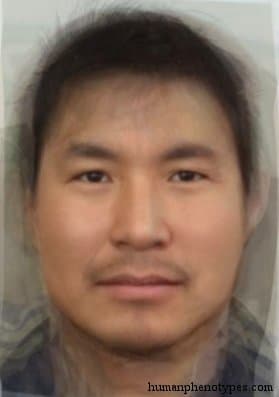
Every face in a round has to come from somewhere, and here it comes from a catalogue of 209 documented appearance patterns drawn from the demic and typological literature, using a baseline of roughly 1500 years ago. Each entry pairs a region with a description and with the publications that named it. Eickstedt's surveys of 1934 and 1937, Coon's 1939 volume, and Giuffrida-Ruggeri's earlier work recur throughout the source list, which is why the vocabulary can sound dated. It is a record of what those authors wrote, and it is labelled as such.
- Inuid: Arctic coasts from Alaska and Nunavut to Greenland, recorded as the northernmost pattern in the catalogue.
- Bukaid: the Western Solomons and Bougainville, recorded as the darkest skin in Oceania, palms included.
- Dinkaid: the Upper Nile swamps of South Sudan, recorded as the tallest pattern in the catalogue.
- Aetid: Luzon, Mindanao and Palawan, described in the source literature as surviving in only a few thousand people.
What the game cannot be about
The catalogue describes historical distributions. It does not sort living people, and it is not a key to anyone's background. R. C. Lewontin's 1972 survey of protein polymorphisms found that the great majority of human genetic variation sits inside any single population rather than between populations, and Frank Livingstone had argued a decade earlier that human variation is clinal, so that no boundary on a map marks a biological edge. A game built on the catalogue can train regional recall. It cannot answer what a stranger is, and it should not be asked to.
Admixture makes the point concrete. The catalogue's baseline sits about fifteen centuries back, and the interval since then contains the later phases of the Bantu expansion, the Germanic and Slavic movements across Europe, the Atlantic and Indian Ocean slave trades, and twentieth-century urban migration at a scale no earlier century matched. Patterns once concentrated locally are now spread across continents. A composite face still works as a puzzle piece, because averaging removes individual noise, but the average describes a documented distribution rather than the person in front of you.
Which version of the game to play
hbd.gg offers the widest mode selection of the sites using the name, with six modes that include a World Cup variant and DoggoGuessr, a version played with dogs. If variety is what keeps a player returning, that breadth is a real advantage, and a catalogue of sourced entries does not substitute for it. ethnoguessr.org positions itself on volume instead, claiming more than 350 ethnic groups and 195 countries. A player who wants the largest possible answer space should weigh that number first.
This site takes the opposite trade. It publishes 209 catalogued patterns and 48 country composites, each tied to a named source, and it refuses to score a player on whether they can identify a living person. A reader who wants an endless supply of modes is better served by hbd.gg. A reader who wants to know why a particular composite was built from the Atlas Mountains rather than the Carpathians will get further with the sourced entries, because the entry itself carries the region, the description and the citation.
Frequently Asked Questions
- Is ethno guessr the same thing as GeoGuessr?
- No. GeoGuessr uses panoramic street photography, and the player reads road markings, vegetation and architecture. The face version uses portraits or composite faces, and the player reads documented appearance patterns. The two share a scoring idea, distance from a recorded origin, and a daily seeded set. They test different skills. A strong GeoGuessr player has no automatic advantage here, and someone who does well at faces may be hopeless at reading a roadside.
- Why does the game use composite faces rather than photographs?
- A composite averages many portraits that the source literature grouped together. That raises the ratio of shared signal to individual noise and removes identifiable people from the puzzle. A single photograph would turn the round into a question about one person, and the answer would be that person's own history rather than a regional tendency. Averaging also makes the ethical position simple: no living person's face is the answer to anything here, and no round can be solved by recognising someone.
- Can playing the game teach you to identify a stranger's background?
- It can improve recall of where documented patterns were recorded, which is geography rather than perception. It cannot supply information the face does not carry. Neighbouring regions overlap heavily, admixture is the common case rather than the exception, and the catalogue's baseline is roughly 1500 years old. Anyone claiming to read a stranger reliably is describing confidence rather than accuracy. The game stays honest about this by scoring distance to a recorded origin instead of the identity of a person.
Related Phenotypes
Faces from the encyclopedia that appear in this article. Open any entry for its full description, distribution, and references.
Inuid
Arctic
Eskimid proper type, ranging over the vast, sparsely populated tundra along the icy coasts of Alaska, Nunavut, and Labrador (Canada) to Gree...
Bukaid
Melanesia
Melanesid variety, associated with the ancient "Walzenbeil" culture. Has sometimes been described as bantuiform, although no close genetic r...
Dinkaid
East Africa
Nilotid proper that shows the most pronounced Nilotic features: the tallest, most long-legged and one of the darkest phenotypes in the world...
Aetid
Southeast Asia
Ancient type found in the mountains of the Philippine islands of Luzon, Mindandao and Palawan. Probably developed during the Paleolithic. Si...
Test what you learned
Put your eye for regional faces to work in the daily quiz — a composite face, a world map, and your best guess.