Bukaid Phenotype - Face Features & Origin
Historical anthropology places the Bukaid phenotype in Melanesia, with a documented center near 6.1° S, 155.2° E. Melanesid variety, associated with the ancient "Walzenbeil" culture. The sections that follow unpack the Bukaid entry in practice: the composite face, the traits it summarizes, the naming history, and the sources.
Average Face
Averaging the portraits behind Bukaid leaves the features that repeat and erases the ones that do not. That is exactly how the Bukaid composite below was built: individual photographs were aligned and statistically merged, exaggerating shared structure into a single reference face that no actual person looks like.
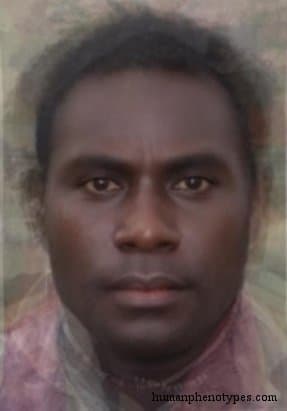
Composite source: Human Phenotypes — Bukaid
Geographic Distribution
Geographically, Bukaid anchors to 6.1° S, 155.2° E (Melanesia). That is the point where historical anthropologists judged Bukaid most concentrated, not a hard edge; modern migration and intermarriage have long since softened whatever boundaries once existed.
Physical Characteristics
Black, sometimes dark dark brown skin - the darkest in Oceania.
- Unlike in African Blacks, even palms are dark
- Tight-curly / kinky hair that is black-brown, rarely blonde or red (especially in children)
- Medium-height, mesoskelic, ecto- to mesomorph
- Mesocephalic, mildly hypsicranic
- Straight or mildly convex, platyrrhine nose
- Relatively soft facial features, supraorbital arches mild
Historical Background
Melanesid variety, associated with the ancient "Walzenbeil" culture. Has sometimes been described as bantuiform, although no close genetic relationship to Africans exists. Dominant in the Western Solomons (e.g. Buka, New Georgia) and Bougainville as well as Nissan. Mixed in the Admiralty Islands, New Ireland, New Hannover, North-East New Guinea, and some other parts of Melanesia.
Research History & Naming
Typological names were coined, contested, and renamed repeatedly across the 20th century, and Bukaid is no exception. The extract below records the researchers who defined Bukaid, the alternative labels it accumulated, and where the modern consensus settled.
Named and defined by Speiser (1938) and later used by Lundman ( 1952 , 1967 , 1988 ) after a Buka type had been recognised much earlier ( Hagen, 1899 ). Eickstedt (1934) and Knussmann (1996) regarded it as a variety of Paleo Melanesid, Biasutti (1967) of Papua-Melanesid.
Comparison With Nearby Phenotypes
Ranked by great-circle distance from Bukaid's reference center, these are the five nearest documented phenotypes — the closest being Insular Melanesid at 416 km. Overlapping distributions like these are exactly what makes the quiz hard, and the Insular Melanesid row is where to start looking.
| Phenotype | Region | Distance | Distinguishing trait |
|---|---|---|---|
| Insular Melanesid | Melanesia | 416 km | Dark brown skin. |
| Mountain Melanesid | Melanesia | 1,085 km | Usually dark, sometimes light brown skin. |
| Brachio Melanesid | Melanesia | 1,226 km | Dark reddish-brown skin. |
| Neo Melanesid | Melanesia | 1,283 km | Dark brown, sometimes medium brown skin. |
| Tapirid | Melanesia | 1,453 km | Dark to medium brown, yellowish-reddish skin. |
Bukaid in the Game
When the Bukaid composite shows up in the quiz, players who know the Melanesia distribution pattern have the edge. The reference answer sits near 6.1° S, 155.2° E; pins on the wrong continent score close to zero, so even a rough regional instinct beats a precise but misdirected pin.
Bukaid Phenotype FAQ
- Where does the Bukaid phenotype come from?
- The reference coordinates for the Bukaid phenotype sit near 6.1° S, 155.2° E, in Melanesia. That point marks the center of the Melanesia distribution documented roughly 1500 years ago — actual prevalence spread well beyond it, toward entries such as Insular Melanesid 416 km away, and modern migration has blurred those boundaries further.
- What does the Bukaid phenotype look like?
- In the historical literature, black, sometimes dark dark brown skin - the darkest in Oceania. For Bukaid these are statistical tendencies across a population, not a checklist every individual matches.
- Is the Bukaid phenotype a race or a nationality?
- No. Phenotypes like Bukaid are descriptive averages, not ancestry groups. Bukaid is one of several types documented in and around Melanesia — see the comparison table above — and the same individual can carry traits associated with several of them at once. The Bukaid entry describes a statistical pattern, not a group of people and not a nationality.
- How does Bukaid appear in the game?
- In Classic Daily and Challenge Mode, the Bukaid composite face appears without a label. Your task is to drop a pin on the world map where you think that face is historically most common — the scoring uses the distance between your pin and the reference coordinates near 6.1° S, 155.2° E. The post-round review then shows the correct location, your distance error, and this Bukaid entry.
References & Literature
Every claim on this page traces back to the sources below — the researchers who defined, measured, and argued over the Bukaid type. The originals behind the Bukaid entry are worth consulting directly.
- Speiser, F. 1938. Melanesien und Indonesien. Zeitschrift fuer Ethnologie. 70(6). Berlin.
- Lundman, B. 1952. Umriss der Rassenkunde des Menschen in geschichtlicher Zeit. Ejnar Munksgaard. Kopenhagen.
- Lundman, B. 1967. Geographische Anthropologie. Rassen und Völker der Erde. G. Fischer, Stuttgart
- Lundman, B. 1988. Jordens folkstammar. Huddinge.
- Hagen, B. 1899. Unter den Papuas. C. W. Kreidel's Verlag. Wiesbaden.
- Eickstedt, E. von. 1934. Rassenkunde und Rassengeschichte der Menschheit. Ferdinand Enke. Stuttgart.
- Biasutti, R. 1967 (1941). Le Razze e i Popoli della terra. 4th Ed. Vol 1-4. U.T.E.T., Torino.
Related Phenotypes
If Bukaid interested you, these neighboring phenotype entries cover adjacent parts of the map with distinctly different trait bundles.
Insular Melanesid
Melanesia · 416 km away
Melanesid proper, associated with many Austronesian speakers of Melanesia. Similar to Paleo Melanesid, but with softer features. Common in E...
Mountain Melanesid
Melanesia · 1,085 km away
Melanesian mountain variety, relatively ancient with similarities to Paleo Melanesid. Found mainly among New Guinean highlanders like Dani, ...
Brachio Melanesid
Melanesia · 1,226 km away
Atypical brachycephalic Melanesid variety native to Melanesia and New Guinea. In its most pronounced form in the Kerewo of Goaribari Island ...
Neo Melanesid
Melanesia · 1,283 km away
Melanesid subtype of New Guinea. Found especially in lowlands and river plains, with its highest concentration in the south of the island. M...
Tapirid
Melanesia · 1,453 km away
Pygmy Melanesian type. In difference to many other Pygmies, it shares a common history with its taller neighbours and probably represents a ...
Further Reading
Background articles from the blog that explain where the Bukaid type fits, how these composites are built, and what a face can and cannot tell you.
Ethno Guessr Explained: The Daily Face-Mapping Game
Ethno guessr is the loose nickname for a family of quiz games in which a face is the only clue. Here is how one round is built, what the...
Ethnicity Guesser vs hbd.gg: Two Ways to Ask a Face
Two sites ask a face to name a place. Here is what each one shows you, where breadth and provenance actually differ, and how to tell...