Mountain Melanesid Phenotype - Face Features & Origin
Historical anthropology places the Mountain Melanesid phenotype in Melanesia, with a documented center near 6.1° S, 145.4° E. Melanesian mountain variety, relatively ancient with similarities to Paleo Melanesid. The sections that follow unpack the Mountain Melanesid entry in practice: the composite face, the traits it summarizes, the naming history, and the sources.
Average Face
Averaging the portraits behind Mountain Melanesid leaves the features that repeat and erases the ones that do not. That is exactly how the Mountain Melanesid composite below was built: individual photographs were aligned and statistically merged, exaggerating shared structure into a single reference face that no actual person looks like.
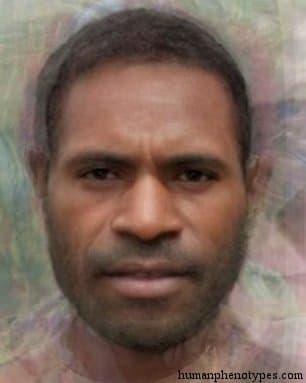
Composite source: Human Phenotypes — Mountain Melanesid
Geographic Distribution
The reference center for Mountain Melanesid sits near 6.1° S, 145.4° E in Melanesia. Around that anchor, prevalence falls off gradually — the type is not confined to one valley or one modern border, and the historical map should be read as a gradient rather than a boundary.
Physical Characteristics
Usually dark, sometimes light brown skin.
- Tight-curly brown-black, sometimes lighter hair
- (Rather) short, mesomorph, very long arms and legs
- Mesocephalic, sometimes brachycephalic, mildly hypsicranic, relatively large head
- Platyrrhine, relatively low or mildly convex nose
- Mouth large, thick lips, face robust and wide, often with heavy brow ridges and deep-set eyes
- Chin receding, prognathy common
- Body hair strong
Historical Background
Melanesian mountain variety, relatively ancient with similarities to Paleo Melanesid. Found mainly among New Guinean highlanders like Dani, Moni, Ekagi, Mbowamb, Enga, Paniani, Yali, and many others. Occasionally across the New Guinean lowlands and the hills of the Bismarck Archipelago (e.g. Baining) and Solomon Islands.
Research History & Naming
Every label in the historical catalogue has an author and a date, and Mountain Melanesid has accumulated its share of competing attributions. For Mountain Melanesid, the literature extract below shows the naming chain — from the first definition through the later revisions that shaped the current entry.
Its distinctiveness was recognised early by Hagen (1899) as "Bergtypus". Later studied by Le Roux (1948-1950) in higher detail. Thus, Biasutti (1967) classified it as a Mountain Papua subrace, some included in in Paleo Melanesid ( Speiser, 1937 ; Weinert, 1965 ). Howells (1971) identified it as "group B1".
Comparison With Nearby Phenotypes
Ranked by great-circle distance from Mountain Melanesid's reference center, these are the five nearest documented phenotypes — the closest being Neo Melanesid at 202 km. Overlapping distributions like these are exactly what makes the quiz hard, and the Neo Melanesid row is where to start looking.
| Phenotype | Region | Distance | Distinguishing trait |
|---|---|---|---|
| Neo Melanesid | Melanesia | 202 km | Dark brown, sometimes medium brown skin. |
| Brachio Melanesid | Melanesia | 228 km | Dark reddish-brown skin. |
| Tapirid | Melanesia | 371 km | Dark to medium brown, yellowish-reddish skin. |
| Insular Melanesid | Melanesia | 689 km | Dark brown skin. |
| North Australid | Australia | 1,011 km | Dark brown, sometimes black skin with wavy or curly hair. |
Mountain Melanesid in the Game
When the Mountain Melanesid composite shows up in the quiz, players who know the Melanesia distribution pattern have the edge. The reference answer sits near 6.1° S, 145.4° E; pins on the wrong continent score close to zero, so even a rough regional instinct beats a precise but misdirected pin.
Mountain Melanesid Phenotype FAQ
- Where does the Mountain Melanesid phenotype come from?
- The reference coordinates for the Mountain Melanesid phenotype sit near 6.1° S, 145.4° E, in Melanesia. That point marks the center of the Melanesia distribution documented roughly 1500 years ago — actual prevalence spread well beyond it, toward entries such as Neo Melanesid 202 km away, and modern migration has blurred those boundaries further.
- What does the Mountain Melanesid phenotype look like?
- In the historical literature, usually dark, sometimes light brown skin. For Mountain Melanesid these are statistical tendencies across a population, not a checklist every individual matches.
- Is the Mountain Melanesid phenotype a race or a nationality?
- No. A phenotype is a recurring bundle of visible traits documented by historical anthropologists across a population — for Mountain Melanesid, patterns such as usually dark, sometimes light brown skin. The Mountain Melanesid entry is not a genetic ancestry, not a nationality, and not a statement about any individual person. Two people from the same country can match completely different phenotypes — one resembling Mountain Melanesid, another closer to Neo Melanesid — and one phenotype can span many modern borders.
- How does Mountain Melanesid appear in the game?
- In Classic Daily and Challenge Mode, the Mountain Melanesid composite face appears without a label. Your task is to drop a pin on the world map where you think that face is historically most common — the scoring uses the distance between your pin and the reference coordinates near 6.1° S, 145.4° E. The post-round review then shows the correct location, your distance error, and this Mountain Melanesid entry.
References & Literature
Primary sources for the Mountain Melanesid entry, listed as cited in the historical literature. The naming and classification debates around Mountain Melanesid referenced above run through these works.
- Hurles M.E. et al. 1999. Recent male-mediated gene flow over a linguistic barrier in Iberia, suggested by analysis of a Y-chromosomal DNA polymorphism. Am. J. Hum. Genet. 65:14371448.
- Le Roux, C.F.M. 1948-1950, De bergpapoea's van Nieuw Guinea en hun woongebied. Deel 1-3. (Read
- Biasutti, R. 1967 (1941). Le Razze e i Popoli della terra. 4th Ed. Vol 1-4. U.T.E.T., Torino.
- Speiser, F. 1938. Melanesien und Indonesien. Zeitschrift fuer Ethnologie. 70(6). Berlin.
- Weinert, H. 1965. Die heutigen Rassen der Menschheit. In: Lundwig, B. and H. Plank. Handbuch der Biologie. Vol 9 (2).
Related Phenotypes
If Mountain Melanesid interested you, these neighboring phenotype entries cover adjacent parts of the map with distinctly different trait bundles.
Neo Melanesid
Melanesia · 202 km away
Melanesid subtype of New Guinea. Found especially in lowlands and river plains, with its highest concentration in the south of the island. M...
Brachio Melanesid
Melanesia · 228 km away
Atypical brachycephalic Melanesid variety native to Melanesia and New Guinea. In its most pronounced form in the Kerewo of Goaribari Island ...
Tapirid
Melanesia · 371 km away
Pygmy Melanesian type. In difference to many other Pygmies, it shares a common history with its taller neighbours and probably represents a ...
Insular Melanesid
Melanesia · 689 km away
Melanesid proper, associated with many Austronesian speakers of Melanesia. Similar to Paleo Melanesid, but with softer features. Common in E...
North Australid
Australia · 1,011 km away
Australid type of Northern and Central Australia typical for the Gulf of Carpentaria. Shows some similarities to Paleo Melanesids. By some a...
Further Reading
Background articles from the blog that explain where the Mountain Melanesid type fits, how these composites are built, and what a face can and cannot tell you.
Ethnicity Guesser vs hbd.gg: Two Ways to Ask a Face
Two sites ask a face to name a place. Here is what each one shows you, where breadth and provenance actually differ, and how to tell...
Race Guesser: Why the Word Does Not Fit a Face Quiz
The phrase is a search term before it is a tool. Here is where the word race came from as a sorting device, why a century of measuring...