Race Guesser: Why the Word Does Not Fit a Face Quiz
The phrase is a search term before it is a tool. Here is where the word race came from as a sorting device, why a century of measuring it kept failing, and what a scored face game needs instead.
The word began as a sorting label
Before race described people, it described lines of descent in animals. The word entered English in the sixteenth century from Italian razza, where it was used for breeds and bloodlines, and it arrived at the moment European naturalists were building classification systems for everything they could collect. Carl Linnaeus, in the 1735 first edition of Systema Naturae, sorted humans into four geographic varieties and appended short notes on customs and temperament to each one. Georgius Blumenbach published five varieties in 1775, then added the name Caucasian in the 1795 edition. The category was a sorting device from the outset, and its axis was never purely physical.
That history matters for anyone typing race guesser into a search box. The searcher is asking for something that reads a label off a face, and the label in question was built as a filing system carrying a cultural load, not as a measured variable. Once the names existed, the measuring followed, and measuring is where the trouble became visible.
Measuring the category made it fragile
Nineteenth-century craniometry tried to put numbers behind the labels. Samuel George Morton's Crania Americana of 1839 and his later skull catalogue measured cranial capacity across groups and presented the results as a natural ordering. A century later, Stephen Jay Gould argued in 1978 that Morton's figures were distorted by inconsistent decisions about which skulls to include and how to fill them. In 2011 Jason Lewis and colleagues re-measured the surviving crania and reported that Morton's numbers largely held, moving the criticism toward his interpretation rather than his calipers. That exchange remains contested, and the fair reading is that both sides found something real.
What the dispute settles is narrower than either camp claims, and it is the part that matters here. Even careful measurement does not yield categories, because somebody still chooses where to cut the range before the first skull is measured. Cranial capacity varies continuously, overlaps heavily between any two groups, and tracks body size, climate and nutrition at least as much as geography. A figure can be accurate while the cut point that gives it meaning stays arbitrary.
The boundaries kept being redrawn
Franz Boas measured the head forms of immigrants and their American-born children, and argued in 1911 that a trait described to him as stable had shifted within a single generation. Reanalysis by Corey Sparks and Richard Jantz in 2002 found the data thinner and the change less dramatic than the original presentation, and later statistical work has kept the argument running. The outcome is not a clean verdict. It is a demonstration that the stability assumption was testable and did not come through intact.
Population genetics then replaced typology with frequency. Sewall Wright introduced the fixation index in 1949 to describe how much variation sits between groups rather than inside them, and genome-wide estimates since have landed around ten to fifteen percent between continental groups, with the remainder distributed among neighbours. The gradients also refuse to line up. The Duffy-null allele that blocks one malaria parasite sits near fixation across much of sub-Saharan Africa, lactase persistence arose through separate mutations in northern Europe and East Africa, and earwax type follows a third distribution altogether. Different traits, different axes, different boundaries.
What a scored game actually needs
A quiz is a machine with a scoring rule, and the rule has to be written before the first round. It needs a finite answer set, a definition for each member of that set, and a way to mark a given answer right or wrong. This site supplies 209 catalogued entries for that purpose. Hallstatt is named after the Iron Age cemetery site in Austria and is reported as most common among Swedes and southern Norwegians. Baskid is associated with the Basques and recorded in its least mixed form around the Pyrénées-Atlantiques. Both are places with names, sources and described features, which is what a scoring rule can work with.
A race-based answer set cannot offer the same thing, and the reason is structural rather than political. Nobody has the authority to publish an official list of races, no version of that list has ever been agreed across disciplines, and the counts proposed in the literature have ranged from three to more than thirty. A game built on such a set would be scoring against an answer key that no two graders would draw the same way, which drains the meaning out of the score before any question of fairness is even raised.
A fixed list cannot hold a contact type
The catalogue keeps demonstrating why fixed lists fail, because a large share of its entries exist precisely because two populations met. Fijid is recorded as a Polynesid and Melanesid contact type dominant in Fiji, with both elements mixing in the zone for several millennia. Congolesid covers the Congo forest basin and is described as spread along the Bantu-speaking expansion from Gabon to Zambia. Entries of this kind describe processes, and a process does not slot neatly into a set of permanent kinds.
For a game this is an advantage rather than a defect. A round can ask where a documented pattern was historically common and be scored without making any claim about who anybody is, because the question concerns a distribution on a map. Offering contact types as answers also teaches something true: populations have mixed throughout the record, and the interesting cases are the ones where the mixing shows up in the description itself.
What people typing that phrase likely want
Four different wishes hide behind one search. Somebody may want ancestry, which is a question for a DNA test and a paper trail rather than for a photograph. Somebody may want an administrative category, which in most countries is a self-identification on a form and is settled by the person filling it in. Somebody may want an honest description of visible features, which a catalogue entry can supply. Somebody else may simply want a game to play with friends. The map has moved as well since the catalogue was drawn: the transatlantic trade, nineteenth-century labour migration and the last seventy years of global movement have all relocated the patterns those entries describe.
Only one of those four wishes is served by software that guesses, and the others receive a worse answer than the question deserved. That is why the honest response to the phrase is to split it rather than to build the tool it names. If ancestry is the real question, the answer lives in a laboratory. If it is a form, the answer belongs to whoever holds the pen. If it is a face, the answer is a description with a source attached.
The word the catalogue uses instead
Phenotype means the observable traits an organism shows, and the term was coined to separate what is visible from what is inherited. Applied to the catalogue, it carries three commitments. An entry describes a pattern instead of assigning a person. It states a region and a time instead of making a claim about anyone alive. It records what trained observers wrote, which means it can be checked, criticised and dated. None of those commitments is available to a label that a classifier produces from an image.
So this site is a geography quiz about documented historical patterns, and its answer key is a map of roughly 1,500 years ago. That is a smaller promise than the search phrase makes, and a far more durable one. A visitor who wanted a sorting tool will not find one here, because the sorting that word implies was never something the data could carry. What is here is a record of how variation was described before anyone could measure a genome, kept as exactly that.
Frequently Asked Questions
- Why does this site not use the word race?
- Because the word names a classification that failed as a biological one. Human variation is clinal, populations overlap heavily, and the gradients of different traits point in different directions. The catalogue here records documented appearance patterns with sources, regions and dates, which makes them descriptions rather than categories. The word race would add a claim the entries cannot support, so the site does not make it.
- What should I use instead of a race guesser?
- It depends on what you actually want. For ancestry, a DNA test and a paper trail. For an administrative category, a self-identification question on a census or a form. For a description of visible features with a documented regional distribution, a catalogue entry. For a game, a geography quiz scored against named places. One phrase, four different instruments, and only one of them involves a photograph.
- Are the catalogue entries still accurate?
- They are accurate as records of what early twentieth-century observers described, which is a narrower claim than being accurate about the world. Some entries overlap heavily, some contradict each other, and the samples behind them were small and uneven. That is precisely why every entry states its author, year and region. Read them as historical documents rather than as a present-day measurement of anyone.
Related Phenotypes
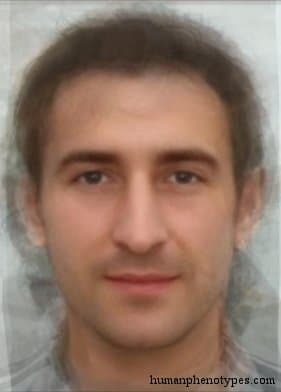
Faces from the encyclopedia that appear in this article. Open any entry for its full description, distribution, and references.
Baskid
Central Europe
Ancient European type associated with the Basques. Found in its purest form in the Pyrénées-Atlantiques region of Southwestern France, altho...
Congolesid
Sub-Saharan Africa
Widespread type of the Congo forest basin, common from Gabon to DR Congo, Central African Republic, Angola, and Zambia. Typical for Western ...
Fijid
Melanesia
Polynesid-Melanesid contact type. The dominant type in the population of the Fiji Islands. Both elements have probably mixed in the zone for...
Hallstatt
Northern Europe
Nordid proper, resembles the Iron Age remains of the Austrian village of Hallstatt. Most common among Swedes and South Norwegians. Frequent ...
Test what you learned
Put your eye for regional faces to work in the daily quiz — a composite face, a world map, and your best guess.