Congolesid Phenotype - Face Features & Origin
Historical anthropology places the Congolesid phenotype in Sub-Saharan Africa, with a documented center near 0.5° S, 18.0° E. Widespread type of the Congo forest basin, common from Gabon to DR Congo, Central African Republic, Angola, and Zambia. The sections that follow unpack the Congolesid entry in practice: the composite face, the traits it summarizes, the naming history, and the sources.
Average Face
Averaging the portraits behind Congolesid leaves the features that repeat and erases the ones that do not. That is exactly how the Congolesid composite below was built: individual photographs were aligned and statistically merged, exaggerating shared structure into a single reference face that no actual person looks like.
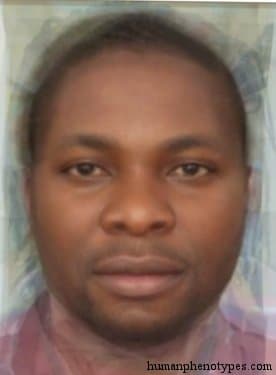
Composite source: Human Phenotypes — Congolesid
Geographic Distribution
The reference center for Congolesid sits near 0.5° S, 18.0° E in Sub-Saharan Africa. Around that anchor, prevalence falls off gradually — the type is not confined to one valley or one modern border, and the historical map should be read as a gradient rather than a boundary.
Physical Characteristics
Dark brown, sometimes light brown skin.
- Kinky, rarely peppercorn hair
- Rather short, mesoskelic with an endomorph to mesomorph body
- Meso- sometimes brachycephalic, orthocranic
- Large, angular face with prominent cheekbones
- (Hyper-)platyrrhine funnel-shaped nose with an extremely depressed root
- Lips thinner than in Sudanids, body hair stronger
- Occiput flat
- Prognathous with a receding chin
Historical Background
Widespread type of the Congo forest basin, common from Gabon to DR Congo, Central African Republic, Angola, and Zambia. Typical for Western and Northern Bantu speakers, e.g. Lingala, Tshiluba, Bapoto, Boa, Ngumba, Ba Soko, Mpongwe, Barotse, and related people, more mixed in Chokwe, Kordofanians, Zande, Kongo, etc.
Research History & Naming
Every label in the historical catalogue has an author and a date, and Congolesid has accumulated its share of competing attributions. For Congolesid, the literature extract below shows the naming chain — from the first definition through the later revisions that shaped the current entry.
Defined as a Paleo Negrid subtype by Eickstedt (1934) or Congolaise by Pales (1953) , Chabeuf (1958) , Vallois (1971) and others. Baker (1981) called it "Palänegrid 1", Biasutti (1967) regarded it as the most typical variety of his race Silvestre, Lundman (1967) of Hylänegrid.
Comparison With Nearby Phenotypes
Geography, not alphabet, ordered this table: the five phenotype centers closest to Congolesid's, with the traits most likely to be mistaken for it (Twa-Cwa leads at 182 km). In gameplay, these five account for most of the wrong-but-nearby pins against Congolesid.
| Phenotype | Region | Distance | Distinguishing trait |
|---|---|---|---|
| Twa-Cwa | Sub-Saharan Africa | 182 km | Usually dark brown, sometimes light brown skin with peppercorn hair. |
| Equatorial Sudanid | West Africa | 655 km | Dark brown, sometimes black skin, kinky hair. |
| West Bambutid | West Africa | 783 km | Medium to dark, sometimes light (yellowish) brown skin with (reddish) brown-black peppercorn hair. |
| West Congolesid | West Africa | 851 km | Dark brown, sometimes black skin, kinky hair. |
| Mundu Mangbeto | Sub-Saharan Africa | 1,130 km | Dark, sometimes medium reddish-brown skin, kinky hair. |
Congolesid in the Game
In gameplay terms, Congolesid rewards region-level recall: the score is computed from the distance between your pin and 0.5° S, 18.0° E. Players often confuse Congolesid with Twa-Cwa (182 km out) in the comparison table above — those confusions are exactly what the distance penalty is designed to expose.
Congolesid Phenotype FAQ
- Where does the Congolesid phenotype come from?
- Historical sources center the Congolesid phenotype on 0.5° S, 18.0° E (Sub-Saharan Africa). Treat that as a rough anchor: the type appeared across a wider surrounding area — its nearest documented neighbors, Twa-Cwa and Equatorial Sudanid, sit 182 and 655 km from the reference point — and its present-day distribution no longer matches the historical map.
- What does the Congolesid phenotype look like?
- The composite emphasizes recurring traits: dark brown, sometimes light brown skin. The full trait list for Congolesid appears in the physical characteristics section above.
- Is the Congolesid phenotype a race or a nationality?
- No — and the Congolesid naming history above shows why. Congolesid was defined, renamed, and regrouped repeatedly by different researchers, which is the opposite of how a fixed racial category would behave. A phenotype is a recurring bundle of visible traits recorded across a population; the Congolesid label says nothing about where any individual's ancestors were born.
- How does Congolesid appear in the game?
- When the Congolesid face comes up in Classic Daily or Challenge Mode, you pin the world map where you believe the type is historically most common, and the score decays with your distance to 0.5° S, 18.0° E. Fair warning: the nearest other entry in our dataset, Twa-Cwa, sits just 182 km away, so this face rewards precise placement — the right country alone is not always enough.
References & Literature
Primary sources for the Congolesid entry, listed as cited in the historical literature. The naming and classification debates around Congolesid referenced above run through these works.
- Eickstedt, E. von. 1934. Rassenkunde und Rassengeschichte der Menschheit. Ferdinand Enke. Stuttgart.
- Pales, L. and T. de St-Péreuse. 1953. Raciologie comparative des populations de l'Afrique occidentale.Bull. et Mém. de la Société d'anthropologie de Paris X. 185-497.
- C58
- Vallois, H. V. 1971. Las races humaines. 8 Ed. Grammont.
- Baker, J.R.. 1981. Race. Oxford Univ. Press. London.
- Biasutti, R. 1967 (1941). Le Razze e i Popoli della terra. 4th Ed. Vol 1-4. U.T.E.T., Torino.
- Lundman, B. 1967. Geographische Anthropologie. Rassen und Völker der Erde. G. Fischer, Stuttgart
Related Phenotypes
Other human phenotypes whose documented centers lie in the same part of the map as Congolesid.
Twa-Cwa
Sub-Saharan Africa · 182 km away
Pygmoid type of the Congo forests intermediate between Bambutid and Congolesid. Important groups in DR Congo are Mongo Cwa close to the Mai-...
Equatorial Sudanid
West Africa · 655 km away
Central African variety with Sudanid and Congolid elements, living in the Savanna regions of East Cameroon, Central African Republic, South ...
West Bambutid
West Africa · 783 km away
Type of the West African Pygmies, that split from East Bambutid during the late Paleolithic. Shows a strong rainforest adaption. Historicall...
West Congolesid
West Africa · 851 km away
African forest type, intermediate between Congolesid, Guinesid, and Sudanid, but with a variety of unique features. Common in Southern Camer...
Mundu Mangbeto
Sub-Saharan Africa · 1,130 km away
Intermediate type of the Northeastern Congo forest. Unique in connecting elements of the tallest (Nilo-Hamitic) and shortest (Bambutid) phen...
Further Reading
Background articles from the blog that explain where the Congolesid type fits, how these composites are built, and what a face can and cannot tell you.
Race Guesser: Why the Word Does Not Fit a Face Quiz
The phrase is a search term before it is a tool. Here is where the word race came from as a sorting device, why a century of measuring...
AI Ethnicity Test: What a Measurement Would Require
A laboratory test has a reference standard, a defined construct and a published error bar. A face-based ethnicity tool owns none of...