East Bambutid Phenotype - Face Features & Origin
Bambutid proper: shortest pygmy type in the world with an extreme rainforest adaption that has evolved since the Middle Paleolithic. The entry below collects the East Bambutid composite face, its documented distribution around 2.1° N, 29.1° E in Sub-Saharan Africa, its physical characteristics, the research history behind the name, and the academic references that support all of it.
Average Face
The East Bambutid composite below is not a photograph of a real person. Historical anthropologists aligned multiple individual portraits from the East Bambutid reference population and averaged them into one image, so recurring structures — skull outline, nose form, lip thickness, brow position — dominate while individual idiosyncrasies cancel out.
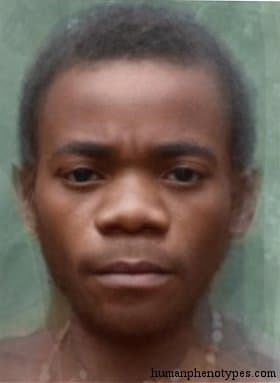
Composite source: Human Phenotypes — East Bambutid
Geographic Distribution
East Bambutid is documented across Sub-Saharan Africa, with its historical reference center near 2.1° N, 29.1° E. The coordinates mark where the type was most characteristic roughly 1500 years ago; population movements since then have scattered and blended the distribution far beyond that point.
Physical Characteristics
Dark, sometimes medium (reddish) brown skin.
- Brown-black, rarely blonde peppercorn hair
- Very short (males 140-145 cm), (hyper-) macroskelic, mesomorph, infantile
- Mesocephalic, orthocranic
- Hyperplatyrrhine
- Face round, prognathy weak, receding chin, upper lip convex, lips rather thin
- Relatively hairy body
- Weak steatopygia
Historical Background
Bambutid proper: shortest pygmy type in the world with an extreme rainforest adaption that has evolved since the Middle Paleolithic. Historically more widespread, still found in the Ituri forest of DR Congo, among Mbuti, Asua, Kango, and Efe. Loss of culture and forest destruction could make this unique type vanish forever soon.
Research History & Naming
Every label in the historical catalogue has an author and a date, and East Bambutid has accumulated its share of competing attributions. For East Bambutid, the literature extract below shows the naming chain — from the first definition through the later revisions that shaped the current entry.
Detailed investigations were made by Schweinfurth (1878) , Schebesta (1952) , Froment (1993) and Gusinde (1956) , the latter measured more than 900 individuals and classified it as Twid. Eickstedt (1934) coined the term Bambutid, this was kept later ( Lundman, 1967 ; Baker, 1981 ; Knussmann, 1996 ). Biasutti (1967) separated the BaMbuti and the BaBinga group like Cole (1965) , who called it the East Negrillo type. Split occurred some 20k years ago ( Patin, 2009 ).
Comparison With Nearby Phenotypes
The five phenotypes whose documented centers lie closest to East Bambutid, ranked by great-circle distance. They are the types players most often confuse with East Bambutid in the quiz, precisely because their distributions overlap.
| Phenotype | Region | Distance | Distinguishing trait |
|---|---|---|---|
| Mundu Mangbeto | Sub-Saharan Africa | 176 km | Dark, sometimes medium reddish-brown skin, kinky hair. |
| South Ethiopid | East Africa | 468 km | Dark brown, sometimes medium brown skin, tight-curly or kinky hair. |
| South Nilotid | East Africa | 566 km | Black skin and kinky hair. |
| Nilo Hamitic | East Africa | 645 km | Dark brown to black skin, usually kinky, sometimes tight-curly hair. |
| Dinkaid | East Africa | 669 km | Black skin and kinky hair. |
East Bambutid in the Game
East Bambutid is one of the faces that can appear in Classic Daily and Challenge Mode. When it does, the winning pin lands near 2.1° N, 29.1° E in Sub-Saharan Africa — and because the scoring decays with distance, recognizing the region matters more than pixel-perfect placement.
East Bambutid Phenotype FAQ
- Where does the East Bambutid phenotype come from?
- The reference coordinates for the East Bambutid phenotype sit near 2.1° N, 29.1° E, in Sub-Saharan Africa. That point marks the center of the Sub-Saharan Africa distribution documented roughly 1500 years ago — actual prevalence spread well beyond it, toward entries such as Mundu Mangbeto 176 km away, and modern migration has blurred those boundaries further.
- What does the East Bambutid phenotype look like?
- In the historical literature, dark, sometimes medium (reddish) brown skin. For East Bambutid these are statistical tendencies across a population, not a checklist every individual matches.
- Is the East Bambutid phenotype a race or a nationality?
- No — and the East Bambutid naming history above shows why. East Bambutid was defined, renamed, and regrouped repeatedly by different researchers, which is the opposite of how a fixed racial category would behave. A phenotype is a recurring bundle of visible traits recorded across a population; the East Bambutid label says nothing about where any individual's ancestors were born.
- How does East Bambutid appear in the game?
- In Classic Daily and Challenge Mode, the East Bambutid composite face appears without a label. Your task is to drop a pin on the world map where you think that face is historically most common — the scoring uses the distance between your pin and the reference coordinates near 2.1° N, 29.1° E. The post-round review then shows the correct location, your distance error, and this East Bambutid entry.
References & Literature
Primary sources for the East Bambutid entry, listed as cited in the historical literature. The naming and classification debates around East Bambutid referenced above run through these works.
- Schweinfurth, G. 1878. Im Herzen von Afrika. Leipzig.
- Schebesta, P. 1952. Die Pygmäenvölker der Erde. Wissenschaftliche Ergebnisse der Forschungen Paul Schebestas unter den Pygmäen Afrikas und Asiens. 3 Bd. Wien.
- Froment, A. 1993. Adaptation biologique et variation dans l'espèce humaine : le cas des Pygmées d'Afrique. Bull. et Mémo. de la Soc. d'anthropologie de Paris, 5 (3-4), 417-448.
- Gusinde, M. 1956. Die Twiden. Pygmäen und Pygmoide im tropischen Afrika. Museum Völkerkunde, Wien.
- Eickstedt, E. von. 1934. Rassenkunde und Rassengeschichte der Menschheit. Ferdinand Enke. Stuttgart.
- Lundman, B. 1967. Geographische Anthropologie. Rassen und Völker der Erde. G. Fischer, Stuttgart
- Baker, J.R.. 1981. Race. Oxford Univ. Press. London.
- Knussmann, R. 1996. Vergleichende Biologie des Menschen: Lehrbuch der Anthropologie und Humangenetik. 2ed. Spektrum Akademischer Verlag.
- Biasutti, R. 1967 (1941). Le Razze e i Popoli della terra. 4th Ed. Vol 1-4. U.T.E.T., Torino.
- Cole, S. 1965. Races of Man. Butler & Tanner Ltd. Frome and London.
- Patin et al. 2009. Inferring the Demographic History of African Farmers and Pygmy Hunter-Gatherers. In: Di Rienzo, A. PLoS Genetics 5 (4): e1000448.
Related Phenotypes
More entries from the same region of the historical map as East Bambutid, each with its own composite and trait profile.
Mundu Mangbeto
Sub-Saharan Africa · 176 km away
Intermediate type of the Northeastern Congo forest. Unique in connecting elements of the tallest (Nilo-Hamitic) and shortest (Bambutid) phen...
South Ethiopid
East Africa · 468 km away
The southernmost Ethiopid, common between Lake Victoria and Lake Tanganyika, especially in Rwanda, Burundi, but also Uganda, Tanzania, and E...
South Nilotid
East Africa · 566 km away
Type common to the southern branch of Nilotic people of Lake Albert south to Lake Victoria, in South Sudan, Uganda, and Western Kenya. In so...
Nilo Hamitic
East Africa · 645 km away
Intermediate type between Nilotid and Ethiopid that is associated with the Nilo Hamites or Half Hamites. Similar to Maasai. Should not be co...
Dinkaid
East Africa · 669 km away
Nilotid proper that shows the most pronounced Nilotic features: the tallest, most long-legged and one of the darkest phenotypes in the world...
Further Reading
Background articles from the blog that explain where the East Bambutid type fits, how these composites are built, and what a face can and cannot tell you.
AI Ethnicity Test: What a Measurement Would Require
A laboratory test has a reference standard, a defined construct and a published error bar. A face-based ethnicity tool owns none of...
Geography Games Like GeoGuessr: Six Kinds of Clue
Street panoramas, country outlines and average faces all answer one question. Here are six geography games sorted by the clue they hand...