South Ethiopid Phenotype - Face Features & Origin
The southernmost Ethiopid, common between Lake Victoria and Lake Tanganyika, especially in Rwanda, Burundi, but also Uganda, Tanzania, and Eastern DR Congo. The entry below collects the South Ethiopid composite face, its documented distribution around 2.0° S, 30.0° E in East Africa, its physical characteristics, the research history behind the name, and the academic references that support all of it.
Average Face
The South Ethiopid composite below is not a photograph of a real person. Historical anthropologists aligned multiple individual portraits from the South Ethiopid reference population and averaged them into one image, so recurring structures — skull outline, nose form, lip thickness, brow position — dominate while individual idiosyncrasies cancel out.
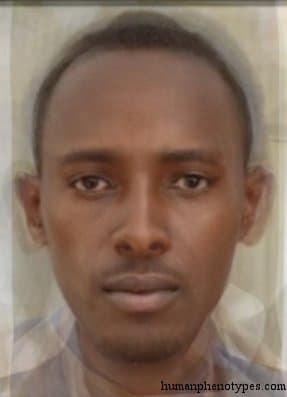
Composite source: Human Phenotypes — South Ethiopid
Geographic Distribution
Geographically, South Ethiopid anchors to 2.0° S, 30.0° E (East Africa). That is the point where historical anthropologists judged South Ethiopid most concentrated, not a hard edge; modern migration and intermarriage have long since softened whatever boundaries once existed.
Physical Characteristics
Dark brown, sometimes medium brown skin, tight-curly or kinky hair.
- (Very) tall, almost reaching Dinkaid standards, ectomorph, hyperbrachyskelic
- Dolichocephalic, orthocranic with mildly leptorrhine or mesorrhine, sometimes convex nose
- Sharp facial features
- Body hair is scant, the lips relatively full
- Mild prognathy possible
Historical Background
The southernmost Ethiopid, common between Lake Victoria and Lake Tanganyika, especially in Rwanda, Burundi, but also Uganda, Tanzania, and Eastern DR Congo. In its purest form in Tutsi. Also common in Hema. Sometimes in various Bantu populations, especially Herero who migrated to Namibia from the Rift Valley some centuries ago, also Zulu, even Khoikhoi. Experienced a dramatic reduction in the 1990s due to the Tutsi genocide.
Research History & Naming
The passage below traces who first defined South Ethiopid, which rival names competed with it, and how later authors consolidated or disputed the classification — the raw material of any serious phenotype reference.
Biasutti (1967) called it Tutsi type, an Ethiopid variety. Originally defined South Ethiopid by Eickstedt ( 1934 , 1943 , 1951 ), who had included Maasai. Also used by Baumann (1952) and Hirschberg (1974) . Baumann's (1975) Fumid that found among Bantu nobles can be integrated. Cole (1965) regarded them an admixed Hamitic type.
Comparison With Nearby Phenotypes
Ranked by great-circle distance from South Ethiopid's reference center, these are the five nearest documented phenotypes — the closest being South Nilotid at 329 km. Overlapping distributions like these are exactly what makes the quiz hard, and the South Nilotid row is where to start looking.
| Phenotype | Region | Distance | Distinguishing trait |
|---|---|---|---|
| South Nilotid | East Africa | 329 km | Black skin and kinky hair. |
| East Bambutid | Sub-Saharan Africa | 468 km | Dark, sometimes medium (reddish) brown skin. |
| Mundu Mangbeto | Sub-Saharan Africa | 593 km | Dark, sometimes medium reddish-brown skin, kinky hair. |
| Hadza | East Africa | 596 km | Dark brown to black skin with kinky hair. |
| Sandawe | East Africa | 789 km | Usually medium brown skin and kinky or peppercorn hair. |
South Ethiopid in the Game
When the South Ethiopid composite shows up in the quiz, players who know the East Africa distribution pattern have the edge. The reference answer sits near 2.0° S, 30.0° E; pins on the wrong continent score close to zero, so even a rough regional instinct beats a precise but misdirected pin.
South Ethiopid Phenotype FAQ
- Where does the South Ethiopid phenotype come from?
- The reference coordinates for the South Ethiopid phenotype sit near 2.0° S, 30.0° E, in East Africa. That point marks the center of the East Africa distribution documented roughly 1500 years ago — actual prevalence spread well beyond it, toward entries such as South Nilotid 329 km away, and modern migration has blurred those boundaries further.
- What does the South Ethiopid phenotype look like?
- In the historical literature, dark brown, sometimes medium brown skin, tight-curly or kinky hair. For South Ethiopid these are statistical tendencies across a population, not a checklist every individual matches.
- Is the South Ethiopid phenotype a race or a nationality?
- No. Phenotypes like South Ethiopid are descriptive averages, not ancestry groups. South Ethiopid is one of several types documented in and around East Africa — see the comparison table above — and the same individual can carry traits associated with several of them at once. The South Ethiopid entry describes a statistical pattern, not a group of people and not a nationality.
- How does South Ethiopid appear in the game?
- In Classic Daily and Challenge Mode, the South Ethiopid composite face appears without a label. Your task is to drop a pin on the world map where you think that face is historically most common — the scoring uses the distance between your pin and the reference coordinates near 2.0° S, 30.0° E. The post-round review then shows the correct location, your distance error, and this South Ethiopid entry.
References & Literature
The South Ethiopid phenotype entry above is compiled from the 8 academic references. Readers are encouraged to consult the original South Ethiopid sources for verification and deeper context.
- Biasutti, R. 1967 (1941). Le Razze e i Popoli della terra. 4th Ed. Vol 1-4. U.T.E.T., Torino.
- Eickstedt, E. von. 1934. Rassenkunde und Rassengeschichte der Menschheit. Ferdinand Enke. Stuttgart.
- Eickstedt, E. von. 1943. Völkerbiologische Probleme der Sahara. In: Beiträge zur Kolonialforschung. Tagungsband I, 169-240.
- Eickstedt, E. von 1951. Die Träger der Afrikanischen Kulturen. In: Bernatzik, H. Afrika. Handbuch der angewandten Völkerkunde. F. Bruckmann. München.
- Baumann, H.. 1952. Die Rassen Afrikas. In: Historia Mundi. Band 1, Munich, 167-174.
- Hirschberg, W. 1974. Die Kulturen Afrikas. Handbuch der Kulturgeschichte. Kulturen der Völker. Akademisch Verlagsgesellschaft Athenaion. Frankfurt a. M.
- Baumann, H. 1975. Die Völker Afrikas und ihre traditionellen Kulturen. Wiesbaden. 41-134.
- Cole, S. 1965. Races of Man. Butler & Tanner Ltd. Frome and London.
Related Phenotypes
Other human phenotypes whose documented centers lie in the same part of the map as South Ethiopid.
South Nilotid
East Africa · 329 km away
Type common to the southern branch of Nilotic people of Lake Albert south to Lake Victoria, in South Sudan, Uganda, and Western Kenya. In so...
East Bambutid
Sub-Saharan Africa · 468 km away
Bambutid proper: shortest pygmy type in the world with an extreme rainforest adaption that has evolved since the Middle Paleolithic. Histori...
Mundu Mangbeto
Sub-Saharan Africa · 593 km away
Intermediate type of the Northeastern Congo forest. Unique in connecting elements of the tallest (Nilo-Hamitic) and shortest (Bambutid) phen...
Hadza
East Africa · 596 km away
Ancient type of the Tanzanian Bushmen, living close to Lake Eyasi. Very distinct from any other type in the world and has probably long been...
Sandawe
East Africa · 789 km away
Distinctive East African type of the Tanzanian savannahs, especially the Dodoma region. A relict of Khoisanid populations that were more wid...
Further Reading
Background articles from the blog that explain where the South Ethiopid type fits, how these composites are built, and what a face can and cannot tell you.
Guess My Ethnicity: What One Guess Can Carry
When someone types guess my ethnicity, they are asking a stranger to place a bet, and the odds depend far more on the list of labels...
What Country Do I Look Like: The Count Comes Before the Face
Which country a face resembles depends on which official list you are using, and the world publishes several that disagree on how many...