Hadza Phenotype - Face Features & Origin
Historical anthropology places the Hadza phenotype in East Africa, with a documented center near 3.6° S, 35.1° E. Ancient type of the Tanzanian Bushmen, living close to Lake Eyasi. The sections that follow unpack the Hadza entry in practice: the composite face, the traits it summarizes, the naming history, and the sources.
Average Face
Averaging the portraits behind Hadza leaves the features that repeat and erases the ones that do not. That is exactly how the Hadza composite below was built: individual photographs were aligned and statistically merged, exaggerating shared structure into a single reference face that no actual person looks like.
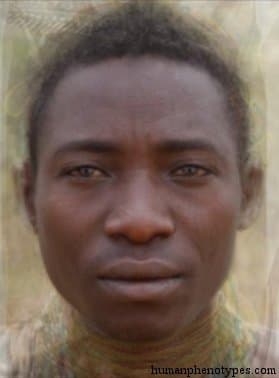
Composite source: Human Phenotypes — Hadza
Geographic Distribution
Geographically, Hadza anchors to 3.6° S, 35.1° E (East Africa). That is the point where historical anthropologists judged Hadza most concentrated, not a hard edge; modern migration and intermarriage have long since softened whatever boundaries once existed.
Physical Characteristics
Dark brown to black skin with kinky hair.
- (Rather) short, ectomorph to mesomorph, meso- brachyskelic
- In a few cases steatopygic, especially men
- Dolichocephalic, broad-faced, small-headed with a mildly platyrrhine button nose and big lips
- Prognathous
- Body hair weak
Historical Background
Ancient type of the Tanzanian Bushmen, living close to Lake Eyasi. Very distinct from any other type in the world and has probably long been isolated. Distant relationships exist to Khoisanids. Basically restricted to the Hadza people, who number no more than 800. Loss of culture might cause this unique type to vanish forever soon.
Research History & Naming
The passage below traces who first defined Hadza, which rival names competed with it, and how later authors consolidated or disputed the classification — the raw material of any serious phenotype reference.
Early descriptions by Obst (1912) and Bleek (1931) , who put them close to Hottentots. Cole (1965) emphasised differences to Khoisan. Modern studies confirm them to be a distinct genetic outlier ( Tishkoff et al., 2009 ; Schlebusch et al., 2012 ). Detailed anthropometric studies by Hiernaux and Boedhi Hartono (1980) .
Comparison With Nearby Phenotypes
Geography, not alphabet, ordered this table: the five phenotype centers closest to Hadza's, with the traits most likely to be mistaken for it (Sandawe leads at 296 km). In gameplay, these five account for most of the wrong-but-nearby pins against Hadza.
| Phenotype | Region | Distance | Distinguishing trait |
|---|---|---|---|
| Sandawe | East Africa | 296 km | Usually medium brown skin and kinky or peppercorn hair. |
| South Nilotid | East Africa | 360 km | Black skin and kinky hair. |
| North Bantuid | Sub-Saharan Africa | 506 km | Dark brown skin, usually kinky, sometimes peppercorn hair. |
| South Ethiopid | East Africa | 596 km | Dark brown, sometimes medium brown skin, tight-curly or kinky hair. |
| Maasai | East Africa | 798 km | Dark brown skin, kinky or tight-curly hair. |
Hadza in the Game
In gameplay terms, Hadza rewards region-level recall: the score is computed from the distance between your pin and 3.6° S, 35.1° E. Players often confuse Hadza with Sandawe (296 km out) in the comparison table above — those confusions are exactly what the distance penalty is designed to expose.
Hadza Phenotype FAQ
- Where does the Hadza phenotype come from?
- The reference coordinates for the Hadza phenotype sit near 3.6° S, 35.1° E, in East Africa. That point marks the center of the East Africa distribution documented roughly 1500 years ago — actual prevalence spread well beyond it, toward entries such as Sandawe 296 km away, and modern migration has blurred those boundaries further.
- What does the Hadza phenotype look like?
- In the historical literature, dark brown to black skin with kinky hair. For Hadza these are statistical tendencies across a population, not a checklist every individual matches.
- Is the Hadza phenotype a race or a nationality?
- No. A phenotype is a recurring bundle of visible traits documented by historical anthropologists across a population — for Hadza, patterns such as dark brown to black skin with kinky hair. The Hadza entry is not a genetic ancestry, not a nationality, and not a statement about any individual person. Two people from the same country can match completely different phenotypes — one resembling Hadza, another closer to Sandawe — and one phenotype can span many modern borders.
- How does Hadza appear in the game?
- In Classic Daily and Challenge Mode, the Hadza composite face appears without a label. Your task is to drop a pin on the world map where you think that face is historically most common — the scoring uses the distance between your pin and the reference coordinates near 3.6° S, 35.1° E. The post-round review then shows the correct location, your distance error, and this Hadza entry.
References & Literature
The Hadza phenotype entry above is compiled from the 6 academic references. Readers are encouraged to consult the original Hadza sources for verification and deeper context.
- Obst, E. 1912. Von Mkalama ins Land der Wakindiga. Mttgn. d. Geogr. Ges. Hamburg.
- Bleek, D.F. 1931. The Hadzapi or Watindega of Tanganyilla Territory, Africa, IV.
- Cole, S. 1965. Races of Man. Butler & Tanner Ltd. Frome and London.
- Tishkoff et al. 2009. The genetic structure and history of Africans and African Americans. Science. 324,1035-1044.
- S12
- Hiernaux, J. and D. Boedhi Hartono. 1980. Physical measurements of the adult Hadza of Tanzania. Annals of Human Biology 7, 339-346.
Related Phenotypes
Other human phenotypes whose documented centers lie in the same part of the map as Hadza.
Sandawe
East Africa · 296 km away
Distinctive East African type of the Tanzanian savannahs, especially the Dodoma region. A relict of Khoisanid populations that were more wid...
South Nilotid
East Africa · 360 km away
Type common to the southern branch of Nilotic people of Lake Albert south to Lake Victoria, in South Sudan, Uganda, and Western Kenya. In so...
North Bantuid
Sub-Saharan Africa · 506 km away
Widespread Bantuid variety of East Africa with relatively narrow noses, possibly due to Ethiopid influence. Found from South Somalia to Keny...
South Ethiopid
East Africa · 596 km away
The southernmost Ethiopid, common between Lake Victoria and Lake Tanganyika, especially in Rwanda, Burundi, but also Uganda, Tanzania, and E...
Maasai
East Africa · 798 km away
Ancient South Ethiopid subtype, influenced by Nilo Hamitic and possibly Sandawe. Has probably been isolated in a remote region west of Lake ...
Further Reading
Background articles from the blog that explain where the Hadza type fits, how these composites are built, and what a face can and cannot tell you.
What Ethnicity Am I? Three Ways to Actually Answer It
The question is personal, but the answers arrive from three different places: records, DNA, and appearance. Each can tell you something...
Guess Ethnicity From a Photo: What Gets Measured First
Before a face model names anything, it measures. Here is the geometry stage: the landmark schemes tools rely on, the photo standards...