North Bantuid Phenotype - Face Features & Origin
Historical anthropology places the North Bantuid phenotype in Sub-Saharan Africa, with a documented center near 0.3° N, 37.5° E. Widespread Bantuid variety of East Africa with relatively narrow noses, possibly due to Ethiopid influence. The sections that follow unpack the North Bantuid entry in practice: the composite face, the traits it summarizes, the naming history, and the sources.
Average Face
Averaging the portraits behind North Bantuid leaves the features that repeat and erases the ones that do not. That is exactly how the North Bantuid composite below was built: individual photographs were aligned and statistically merged, exaggerating shared structure into a single reference face that no actual person looks like.
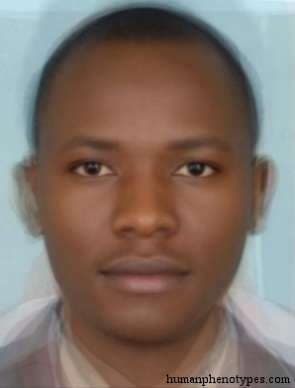
Composite source: Human Phenotypes — North Bantuid
Geographic Distribution
Geographically, North Bantuid anchors to 0.3° N, 37.5° E (Sub-Saharan Africa). That is the point where historical anthropologists judged North Bantuid most concentrated, not a hard edge; modern migration and intermarriage have long since softened whatever boundaries once existed.
Physical Characteristics
Dark brown skin, usually kinky, sometimes peppercorn hair.
- Medium tall, brachyskelic, mesomorph
- Dolicho- mesocephalic, chamae- orthocranic
- Rather wide face
- Meso- platyrrhine nose, narrower than in other Bantuids
- Mouth large, lips rather full
- Eyes often narrow
- Prognathy and receding chin occasionally found
Historical Background
Widespread Bantuid variety of East Africa with relatively narrow noses, possibly due to Ethiopid influence. Found from South Somalia to Kenya, Tanzania, Uganda, Zambia, Zimbabwe, especially in Ganda, Hutu, Nyoro, Hehe, Gogo, Chaga, Sukuma, Nyamwezi, Swahili, mixed in Hemba, Kikuyu, Kamba, and others. As early as 1000 years ago slavery brought it to Arabia and Iran, from 1500 CE on it expanded south to Namibia and gave rise to Herero and others.
Research History & Naming
The passage below traces who first defined North Bantuid, which rival names competed with it, and how later authors consolidated or disputed the classification — the raw material of any serious phenotype reference.
The North Bantuid variety was defined by Eickstedt (1934) and kept later as North Kafrid ( Eickstedt, 1951 ; Schwidetzky, 1965 ; Hirschberg, 1974 ) or alternatively East Bantuid ( Vogel, 1974 ). Usually part of Kaf(f)rid ( Baumann, 1952 ; Lundman, 1967 ; Baker, 1981 ) or Zambesid / South Africanid ( Chabeuf, 1959 ; Vallois, 1971 ).
Comparison With Nearby Phenotypes
Geography, not alphabet, ordered this table: the five phenotype centers closest to North Bantuid's, with the traits most likely to be mistaken for it (Maasai leads at 395 km). In gameplay, these five account for most of the wrong-but-nearby pins against North Bantuid.
| Phenotype | Region | Distance | Distinguishing trait |
|---|---|---|---|
| Maasai | East Africa | 395 km | Dark brown skin, kinky or tight-curly hair. |
| Hadza | East Africa | 506 km | Dark brown to black skin with kinky hair. |
| South Nilotid | East Africa | 545 km | Black skin and kinky hair. |
| Omotic | East Africa | 621 km | Dark brown skin and kinky-curly hair. |
| Sandawe | East Africa | 745 km | Usually medium brown skin and kinky or peppercorn hair. |
North Bantuid in the Game
In gameplay terms, North Bantuid rewards region-level recall: the score is computed from the distance between your pin and 0.3° N, 37.5° E. Players often confuse North Bantuid with Maasai (395 km out) in the comparison table above — those confusions are exactly what the distance penalty is designed to expose.
North Bantuid Phenotype FAQ
- Where does the North Bantuid phenotype come from?
- Historical sources center the North Bantuid phenotype on 0.3° N, 37.5° E (Sub-Saharan Africa). Treat that as a rough anchor: the type appeared across a wider surrounding area — its nearest documented neighbors, Maasai and Hadza, sit 395 and 506 km from the reference point — and its present-day distribution no longer matches the historical map.
- What does the North Bantuid phenotype look like?
- The composite emphasizes recurring traits: dark brown skin, usually kinky, sometimes peppercorn hair. The full trait list for North Bantuid appears in the physical characteristics section above.
- Is the North Bantuid phenotype a race or a nationality?
- No. A phenotype is a recurring bundle of visible traits documented by historical anthropologists across a population — for North Bantuid, patterns such as dark brown skin, usually kinky, sometimes peppercorn hair. The North Bantuid entry is not a genetic ancestry, not a nationality, and not a statement about any individual person. Two people from the same country can match completely different phenotypes — one resembling North Bantuid, another closer to Maasai — and one phenotype can span many modern borders.
- How does North Bantuid appear in the game?
- When the North Bantuid face comes up in Classic Daily or Challenge Mode, you pin the world map where you believe the type is historically most common, and the score decays with your distance to 0.3° N, 37.5° E. Fair warning: the nearest other entry in our dataset, Maasai, sits just 395 km away, so this face rewards precise placement — the right country alone is not always enough.
References & Literature
The North Bantuid phenotype entry above is compiled from the 10 academic references. Readers are encouraged to consult the original North Bantuid sources for verification and deeper context.
- Eickstedt, E. von. 1934. Rassenkunde und Rassengeschichte der Menschheit. Ferdinand Enke. Stuttgart.
- Eickstedt, E. von 1951. Die Träger der Afrikanischen Kulturen. In: Bernatzik, H. Afrika. Handbuch der angewandten Völkerkunde. F. Bruckmann. München.
- Schwidetzky, I. 1965. Variations- und Typenkunde des Menschen. In: Lundwig, B. and H. Plank. Handbuch der Biologie. Vol 9 (2).
- Hirschberg, W. 1974. Die Kulturen Afrikas. Handbuch der Kulturgeschichte. Kulturen der Völker. Akademisch Verlagsgesellschaft Athenaion. Frankfurt a. M.
- Virchow, R. 1874. Die physische Anthropologie der Finnen. Verh. Berliner Ges. Anthr. Ethnol. Urg. VI. 185-189.
- Baumann, H.. 1952. Die Rassen Afrikas. In: Historia Mundi. Band 1, Munich, 167-174.
- Lundman, B. 1967. Geographische Anthropologie. Rassen und Völker der Erde. G. Fischer, Stuttgart
- Baker, J.R.. 1981. Race. Oxford Univ. Press. London.
- Chabeuf, M. 1959. Anthropologie physique du Moyen-Congo et du Gabon méridional. Bull- et Mém- de la Société d'anthr- de Paris. 10, 2, 97-185.
- Vallois, H. V. 1971. Las races humaines. 8 Ed. Grammont.
Related Phenotypes
More entries from the same region of the historical map as North Bantuid, each with its own composite and trait profile.
Maasai
East Africa · 395 km away
Ancient South Ethiopid subtype, influenced by Nilo Hamitic and possibly Sandawe. Has probably been isolated in a remote region west of Lake ...
Hadza
East Africa · 506 km away
Ancient type of the Tanzanian Bushmen, living close to Lake Eyasi. Very distinct from any other type in the world and has probably long been...
South Nilotid
East Africa · 545 km away
Type common to the southern branch of Nilotic people of Lake Albert south to Lake Victoria, in South Sudan, Uganda, and Western Kenya. In so...
Omotic
East Africa · 621 km away
Isolated type of Southwestern Ethiopia and Northern Kenya, probably belonging to a group of ancient Ethiopids. Probably a relict of Pre-Neol...
Sandawe
East Africa · 745 km away
Distinctive East African type of the Tanzanian savannahs, especially the Dodoma region. A relict of Khoisanid populations that were more wid...
Further Reading
Background articles from the blog that explain where the North Bantuid type fits, how these composites are built, and what a face can and cannot tell you.
AI Ethnicity Test: What a Measurement Would Require
A laboratory test has a reference standard, a defined construct and a published error bar. A face-based ethnicity tool owns none of...
Geography Games Like GeoGuessr: Six Kinds of Clue
Street panoramas, country outlines and average faces all answer one question. Here are six geography games sorted by the clue they hand...