Maasai Phenotype - Face Features & Origin
Ancient South Ethiopid subtype, influenced by Nilo Hamitic and possibly Sandawe. Its reference coordinates sit near 3.5° N, 36.1° E in East Africa. Rather than a single portrait, the Maasai composite below is a statistical average, and the surrounding sections — traits, distribution, research history, references — give that average its context.
Average Face
What you see below is a statistical construction of the Maasai reference population. Faces recorded from the Maasai sample were overlaid and merged; the result keeps the features most members shared and discards personal variation. It reads like a Maasai portrait, but it works like a histogram.
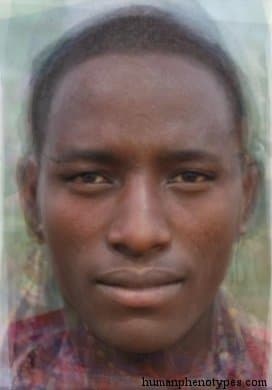
Composite source: Human Phenotypes — Maasai
Geographic Distribution
Geographically, Maasai anchors to 3.5° N, 36.1° E (East Africa). That is the point where historical anthropologists judged Maasai most concentrated, not a hard edge; modern migration and intermarriage have long since softened whatever boundaries once existed.
Physical Characteristics
Dark brown skin, kinky or tight-curly hair.
- Tall, hyperbrachyskelic, ectomorph
- Dolichocephalic, chamae- orthocranic
- Long, mildly leptorrhine noses that may be straight or convex
- Body hair is scant, the lips relatively full
- The eyes are narrow and may sometimes appear pseudo-Mongoloid
- Mild prognathy possible
Historical Background
Ancient South Ethiopid subtype, influenced by Nilo Hamitic and possibly Sandawe. Has probably been isolated in a remote region west of Lake Turkana some centuries ago. Only from the 15th century on they started to migrate south deep into Kenya and Tanzania, where they are found today. Typical for Maasai people, sometimes in related tribes, e.g. Samburu, Dorobo, Okiek, and Lotuko.
Research History & Naming
Typological names were coined, contested, and renamed repeatedly across the 20th century, and Maasai is no exception. The extract below records the researchers who defined Maasai, the alternative labels it accumulated, and where the modern consensus settled.
Biasutti (1967) defined the Maasai as an Ethiopid subtype. Lundman (1967) as a very ancient, stabilised Europid-Nilotid blend. Often included in South Ethiopid (Eickstedt, 1943 , 1951 ; Knussmann, 1996 ) or Nilo Hamitic ( Cole, 1965 ) or regarded a mix of the two ( Baker, 1981 ).
Comparison With Nearby Phenotypes
The five phenotypes whose documented centers lie closest to Maasai, ranked by great-circle distance. They are the types players most often confuse with Maasai in the quiz, precisely because their distributions overlap.
| Phenotype | Region | Distance | Distinguishing trait |
|---|---|---|---|
| Omotic | East Africa | 257 km | Dark brown skin and kinky-curly hair. |
| North Bantuid | Sub-Saharan Africa | 395 km | Dark brown skin, usually kinky, sometimes peppercorn hair. |
| South Nilotid | East Africa | 641 km | Black skin and kinky hair. |
| Shillukid | East Africa | 697 km | Black skin, usually kinky, sometimes tight-curly hair. |
| Dinkaid | East Africa | 777 km | Black skin and kinky hair. |
Maasai in the Game
Maasai is one of the faces that can appear in Classic Daily and Challenge Mode. When it does, the winning pin lands near 3.5° N, 36.1° E in East Africa — and because the scoring decays with distance, recognizing the region matters more than pixel-perfect placement.
Maasai Phenotype FAQ
- Where does the Maasai phenotype come from?
- The reference coordinates for the Maasai phenotype sit near 3.5° N, 36.1° E, in East Africa. That point marks the center of the East Africa distribution documented roughly 1500 years ago — actual prevalence spread well beyond it, toward entries such as Omotic 257 km away, and modern migration has blurred those boundaries further.
- What does the Maasai phenotype look like?
- In the historical literature, dark brown skin, kinky or tight-curly hair. For Maasai these are statistical tendencies across a population, not a checklist every individual matches.
- Is the Maasai phenotype a race or a nationality?
- No. Phenotypes like Maasai are descriptive averages, not ancestry groups. Maasai is one of several types documented in and around East Africa — see the comparison table above — and the same individual can carry traits associated with several of them at once. The Maasai entry describes a statistical pattern, not a group of people and not a nationality.
- How does Maasai appear in the game?
- In Classic Daily and Challenge Mode, the Maasai composite face appears without a label. Your task is to drop a pin on the world map where you think that face is historically most common — the scoring uses the distance between your pin and the reference coordinates near 3.5° N, 36.1° E. The post-round review then shows the correct location, your distance error, and this Maasai entry.
References & Literature
Every claim on this page traces back to the sources below — the researchers who defined, measured, and argued over the Maasai type. The originals behind the Maasai entry are worth consulting directly.
- Biasutti, R. 1967 (1941). Le Razze e i Popoli della terra. 4th Ed. Vol 1-4. U.T.E.T., Torino.
- Lundman, B. 1967. Geographische Anthropologie. Rassen und Völker der Erde. G. Fischer, Stuttgart
- Eickstedt, E. von. 1943. Völkerbiologische Probleme der Sahara. In: Beiträge zur Kolonialforschung. Tagungsband I, 169-240.
- Eickstedt, E. von 1951. Die Träger der Afrikanischen Kulturen. In: Bernatzik, H. Afrika. Handbuch der angewandten Völkerkunde. F. Bruckmann. München.
- Knussmann, R. 1996. Vergleichende Biologie des Menschen: Lehrbuch der Anthropologie und Humangenetik. 2ed. Spektrum Akademischer Verlag.
- Cole, S. 1965. Races of Man. Butler & Tanner Ltd. Frome and London.
- Baker, J.R.. 1981. Race. Oxford Univ. Press. London.
Related Phenotypes
If Maasai interested you, these neighboring phenotype entries cover adjacent parts of the map with distinctly different trait bundles.
Omotic
East Africa · 257 km away
Isolated type of Southwestern Ethiopia and Northern Kenya, probably belonging to a group of ancient Ethiopids. Probably a relict of Pre-Neol...
North Bantuid
Sub-Saharan Africa · 395 km away
Widespread Bantuid variety of East Africa with relatively narrow noses, possibly due to Ethiopid influence. Found from South Somalia to Keny...
South Nilotid
East Africa · 641 km away
Type common to the southern branch of Nilotic people of Lake Albert south to Lake Victoria, in South Sudan, Uganda, and Western Kenya. In so...
Shillukid
East Africa · 697 km away
Nilotid variety similar to Dinkaid, but with slightly modified features. Typically found in the savannahs of the Upper Nile of South Sudan. ...
Dinkaid
East Africa · 777 km away
Nilotid proper that shows the most pronounced Nilotic features: the tallest, most long-legged and one of the darkest phenotypes in the world...
Further Reading
Background articles from the blog that explain where the Maasai type fits, how these composites are built, and what a face can and cannot tell you.
Ethnoguessr: The Spelling, the Sites, and the Game
Ethnoguessr is a compressed spelling of "ethnicity guesser", and more than one site answers to it. Here is how to tell what you are...
AI Phenotype Scanner: What a Scanner Cannot Do for a Face
The phrase names a face classifier, not a device that reads a stored record. What the scanner metaphor hides, what the 209-entry...