Ethnoguessr: The Spelling, the Sites, and the Game
Ethnoguessr is a compressed spelling of "ethnicity guesser", and more than one site answers to it. Here is how to tell what you are looking at, how a daily round is assembled, and what a score can honestly mean.
The missing vowel does real work
The name is a compression rather than a coinage. Trim "ethnicity" to its first five letters, weld on the "-guessr" ending borrowed from the geography game it imitates, and you get a ten-letter string that several unrelated projects have since adopted. That matters for one practical reason: this string is what people type into a search box, and a search does not resolve to a single owner. It resolves to whichever page has earned the most relevance for that exact spelling.
So the useful question is not which project is the real one. It is whether the page in front of you will say what it is showing. A round built on composite faces should state that plainly, because a composite is a diagram rather than a photograph of any single person. It should name the reference material behind its answers, and it should explain how a score is produced. A page that returns a number with no visible provenance cannot be reasoned about, whatever its domain name happens to be.
Ten faces and one fixed draw
The daily format is deliberately narrow. Ten faces appear, each paired with five candidate answers, and the draw is deterministic: a date-seeded generator selects the same ten on every run, so all players meet an identical set on the same day. That choice removes the two features that normally make quiz scores incomparable, namely luck of the draw and the chance to farm an easy sequence.
Composite construction is what makes those ten faces legible at all. Portraits are scaled to a common frame, a landmark detector places 68 or 478 reference points on brows, orbits, nostrils and mouth corners, and a thin-plate spline warps each face onto the mean. The arithmetic is older than the software. Francis Galton presented his first composite portraits to the Anthropological Institute in 1878, exposing several sitters onto one plate, and his composites of what he called the Jewish type followed in 1883. The instruments changed; the arithmetic carried over unchanged.
A catalogue of 209 documented patterns
Behind every answer sits a reference catalogue: 209 entries describing appearance patterns recorded in the anthropological literature, plus 48 country-level face averages. An entry gives the region where the pattern was observed, the traits recorded for it, and the neighbouring patterns it grades into. The catalogue is explicit that each entry describes a historical distribution, a map drawn from the literature with a baseline of roughly 1,500 years ago, rather than the appearance of anyone living now.
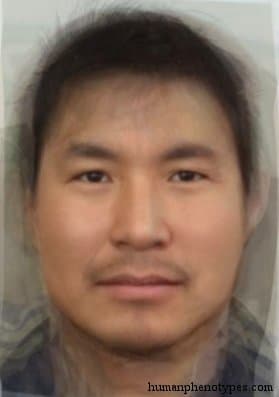
Four entries show the catalogue's range. Inuid covers the tundra and ice coasts from Alaska through Nunavut and Labrador to Greenland, described in the source material as the northernmost pattern in the world, with the North Greenlandic Inughuit as its extreme case, and attributed to a relatively late migration into the Americas. Fijid is catalogued as a contact type formed where Polynesid and Melanesid elements met in the Fiji group over several millennia, and recorded as well in the Solomons, Vanuatu and eastern New Guinea. Maasai is an ancient South Ethiopid subtype that stayed near Lake Turkana before moving south into Kenya and Tanzania from the fifteenth century. Dayakid is the insular Proto Malayid counterpart, the interior-of-Borneo pattern that predates the Deutero Malayid arrival.
Two effects decide most rounds
Own-group advantage comes first. A meta-analysis by Meissner and Brigham, published in 2001, pooled 91 independent samples covering 4,996 participants and found a reliable memory advantage for faces from one's own group, which the authors reported at roughly d = 0.37. The size is modest, and that modest size is precisely why the effect is easy to feel but hard to demonstrate: it shifts the odds without dictating an outcome.
Neighbouring regions sharing traits comes second, because appearance varies clinally instead of in blocks. Livingstone made the argument in 1962 that there are no races, only clines, and Lewontin's 1972 partition, which placed roughly 85 percent of human genetic variation inside populations and about 15 percent between them, points the same way. Adjacent catalogue entries overlap heavily on the features a quiz can display, so the scoring rewards landing near a regional centre rather than naming one specific entry.
What a daily score cannot mean
A finished round produces a number with a narrow, specific meaning: it records how close your answer sat to the catalogue's regional centre. It says nothing about ancestry, and it cannot, because the two are different kinds of object. Ancestry is a genealogical statement about where someone's forebears lived. Appearance is a set of visible traits produced by a modest number of genes plus developmental noise. Nothing about a composite face licenses a claim about a living person's background, and no score counts as evidence about who anyone is.
How loose that link runs can be measured. Serre and Pääbo reported in 2004 that genetic markers place individuals on the correct continent with near-perfect accuracy, while assignment within a continent is far weaker; in their sub-Saharan African sample the success rate sat close to 30 percent. When the markers themselves blur at that scale, a face will not sharpen the picture.
Where the historical map has drifted
The catalogue is candid about its baseline being old, and the centuries since then moved a great many people. The transatlantic trade forced roughly 12.5 million people out of Africa between 1526 and 1867, according to the SlaveVoyages database, with about 10.7 million surviving the crossing. Indenture carried 60,965 registered labourers from India to Fiji between 1879 and 1916. Around 60 million Europeans left the continent between 1820 and 1920. Each of those movements landed inside regions the catalogue describes with earlier populations in mind.
Mixture, meanwhile, is the ordinary condition rather than a complication. A pattern catalogued as a contact type, like Fiji's, was already blended when the literature described it; others survive in narrow pockets. Every entry states its own range and its own sources, and reading an entry as a description of a present-day population, rather than of a distribution recorded in a place and a period, is the one error the catalogue cannot guard against.
Three checks before you play
Not every page using the name is built the same way. A handful of questions separate a game you can reason about from a box that returns numbers, and they can be asked of any version of the format in under a minute.
- Is the face set explained? A round assembled from composites should say so, and name the catalogue its answers come from.
- Is the draw fixed? A date-seeded generator makes scores comparable between players, which a random draw does not.
- Is the claim bounded? The page should state that a composite is not a person and that a score is not an ancestry result.
Frequently Asked Questions
- Is there one Ethnoguessr, or several?
- Several. The spelling is a compressed form of "ethnicity guesser", and more than one project has adopted a close variant of it. They differ in what they show, since some build rounds from composite faces while others accept an uploaded photograph, and they differ in how much they explain about their data. The same word therefore does not guarantee the same product, so read the page before you trust the result it hands you.
- Can a daily face quiz tell me my ethnicity?
- No. A round measures how closely your answer matched a catalogued appearance pattern that has a recorded historical range. Ethnicity is a label about people and descent, not a property of a face, and the two do not convert into each other. The catalogue states that its entries describe documented distributions at roughly a 1,500-year baseline, not the ancestry of anyone playing today. Treat a score as a geography exercise.
- Why are some rounds so hard to score on?
- Because neighbouring entries overlap. Human appearance changes gradually across space rather than in sharp blocks, so adjacent regions share most of the features a composite can display. A meta-analysis of face memory found only a modest own-group advantage on average, and the catalogue's own advice is to think in gradients: pick the region rather than the exact entry, and expect the middle of a large continent to stay genuinely ambiguous.
Related Phenotypes
Faces from the encyclopedia that appear in this article. Open any entry for its full description, distribution, and references.
Inuid
Arctic
Eskimid proper type, ranging over the vast, sparsely populated tundra along the icy coasts of Alaska, Nunavut, and Labrador (Canada) to Gree...
Fijid
Melanesia
Polynesid-Melanesid contact type. The dominant type in the population of the Fiji Islands. Both elements have probably mixed in the zone for...
Maasai
East Africa
Ancient South Ethiopid subtype, influenced by Nilo Hamitic and possibly Sandawe. Has probably been isolated in a remote region west of Lake ...
Dayakid
Southeast Asia
Proto Malayid subtype, the insular counterpart of Palaungids, predates the arrival of Deutero Malayids. Has thus developed a stronger tropic...
Test what you learned
Put your eye for regional faces to work in the daily quiz — a composite face, a world map, and your best guess.