Fijid Phenotype - Face Features & Origin
Polynesid-Melanesid contact type. Its reference coordinates sit near 18.1° S, 179.0° E in Melanesia. Rather than a single portrait, the Fijid composite below is a statistical average, and the surrounding sections — traits, distribution, research history, references — give that average its context.
Average Face
What you see below is a statistical construction of the Fijid reference population. Faces recorded from the Fijid sample were overlaid and merged; the result keeps the features most members shared and discards personal variation. It reads like a Fijid portrait, but it works like a histogram.
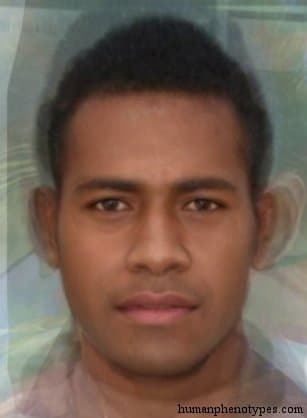
Composite source: Human Phenotypes — Fijid
Geographic Distribution
Geographically, Fijid anchors to 18.1° S, 179.0° E (Melanesia). That is the point where historical anthropologists judged Fijid most concentrated, not a hard edge; modern migration and intermarriage have long since softened whatever boundaries once existed.
Physical Characteristics
Dark, sometimes medium brown skin.
- Usually tight-curly black-brown hair
- (Rather) tall, brachyskelic, mesomorph, sometimes endomorph
- Meso- brachycephalic, orthocranic
- Mildly platyrrhine nose, often straight, sometimes with a depressed root
- Lips are relatively thick, brow ridges marked, prognathy mild, forehead sloping, hairiness relatively strong
Historical Background
Polynesid-Melanesid contact type. The dominant type in the population of the Fiji Islands. Both elements have probably mixed in the zone for several millennia. Also found in the Solomons, Vanuatu, East New Guinea, and some other regions of Melanesia and Polynesia.
Research History & Naming
The passage below traces who first defined Fijid, which rival names competed with it, and how later authors consolidated or disputed the classification — the raw material of any serious phenotype reference.
Named and defined as a hybrid Fijian subrace by Biasutti (1967) . Detailed investigations were made by Howells and Moss (1933) and Gabel (1958) , among others. Eickstedt (1934) regarded it as a tall, robust Polynesid-Melanesid mix, Howells (1970) as "group G2".
Comparison With Nearby Phenotypes
The five phenotypes whose documented centers lie closest to Fijid, ranked by great-circle distance. They are the types players most often confuse with Fijid in the quiz, precisely because their distributions overlap.
| Phenotype | Region | Distance | Distinguishing trait |
|---|---|---|---|
| Robust Polynesid | Polynesia | 640 km | Light brown, velvet-like skin, curly or wavy brown-black hair. |
| Nesiotid | Polynesia | 1,064 km | Light to medium brown, velvet-like skin, wavy, sometimes curly brown-black, rarely light hair. |
| Paleo Melanesid | Melanesia | 1,887 km | Dark brown skin. |
| South Polynesid | Polynesia | 2,665 km | Medium brown, velvet-like skin, wavy or curly usually brown-black hair. |
| Bukaid | Melanesia | 2,905 km | Black, sometimes dark dark brown skin - the darkest in Oceania. |
Fijid in the Game
Fijid is one of the faces that can appear in Classic Daily and Challenge Mode. When it does, the winning pin lands near 18.1° S, 179.0° E in Melanesia — and because the scoring decays with distance, recognizing the region matters more than pixel-perfect placement.
Fijid Phenotype FAQ
- Where does the Fijid phenotype come from?
- The reference coordinates for the Fijid phenotype sit near 18.1° S, 179.0° E, in Melanesia. That point marks the center of the Melanesia distribution documented roughly 1500 years ago — actual prevalence spread well beyond it, toward entries such as Robust Polynesid 640 km away, and modern migration has blurred those boundaries further.
- What does the Fijid phenotype look like?
- In the historical literature, dark, sometimes medium brown skin. For Fijid these are statistical tendencies across a population, not a checklist every individual matches.
- Is the Fijid phenotype a race or a nationality?
- No — and the Fijid naming history above shows why. Fijid was defined, renamed, and regrouped repeatedly by different researchers, which is the opposite of how a fixed racial category would behave. A phenotype is a recurring bundle of visible traits recorded across a population; the Fijid label says nothing about where any individual's ancestors were born.
- How does Fijid appear in the game?
- In Classic Daily and Challenge Mode, the Fijid composite face appears without a label. Your task is to drop a pin on the world map where you think that face is historically most common — the scoring uses the distance between your pin and the reference coordinates near 18.1° S, 179.0° E. The post-round review then shows the correct location, your distance error, and this Fijid entry.
References & Literature
The Fijid phenotype entry above is compiled from the 5 academic references. Readers are encouraged to consult the original Fijid sources for verification and deeper context.
- Biasutti, R. 1967 (1941). Le Razze e i Popoli della terra. 4th Ed. Vol 1-4. U.T.E.T., Torino.
- Howells, W. W. and Moss, W. L. 1933. Anthropometry and blood types in Fiji and the Solomon Islands. Anthropological papers of the AMNH. 33, 4.
- Gabel, N. E. 1958. A Racial Study of the Fijians. Anthropological Records 20, 1.
- Eickstedt, E. von. 1934. Rassenkunde und Rassengeschichte der Menschheit. Ferdinand Enke. Stuttgart.
- Howells, W. W. 1970. Anthropometric Grouping Analysis of Pacific Peoples. Archaeology & Physical Anthropology in Oceania. 5, 3. 192-217.
Related Phenotypes
More entries from the same region of the historical map as Fijid, each with its own composite and trait profile.
Robust Polynesid
Polynesia · 640 km away
Relatively recent Polynesid variety that developed after the Southeast Asian migration waves had reached Oceania. Most likely a brachycephal...
Nesiotid
Polynesia · 1,064 km away
Mediterraniform Polynesid variety. Has been noted for its Europoid features, although no close genetic relationship exists. Typical in Samoa...
Paleo Melanesid
Melanesia · 1,887 km away
Melanesid variety with very ancient features, closer to Australids. Typified by the Kanak of New Caledonia, in its purest form in the north ...
South Polynesid
Polynesia · 2,665 km away
Southern Polynesid variety. Some assume similarities with the first Polynesid variety that migrated from South-East Asia into Oceania. Found...
Bukaid
Melanesia · 2,905 km away
Melanesid variety, associated with the ancient "Walzenbeil" culture. Has sometimes been described as bantuiform, although no close genetic r...
Further Reading
Background articles from the blog that explain where the Fijid type fits, how these composites are built, and what a face can and cannot tell you.
Race Guesser: Why the Word Does Not Fit a Face Quiz
The phrase is a search term before it is a tool. Here is where the word race came from as a sorting device, why a century of measuring...
Ethnoguessr: The Spelling, the Sites, and the Game
Ethnoguessr is a compressed spelling of "ethnicity guesser", and more than one site answers to it. Here is how to tell what you are...