Robust Polynesid Phenotype - Face Features & Origin
Relatively recent Polynesid variety that developed after the Southeast Asian migration waves had reached Oceania. The entry below collects the Robust Polynesid composite face, its documented distribution around 19.9° S, 175.2° W in Polynesia, its physical characteristics, the research history behind the name, and the academic references that support all of it.
Average Face
The Robust Polynesid composite below is not a photograph of a real person. Historical anthropologists aligned multiple individual portraits from the Robust Polynesid reference population and averaged them into one image, so recurring structures — skull outline, nose form, lip thickness, brow position — dominate while individual idiosyncrasies cancel out.
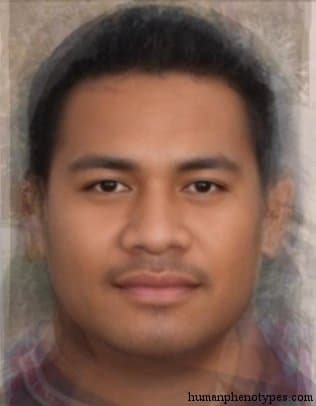
Composite source: Human Phenotypes — Robust Polynesid
Geographic Distribution
Geographically, Robust Polynesid anchors to 19.9° S, 175.2° W (Polynesia). That is the point where historical anthropologists judged Robust Polynesid most concentrated, not a hard edge; modern migration and intermarriage have long since softened whatever boundaries once existed.
Physical Characteristics
Light brown, velvet-like skin, curly or wavy brown-black hair.
- Tall, mesoskelic sometimes macroskelic, endomorph to mesomorph, often very massive body
- Brachycephalic, hypsicranic, rather large-headed
- Mesorrhine, sometimes convex nose
- Facial features are robust
- The neck is thick, chin broad, jaw massive, the face large, forehead receding, lips not very thick, supraorbital arches mild
Historical Background
Relatively recent Polynesid variety that developed after the Southeast Asian migration waves had reached Oceania. Most likely a brachycephalised Nesiotid - Proto Malayid blend, possibly with Indianid influence. Typical in Hawaii, Tonga, Samoa, Cook Islands, Marquesas, and Tahiti, where the cephalic index peaks. Extends across all of Oceania and may sometimes be found in Melanesia and Western America.
Research History & Naming
The passage below traces who first defined Robust Polynesid, which rival names competed with it, and how later authors consolidated or disputed the classification — the raw material of any serious phenotype reference.
Described as the Robust Polynesid by Eickstedt (1934) after Sullivan (1923) had called it the Indonesian-like element. The proper Polynesid of Biasutti (1967) as well as Lundman ( 1952 , 1967 ), who regarded it a mixed type. Howells (1970) identified it as "group G1".
Comparison With Nearby Phenotypes
Ranked by great-circle distance from Robust Polynesid's reference center, these are the five nearest documented phenotypes — the closest being Fijid at 640 km. Overlapping distributions like these are exactly what makes the quiz hard, and the Fijid row is where to start looking.
| Phenotype | Region | Distance | Distinguishing trait |
|---|---|---|---|
| Fijid | Melanesia | 640 km | Dark, sometimes medium brown skin. |
| Nesiotid | Polynesia | 758 km | Light to medium brown, velvet-like skin, wavy, sometimes curly brown-black, rarely light hair. |
| Paleo Melanesid | Melanesia | 2,459 km | Dark brown skin. |
| South Polynesid | Polynesia | 2,652 km | Medium brown, velvet-like skin, wavy or curly usually brown-black hair. |
| Bukaid | Melanesia | 3,543 km | Black, sometimes dark dark brown skin - the darkest in Oceania. |
Robust Polynesid in the Game
When the Robust Polynesid composite shows up in the quiz, players who know the Polynesia distribution pattern have the edge. The reference answer sits near 19.9° S, 175.2° W; pins on the wrong continent score close to zero, so even a rough regional instinct beats a precise but misdirected pin.
Robust Polynesid Phenotype FAQ
- Where does the Robust Polynesid phenotype come from?
- Historical sources center the Robust Polynesid phenotype on 19.9° S, 175.2° W (Polynesia). Treat that as a rough anchor: the type appeared across a wider surrounding area — its nearest documented neighbors, Fijid and Nesiotid, sit 640 and 758 km from the reference point — and its present-day distribution no longer matches the historical map.
- What does the Robust Polynesid phenotype look like?
- The composite emphasizes recurring traits: light brown, velvet-like skin, curly or wavy brown-black hair. The full trait list for Robust Polynesid appears in the physical characteristics section above.
- Is the Robust Polynesid phenotype a race or a nationality?
- No. Phenotypes like Robust Polynesid are descriptive averages, not ancestry groups. Robust Polynesid is one of several types documented in and around Polynesia — see the comparison table above — and the same individual can carry traits associated with several of them at once. The Robust Polynesid entry describes a statistical pattern, not a group of people and not a nationality.
- How does Robust Polynesid appear in the game?
- When the Robust Polynesid face comes up in Classic Daily or Challenge Mode, you pin the world map where you believe the type is historically most common, and the score decays with your distance to 19.9° S, 175.2° W. The nearest documented type, Fijid, lies about 640 km away, so regional placement usually carries most of the score.
References & Literature
The Robust Polynesid phenotype entry above is compiled from the 6 academic references. Readers are encouraged to consult the original Robust Polynesid sources for verification and deeper context.
- Eickstedt, E. von. 1934. Rassenkunde und Rassengeschichte der Menschheit. Ferdinand Enke. Stuttgart.
- Sullivan, L.R. 1923. The Racial Diversity of the Polynesian People. Am. Mus. Nat. Hist. 23. 65-71.
- Biasutti, R. 1967 (1941). Le Razze e i Popoli della terra. 4th Ed. Vol 1-4. U.T.E.T., Torino.
- Lundman, B. 1952. Umriss der Rassenkunde des Menschen in geschichtlicher Zeit. Ejnar Munksgaard. Kopenhagen.
- Lundman, B. 1967. Geographische Anthropologie. Rassen und Völker der Erde. G. Fischer, Stuttgart
- Howells, W. W. 1970. Anthropometric Grouping Analysis of Pacific Peoples. Archaeology & Physical Anthropology in Oceania. 5, 3. 192-217.
Related Phenotypes
Other human phenotypes whose documented centers lie in the same part of the map as Robust Polynesid.
Fijid
Melanesia · 640 km away
Polynesid-Melanesid contact type. The dominant type in the population of the Fiji Islands. Both elements have probably mixed in the zone for...
Nesiotid
Polynesia · 758 km away
Mediterraniform Polynesid variety. Has been noted for its Europoid features, although no close genetic relationship exists. Typical in Samoa...
Paleo Melanesid
Melanesia · 2,459 km away
Melanesid variety with very ancient features, closer to Australids. Typified by the Kanak of New Caledonia, in its purest form in the north ...
South Polynesid
Polynesia · 2,652 km away
Southern Polynesid variety. Some assume similarities with the first Polynesid variety that migrated from South-East Asia into Oceania. Found...
Bukaid
Melanesia · 3,543 km away
Melanesid variety, associated with the ancient "Walzenbeil" culture. Has sometimes been described as bantuiform, although no close genetic r...
Further Reading
Background articles from the blog that explain where the Robust Polynesid type fits, how these composites are built, and what a face can and cannot tell you.
Ethnicity Guesser Photo: What Happens to the File First
A photo handed to a face tool stops being a photograph almost at once: the file is decoded, rotated, colour-converted and resized before...
Ethnicity Guesser AI: Two Model Families, Two Kinds of Error
Tools sold under the same name behave nothing alike. One prints a label from a fixed list; the other writes a sentence.