South Polynesid Phenotype - Face Features & Origin
Southern Polynesid variety. The entry below collects the South Polynesid composite face, its documented distribution around 41.5° S, 172.8° E in Polynesia, its physical characteristics, the research history behind the name, and the academic references that support all of it.
Average Face
The South Polynesid composite below is not a photograph of a real person. Historical anthropologists aligned multiple individual portraits from the South Polynesid reference population and averaged them into one image, so recurring structures — skull outline, nose form, lip thickness, brow position — dominate while individual idiosyncrasies cancel out.
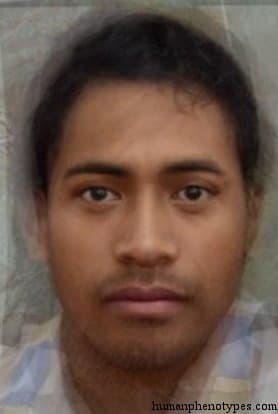
Composite source: Human Phenotypes — South Polynesid
Geographic Distribution
The reference center for South Polynesid sits near 41.5° S, 172.8° E in Polynesia. Around that anchor, prevalence falls off gradually — the type is not confined to one valley or one modern border, and the historical map should be read as a gradient rather than a boundary.
Physical Characteristics
Medium brown, velvet-like skin, wavy or curly usually brown-black hair.
- Tall, mesoskelic, mesomorph to endomorph
- Mesocephalic, mildly hypsicranic
- Mesorrhine, sometimes convex nose
- Facial features are relatively robust with significant supraorbital arches, a relatively wide face, and large eyes
- Lips are not very thick
Historical Background
Southern Polynesid variety. Some assume similarities with the first Polynesid variety that migrated from South-East Asia into Oceania. Found in its purest from in the Maori of New Zealand, but also Moriori and Rapa Nui, and occasionally across Polynesia. New Zealand and Easter Island were reached in the Middle Ages, sometimes replacing older Melanesids. Population collapsed due to introduced diseases from Europeans. Only in Maori the type could recover, although admixture is relatively high.
Research History & Naming
The passage below traces who first defined South Polynesid, which rival names competed with it, and how later authors consolidated or disputed the classification — the raw material of any serious phenotype reference.
Named and separated from other Polynesians by Biasutti (1967) as a Maori-Pasquese subrace after detailed investigations had been made by Tregear (1904) and Best (1924) , among others. Often included in Polynesid ( Eickstedt, 1934 ; Lundman, 1967 ; Knussmann, 1996 ).
Comparison With Nearby Phenotypes
Geography, not alphabet, ordered this table: the five phenotype centers closest to South Polynesid's, with the traits most likely to be mistaken for it (Desert Australid leads at 2,075 km). In gameplay, these five account for most of the wrong-but-nearby pins against South Polynesid.
| Phenotype | Region | Distance | Distinguishing trait |
|---|---|---|---|
| Desert Australid | Australia | 2,075 km | Dark, sometimes medium brown skin. |
| Tasmanid | Australia | 2,165 km | Dark brown, sometimes black skin with kinky hair. |
| Paleo Melanesid | Melanesia | 2,565 km | Dark brown skin. |
| South Australid | Australia | 2,634 km | Medium to dark reddish-brown skin with wavy to tight-curly brown or black hair. |
| Robust Polynesid | Polynesia | 2,652 km | Light brown, velvet-like skin, curly or wavy brown-black hair. |
South Polynesid in the Game
In gameplay terms, South Polynesid rewards region-level recall: the score is computed from the distance between your pin and 41.5° S, 172.8° E. Players often confuse South Polynesid with Desert Australid (2,075 km out) in the comparison table above — those confusions are exactly what the distance penalty is designed to expose.
South Polynesid Phenotype FAQ
- Where does the South Polynesid phenotype come from?
- Historical sources center the South Polynesid phenotype on 41.5° S, 172.8° E (Polynesia). Treat that as a rough anchor: the type appeared across a wider surrounding area — its nearest documented neighbors, Desert Australid and Tasmanid, sit 2,075 and 2,165 km from the reference point — and its present-day distribution no longer matches the historical map.
- What does the South Polynesid phenotype look like?
- The composite emphasizes recurring traits: medium brown, velvet-like skin, wavy or curly usually brown-black hair. The full trait list for South Polynesid appears in the physical characteristics section above.
- Is the South Polynesid phenotype a race or a nationality?
- No. A phenotype is a recurring bundle of visible traits documented by historical anthropologists across a population — for South Polynesid, patterns such as medium brown, velvet-like skin, wavy or curly usually brown-black hair. The South Polynesid entry is not a genetic ancestry, not a nationality, and not a statement about any individual person. Two people from the same country can match completely different phenotypes — one resembling South Polynesid, another closer to Desert Australid — and one phenotype can span many modern borders.
- How does South Polynesid appear in the game?
- When the South Polynesid face comes up in Classic Daily or Challenge Mode, you pin the world map where you believe the type is historically most common, and the score decays with your distance to 41.5° S, 172.8° E. The nearest documented type, Desert Australid, lies 2,075 km away — an isolated reference point, so even a broad regional answer scores respectably here.
References & Literature
The South Polynesid phenotype entry above is compiled from the 6 academic references. Readers are encouraged to consult the original South Polynesid sources for verification and deeper context.
- Biasutti, R. 1967 (1941). Le Razze e i Popoli della terra. 4th Ed. Vol 1-4. U.T.E.T., Torino.
- T04
- Best, E. 1924. The Maori. Wellington.
- Eickstedt, E. von. 1934. Rassenkunde und Rassengeschichte der Menschheit. Ferdinand Enke. Stuttgart.
- Lundman, B. 1967. Geographische Anthropologie. Rassen und Völker der Erde. G. Fischer, Stuttgart
- Knussmann, R. 1996. Vergleichende Biologie des Menschen: Lehrbuch der Anthropologie und Humangenetik. 2ed. Spektrum Akademischer Verlag.
Related Phenotypes
Other human phenotypes whose documented centers lie in the same part of the map as South Polynesid.
Desert Australid
Australia · 2,075 km away
Australid desert variety adapted to the arid interior of Australia. Has furnished the general public idea of the typical Australian Aborigin...
Tasmanid
Australia · 2,165 km away
Insular, slightly gracilised Australid subtype of Tasmania. Similar to Barrinean, sometimes also associated with Melanesid or Negritid. Most...
Paleo Melanesid
Melanesia · 2,565 km away
Melanesid variety with very ancient features, closer to Australids. Typified by the Kanak of New Caledonia, in its purest form in the north ...
South Australid
Australia · 2,634 km away
Australid subtype with proto-Caucasiform features associated with the people of the Murray basin of Southeastern Australia. Originally the m...
Robust Polynesid
Polynesia · 2,652 km away
Relatively recent Polynesid variety that developed after the Southeast Asian migration waves had reached Oceania. Most likely a brachycephal...
Further Reading
Background articles from the blog that explain where the South Polynesid type fits, how these composites are built, and what a face can and cannot tell you.
Ethnicity Guesser Photo: What Happens to the File First
A photo handed to a face tool stops being a photograph almost at once: the file is decoded, rotated, colour-converted and resized before...
Ethnicity Guesser AI: Two Model Families, Two Kinds of Error
Tools sold under the same name behave nothing alike. One prints a label from a fixed list; the other writes a sentence.