Paleo Melanesid Phenotype - Face Features & Origin
Historical anthropology places the Paleo Melanesid phenotype in Melanesia, with a documented center near 20.6° S, 161.2° E. Melanesid variety with very ancient features, closer to Australids. The sections that follow unpack the Paleo Melanesid entry in practice: the composite face, the traits it summarizes, the naming history, and the sources.
Average Face
Averaging the portraits behind Paleo Melanesid leaves the features that repeat and erases the ones that do not. That is exactly how the Paleo Melanesid composite below was built: individual photographs were aligned and statistically merged, exaggerating shared structure into a single reference face that no actual person looks like.
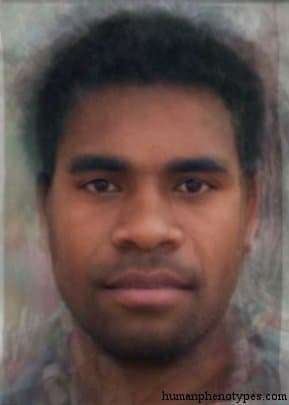
Composite source: Human Phenotypes — Paleo Melanesid
Geographic Distribution
Geographically, Paleo Melanesid anchors to 20.6° S, 161.2° E (Melanesia). That is the point where historical anthropologists judged Paleo Melanesid most concentrated, not a hard edge; modern migration and intermarriage have long since softened whatever boundaries once existed.
Physical Characteristics
Dark brown skin.
- Black-brown, rarely red, tight-curly, sometimes kinky hair
- Medium-height, hyperbrachyskelic, meso- to endomorph
- Dolicho- mesocephalic, mildly hypsicranic
- Low, robust face, massive jaw
- Nose hyperplatyrrhine, concave with a depressed root
- Lips rather thick, not bulging
- Supraorbital arches common, forehead high, mouth very large, hairiness strong, chin receding, prognathy mild
Historical Background
Melanesid variety with very ancient features, closer to Australids. Typified by the Kanak of New Caledonia, in its purest form in the north of the island. Also important on the Loyalty Islands, Vanuatu, Solomons, East New Guinea and Eastern Australia, Fiji, occasionally across Polynesia. Maori wiped it out in New Zealand many centuries ago. Has recently been pushed into minority status in New Caledonia.
Research History & Naming
The passage below traces who first defined Paleo Melanesid, which rival names competed with it, and how later authors consolidated or disputed the classification — the raw material of any serious phenotype reference.
After studies of Sarasin (1916) defined by Eickstedt (1934) as an "Australoid "Paleo Melanesid subtype and used accordingly by others ( Weinert, 1965 ; Knussmann; 1996 ). Biasutti (1967) and Vallois (1974) separated it from Melanesid as a "New Caledonian" Australid variety. Some anthropometric analyses place it closer to Australid ( Howells, 1970 ), others to Melanesid ( Pietrusewsky, 2005 ).
Comparison With Nearby Phenotypes
Ranked by great-circle distance from Paleo Melanesid's reference center, these are the five nearest documented phenotypes — the closest being Barrinean at 1,680 km. Overlapping distributions like these are exactly what makes the quiz hard, and the Barrinean row is where to start looking.
| Phenotype | Region | Distance | Distinguishing trait |
|---|---|---|---|
| Barrinean | Australia | 1,680 km | Dark brown skin with curly or tight-curly brown-black hair. |
| Bukaid | Melanesia | 1,737 km | Black, sometimes dark dark brown skin - the darkest in Oceania. |
| Desert Australid | Australia | 1,772 km | Dark, sometimes medium brown skin. |
| Fijid | Melanesia | 1,887 km | Dark, sometimes medium brown skin. |
| Insular Melanesid | Melanesia | 2,006 km | Dark brown skin. |
Paleo Melanesid in the Game
When the Paleo Melanesid composite shows up in the quiz, players who know the Melanesia distribution pattern have the edge. The reference answer sits near 20.6° S, 161.2° E; pins on the wrong continent score close to zero, so even a rough regional instinct beats a precise but misdirected pin.
Paleo Melanesid Phenotype FAQ
- Where does the Paleo Melanesid phenotype come from?
- The reference coordinates for the Paleo Melanesid phenotype sit near 20.6° S, 161.2° E, in Melanesia. That point marks the center of the Melanesia distribution documented roughly 1500 years ago — actual prevalence spread well beyond it, toward entries such as Barrinean 1,680 km away, and modern migration has blurred those boundaries further.
- What does the Paleo Melanesid phenotype look like?
- In the historical literature, dark brown skin. For Paleo Melanesid these are statistical tendencies across a population, not a checklist every individual matches.
- Is the Paleo Melanesid phenotype a race or a nationality?
- No. Phenotypes like Paleo Melanesid are descriptive averages, not ancestry groups. Paleo Melanesid is one of several types documented in and around Melanesia — see the comparison table above — and the same individual can carry traits associated with several of them at once. The Paleo Melanesid entry describes a statistical pattern, not a group of people and not a nationality.
- How does Paleo Melanesid appear in the game?
- In Classic Daily and Challenge Mode, the Paleo Melanesid composite face appears without a label. Your task is to drop a pin on the world map where you think that face is historically most common — the scoring uses the distance between your pin and the reference coordinates near 20.6° S, 161.2° E. The post-round review then shows the correct location, your distance error, and this Paleo Melanesid entry.
References & Literature
The Paleo Melanesid phenotype entry above is compiled from the 8 academic references. Readers are encouraged to consult the original Paleo Melanesid sources for verification and deeper context.
- Sarasin, F. 1916-1922, Nova Caledonia. Anthropologie der Neu-Caledonier und Loyality-Insulaner. Berlin.
- Eickstedt, E. von. 1934. Rassenkunde und Rassengeschichte der Menschheit. Ferdinand Enke. Stuttgart.
- Weinert, H. 1965. Die heutigen Rassen der Menschheit. In: Lundwig, B. and H. Plank. Handbuch der Biologie. Vol 9 (2).
- Knussmann, R. 1996. Vergleichende Biologie des Menschen: Lehrbuch der Anthropologie und Humangenetik. 2ed. Spektrum Akademischer Verlag.
- Biasutti, R. 1967 (1941). Le Razze e i Popoli della terra. 4th Ed. Vol 1-4. U.T.E.T., Torino.
- Virchow, R. 1874. Die physische Anthropologie der Finnen. Verh. Berliner Ges. Anthr. Ethnol. Urg. VI. 185-189.
- Howells, W. W. 1970. Anthropometric Grouping Analysis of Pacific Peoples. Archaeology & Physical Anthropology in Oceania. 5, 3. 192-217.
- Pietrusewsky, M. 2005. The physical anthropology of the Pacific, East Asia and Southeast Asia. In: Genetics and Physcial Anthropology.
Related Phenotypes
More entries from the same region of the historical map as Paleo Melanesid, each with its own composite and trait profile.
Barrinean
Australia · 1,680 km away
Australid subtype of the forest belt associated with the Australian pygmies. Could be the remnant of an ancient Negrito strain that once occ...
Bukaid
Melanesia · 1,737 km away
Melanesid variety, associated with the ancient "Walzenbeil" culture. Has sometimes been described as bantuiform, although no close genetic r...
Desert Australid
Australia · 1,772 km away
Australid desert variety adapted to the arid interior of Australia. Has furnished the general public idea of the typical Australian Aborigin...
Fijid
Melanesia · 1,887 km away
Polynesid-Melanesid contact type. The dominant type in the population of the Fiji Islands. Both elements have probably mixed in the zone for...
Insular Melanesid
Melanesia · 2,006 km away
Melanesid proper, associated with many Austronesian speakers of Melanesia. Similar to Paleo Melanesid, but with softer features. Common in E...
Further Reading
Background articles from the blog that explain where the Paleo Melanesid type fits, how these composites are built, and what a face can and cannot tell you.
Free Ethnicity Guesser: What Free Actually Costs
The phrase covers a quiz, a photo classifier and a reference library. What separates them is not the price but how each is funded, and...
Race Guesser: Why the Word Does Not Fit a Face Quiz
The phrase is a search term before it is a tool. Here is where the word race came from as a sorting device, why a century of measuring...