Free Ethnicity Guesser: What Free Actually Costs
The phrase covers a quiz, a photo classifier and a reference library. What separates them is not the price but how each is funded, and what each asks of your photograph.
Three products share the free label
The phrase covers at least three unrelated things, and the price tag is the only property they share. One is a game: a composite face goes up, you drop a pin on a map, and the score measures how well you place a documented pattern. One is a photo tool: you upload a picture and receive a label. One is a reference library: papers, catalogues and image archives that anyone can read. A search for the phrase returns all three in one list of results.
Free also means something different in each case. For a library it describes the licence attached to the material. For a game it describes the absence of a paywall, which raises an immediate question about how the site is funded. For a photo tool it describes the absence of a charge for this particular use, and the interesting question moves to whatever else the service receives in the transaction. Three separate questions hide behind one word, and the price answers none of them.
How a free tool pays for itself
Advertising pays for the first model: the tool costs nothing at the point of use and carries third-party scripts and audience measurement instead. Freemium is the second: the free tier returns something deliberately partial, such as a single top label, a shortened result or a small daily quota, and the full output sits behind a payment. The third model is non-commercial. A research group or a university project publishes the work because the data or the method is the point, and there is no product to sell.
The funding model matters less than what it makes necessary. A game and a reference library can both run without ever receiving a photograph, because neither needs one: the composites are statistical averages and the entries are text. A photo classifier cannot work without an image, so the upload is the product's input as well as its cost, and the terms attached to that image deserve more of your attention than the feature list does. Read the retention wording first.
What the law says about a face
A photograph of a face is ordinary personal data in most jurisdictions, but a face used to identify one particular person is not. European data-protection law places biometric data processed for the purpose of uniquely identifying a natural person in a special category under Article 9, which requires a specific legal basis and normally explicit consent. A serious free tool therefore states whether the image is stored, for how long, whether it is used to train or improve a model, and whether it passes to a third-party supplier. Those four answers are the ones worth hunting for.
Some jurisdictions go further. Illinois passed the Biometric Information Privacy Act in 2008, and it covers biometric identifiers including a scan of face geometry. The statute carries a private right of action with statutory damages, which is why some tools geoblock the state or carve it out of their terms. Texas and Washington enacted their own versions in 2009 and 2017. A free tool that handles faces without saying where the images go has not given you a bargain; it has given you an unpriced transaction.
The wrapper problem behind the answers
A large share of free tools that return an ethnicity label are interfaces rather than models. They call a general-purpose vision service, pass the photograph along with a prompt or a fixed list of candidate labels, and display whatever comes back. Nothing in that arrangement is dishonest, but it has two consequences worth expecting. The label set belongs to whoever configured the tool rather than to a published taxonomy, and the same photograph can return different answers on consecutive runs when the underlying model samples its output.
A few checks separate an interface from a model with a method behind it. Does the page name the model, or the data the labels were drawn from? Is the candidate list published, and can the tool return uncertainty or no match at all? Does the same image produce the same result twice? A classifier required to choose among five options will return one of the five whether or not the face belongs to any of them, so a tool that never answers no match is describing its own constraint rather than your photograph.
What free reference material looks like
The alternative to a classifier does not have to be another classifier. Public science resources are free in the sense that matters: openly licensed, citable, and indifferent to whether anyone buys anything afterwards. The 1000 Genomes Project published its final phase in 2015 with whole-genome sequences from 2,504 individuals across 26 populations, all of it downloadable, with the sampling described in the accompanying papers. The Genome Aggregation Database takes a different route and aggregates exome and genome sequences at a scale no single study could reach.
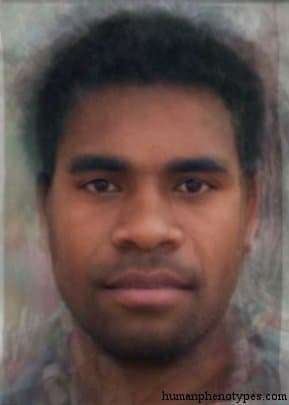
Reference imagery has opened up too. The Allen Ancient DNA Resource curates published ancient genomes in one download with their dates and locations, which makes the time dimension of human variation checkable rather than rhetorical. Wellcome Collection and the Smithsonian's open-access programme release large image archives under licences that permit reuse. A documented catalogue belongs in the same list, since an entry names a described pattern, a region, a source and a rough date. Paleo Melanesid shows how specific an entry gets, tied to the Kanak of New Caledonia; East Pamirid narrows further, to Pamiri-speaking communities of the Pamir mountains in eastern Tajikistan and northern Afghanistan.
What the map game never asks for
One free model is worth describing in plain terms because it is easy to inspect. The quiz on this site shows composite faces built by aligning and averaging many photographs until only the shared architecture survives, so no image in the game depicts a real person. Playing needs no account and no upload: the player points at a map, and no face travels back the other way. Underneath sits a catalogue of 209 entries describing patterns documented in the demic and typological literature, each with a region, a period and a source.
None of that is a claim to be more accurate than anything else; the difference it makes is one of scope rather than quality. A score here measures how well someone places a historical pattern on a map, which is a geographic skill. The entries are dated, unevenly sampled and sometimes arbitrary at their edges, and plenty describe populations that no longer exist in the form that was recorded. Strandlooper, once documented along the South African coast and named for a shellfish diet, is catalogued as effectively gone; Californid, recorded along the Californian coast, is described as close to extinction.
How to judge a free tool in two minutes
A short inspection separates the useful from the merely free. The questions below are the ones that change what a result can mean, and none of them needs technical knowledge to answer. Every page either states these things or leaves them out, and a missing answer is itself informative, because a tool that cannot describe its own method cannot be checked by anyone reading it.
- Does it accept an upload, and does it say whether the image is stored, for how long, and whether it is used for training?
- Is the model named, or at least the family it belongs to?
- Is the list of possible answers published, and can the tool return uncertainty or no match?
- Does the same image return the same result when submitted twice?
- Is the output a label, or a pattern with a region, a period and a citation?
Frequently Asked Questions
- Are free ethnicity guessers really free?
- In the sense that no payment is taken at the point of use, usually yes, but the funding model decides what else is involved. Advertising-supported tools run third-party scripts and measure the session. Freemium tools return a partial result and hold the rest behind a payment. A game or a reference library can run without receiving a photograph at all, because composites and catalogue entries need no upload. The question worth asking is not the price but what the service receives.
- What happens to a photo I upload to a free face tool?
- It depends entirely on the terms, which is why they are worth reading before the upload rather than after. A photograph on its own is ordinary personal data, but a face used to identify a specific person falls into a special category under European data-protection law, and Illinois law covers face-geometry scans with statutory damages. A tool that does not state its retention period, its training use and its third-party sharing has not answered the most important question about itself.
- Is there a free way to explore this subject without uploading a photo?
- Yes, and most of it is better sourced than a label. The 1000 Genomes Project, the Genome Aggregation Database and the Allen Ancient DNA Resource all publish data openly for research use. Image archives such as Wellcome Collection and the Smithsonian's open-access programme release material under reuse licences. A documented phenotype catalogue adds described patterns with their regions, periods and citations. None of these will tell you what you are; each hands you something you can check.
Related Phenotypes
Faces from the encyclopedia that appear in this article. Open any entry for its full description, distribution, and references.
Paleo Melanesid
Australia
Melanesid variety with very ancient features, closer to Australids. Typified by the Kanak of New Caledonia, in its purest form in the north ...
East Pamirid
Central Asia
The most Europoid Pamirid subtype. Most common in Pamiri speakers of the Pamir Mountains in Eastern Tajikistan and Northern Afghanistan, esp...
Strandlooper
South Africa
Almost extinct Khoisanid type, once common along the South African coasts from Cape Colony to the Skeleton Coast. The name derives from the ...
Californid
East Asia
Ancient Margid subtype, probably arrived with one of the oldest migrations to America. Shares some features with Ainuids. During the last ce...
Test what you learned
Put your eye for regional faces to work in the daily quiz — a composite face, a world map, and your best guess.