Strandlooper Phenotype - Face Features & Origin
Historical anthropology places the Strandlooper phenotype in Sub-Saharan Africa, with a documented center near 19.2° S, 12.8° E. Almost extinct Khoisanid type, once common along the South African coasts from Cape Colony to the Skeleton Coast. The sections that follow unpack the Strandlooper entry in practice: the composite face, the traits it summarizes, the naming history, and the sources.
Average Face
Averaging the portraits behind Strandlooper leaves the features that repeat and erases the ones that do not. That is exactly how the Strandlooper composite below was built: individual photographs were aligned and statistically merged, exaggerating shared structure into a single reference face that no actual person looks like.
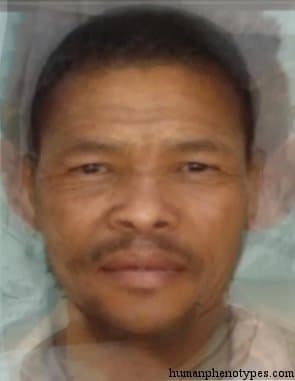
Composite source: Human Phenotypes — Strandlooper
Geographic Distribution
The reference center for Strandlooper sits near 19.2° S, 12.8° E in Sub-Saharan Africa. Around that anchor, prevalence falls off gradually — the type is not confined to one valley or one modern border, and the historical map should be read as a gradient rather than a boundary.
Physical Characteristics
Yellowish brown skin, wrinkled in old age, kinky, sometimes peppercorn hair.
- Short, ectomorph, sometimes endomorph, women may show steatopygia
- Mesocephalic, sometimes brachycephalic, with a large and chamaecranic skull
- Mesorrhine nose with a depressed root and dilated wings
- The face is broad and low, orbits are large, prognathy common, eyes show pseudo-Mongoloid features
Historical Background
Almost extinct Khoisanid type, once common along the South African coasts from Cape Colony to the Skeleton Coast. The name derives from the "beach-combers" who lived mainly on shellfish. Probably a Proto-Khoisanid type, very ancient and less specialised. Has vanished as a result of European colonisation, however some individuals of Topnaar (ǂ Aonin) may still show this type.
Research History & Naming
Every label in the historical catalogue has an author and a date, and Strandlooper has accumulated its share of competing attributions. For Strandlooper, the literature extract below shows the naming chain — from the first definition through the later revisions that shaped the current entry.
The type was identified and named by Shrubsall ( 1898 , 1911 ). Biasutti (1967) adopted as a Khoisanid subrace he called "Costiera". Detailed investigations were also made by Johnston (1910) , Dart (1955) and Sydow (1973) . Sometimes placed between Khoe and San ( Cole, 1965 ).
Comparison With Nearby Phenotypes
The five phenotypes whose documented centers lie closest to Strandlooper, ranked by great-circle distance. They are the types players most often confuse with Strandlooper in the quiz, precisely because their distributions overlap.
| Phenotype | Region | Distance | Distinguishing trait |
|---|---|---|---|
| Mountain Dama | Sub-Saharan Africa | 287 km | (Bluish) black skin with kinky or peppercorn hair. |
| Khoid | Sub-Saharan Africa | 654 km | Yellowish, light brown skin, wrinkled in old age, peppercorn hair. |
| Kalaharid | Sub-Saharan Africa | 1,048 km | Yellowish/reddish medium brown skin, wrinkled in old age, peppercorn hair (< 15 mm). |
| Chopi-Tswana | Sub-Saharan Africa | 1,304 km | Yellowish dark, sometimes medium brown skin, usually kinky, sometimes peppercorn hair. |
| Central Bantuid | Sub-Saharan Africa | 1,789 km | Dark brown, sometimes black skin, usually kinky, sometimes peppercorn hair. |
Strandlooper in the Game
Strandlooper is one of the faces that can appear in Classic Daily and Challenge Mode. When it does, the winning pin lands near 19.2° S, 12.8° E in Sub-Saharan Africa — and because the scoring decays with distance, recognizing the region matters more than pixel-perfect placement.
Strandlooper Phenotype FAQ
- Where does the Strandlooper phenotype come from?
- Historical sources center the Strandlooper phenotype on 19.2° S, 12.8° E (Sub-Saharan Africa). Treat that as a rough anchor: the type appeared across a wider surrounding area — its nearest documented neighbors, Mountain Dama and Khoid, sit 287 and 654 km from the reference point — and its present-day distribution no longer matches the historical map.
- What does the Strandlooper phenotype look like?
- The composite emphasizes recurring traits: yellowish brown skin, wrinkled in old age, kinky, sometimes peppercorn hair. The full trait list for Strandlooper appears in the physical characteristics section above.
- Is the Strandlooper phenotype a race or a nationality?
- No. Phenotypes like Strandlooper are descriptive averages, not ancestry groups. Strandlooper is one of several types documented in and around Sub-Saharan Africa — see the comparison table above — and the same individual can carry traits associated with several of them at once. The Strandlooper entry describes a statistical pattern, not a group of people and not a nationality.
- How does Strandlooper appear in the game?
- When the Strandlooper face comes up in Classic Daily or Challenge Mode, you pin the world map where you believe the type is historically most common, and the score decays with your distance to 19.2° S, 12.8° E. Fair warning: the nearest other entry in our dataset, Mountain Dama, sits just 287 km away, so this face rewards precise placement — the right country alone is not always enough.
References & Literature
Primary sources for the Strandlooper entry, listed as cited in the historical literature. The naming and classification debates around Strandlooper referenced above run through these works.
- Shrubsall, F. C. 1898. Crania of african Bush Races, JRAI 27. London.
- Shrubsall, F. C. 1911. A note on the craniology of South African Bushmen, Ivi, 8.
- Biasutti, R. 1967 (1941). Le Razze e i Popoli della terra. 4th Ed. Vol 1-4. U.T.E.T., Torino.
- Johnston, H. H. Sir. 1910. The Negro in the New World. Methuen & Co. London.
- Dart, R. 1955. Three Strandloper from the Kaokoveld Coast. S. Afr. J. Sci 51. 175-179.
- Sydow, W. 1973. Contributions to the history and protohistory of the Topnaar Strandloper settlement at the Kuiseb River Mouth near Walvis Bay. South African Archaeological Bulletin 28 (111/112). 73-77. )
- Cole, S. 1965. Races of Man. Butler & Tanner Ltd. Frome and London.
Related Phenotypes
If Strandlooper interested you, these neighboring phenotype entries cover adjacent parts of the map with distinctly different trait bundles.
Mountain Dama
Sub-Saharan Africa · 287 km away
Ancient type of the Namibian highlands, especially the Brandberg and Otavi mountains. Probably a relict of groups that were widespread in So...
Khoid
Sub-Saharan Africa · 654 km away
Khoisanid type, similar to Sanid, but with a slightly different morphology. Was more common in farmers and less common in hunter-gatherers c...
Kalaharid
Sub-Saharan Africa · 1,048 km away
Sanid variety, native to the Kalahari. Very ancient and distinct, specialised desert type with many unique features. Typical for the Norther...
Chopi-Tswana
Sub-Saharan Africa · 1,304 km away
Bantuid variety, overall similar to Central Bantuid, but with weak Khoisan influence, placing it closer to Xhosaid. Developed as a result of...
Central Bantuid
Sub-Saharan Africa · 1,789 km away
Bantuid variety, characterised by elongated features and strong dolichocephaly. Found especially in Mozambique and Zimbabwe, also Malawi, Na...
Further Reading
Background articles from the blog that explain where the Strandlooper type fits, how these composites are built, and what a face can and cannot tell you.
Free Ethnicity Guesser: What Free Actually Costs
The phrase covers a quiz, a photo classifier and a reference library. What separates them is not the price but how each is funded, and...
AI Ethnicity Test: What a Measurement Would Require
A laboratory test has a reference standard, a defined construct and a published error bar. A face-based ethnicity tool owns none of...