Khoid Phenotype - Face Features & Origin
Khoisanid type, similar to Sanid, but with a slightly different morphology. Its reference coordinates sit near 23.2° S, 17.3° E in Sub-Saharan Africa. Rather than a single portrait, the Khoid composite below is a statistical average, and the surrounding sections — traits, distribution, research history, references — give that average its context.
Average Face
What you see below is a statistical construction of the Khoid reference population. Faces recorded from the Khoid sample were overlaid and merged; the result keeps the features most members shared and discards personal variation. It reads like a Khoid portrait, but it works like a histogram.
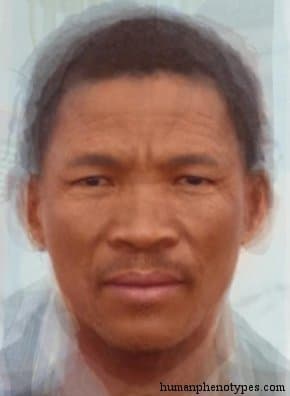
Composite source: Human Phenotypes — Khoid
Geographic Distribution
The reference center for Khoid sits near 23.2° S, 17.3° E in Sub-Saharan Africa. Around that anchor, prevalence falls off gradually — the type is not confined to one valley or one modern border, and the historical map should be read as a gradient rather than a boundary.
Physical Characteristics
Yellowish, light brown skin, wrinkled in old age, peppercorn hair.
- Rather short, but taller than Sanid, meso- brachyskelic, ectomorph, but not infantile, women often show extreme steatopygia
- Dolichocephalic, chamae- orthocranic with (hyper-)platyrrhine, depressed noses
- Face rhomboid and long, chin pointed, eyes pseudo-Mongoloid, often with the Hottentot fold, prognathy only mild
Historical Background
Khoisanid type, similar to Sanid, but with a slightly different morphology. Was more common in farmers and less common in hunter-gatherers compared to Sanids. Native to Namibia and South Africa, especially in Khoikhoi (Hottentots). Most groups like Cape Khoe and Korana became extinct due to Bantu and European colonisation, but the Nama are still numerous.
Research History & Naming
Every label in the historical catalogue has an author and a date, and Khoid has accumulated its share of competing attributions. For Khoid, the literature extract below shows the naming chain — from the first definition through the later revisions that shaped the current entry.
Bory (1825) already described the type as Homo hottentottus. Was named Khoi(ni)d by Eickstedt ( 1934 , 1952b ). Others followed him ( Lundman, 1967 , as a mixed type; Baker, 1981 ; Knussmann, 1996 ). Biasutti (1967) calls it Ottentotta, Cole (1965) simply Hottentot. Schlebusch et al. 2012 finds genetic relationships to Karroid groups.
Comparison With Nearby Phenotypes
Ranked by great-circle distance from Khoid's reference center, these are the five nearest documented phenotypes — the closest being Mountain Dama at 369 km. Overlapping distributions like these are exactly what makes the quiz hard, and the Mountain Dama row is where to start looking.
| Phenotype | Region | Distance | Distinguishing trait |
|---|---|---|---|
| Mountain Dama | Sub-Saharan Africa | 369 km | (Bluish) black skin with kinky or peppercorn hair. |
| Kalaharid | Sub-Saharan Africa | 479 km | Yellowish/reddish medium brown skin, wrinkled in old age, peppercorn hair (< 15 mm). |
| Strandlooper | Sub-Saharan Africa | 654 km | Yellowish brown skin, wrinkled in old age, kinky, sometimes peppercorn hair. |
| Chopi-Tswana | Sub-Saharan Africa | 743 km | Yellowish dark, sometimes medium brown skin, usually kinky, sometimes peppercorn hair. |
| Karroid | Sub-Saharan Africa | 1,162 km | Yellowish light or medium brown skin, heavily wrinkled in old age, peppercorn hair. |
Khoid in the Game
When the Khoid composite shows up in the quiz, players who know the Sub-Saharan Africa distribution pattern have the edge. The reference answer sits near 23.2° S, 17.3° E; pins on the wrong continent score close to zero, so even a rough regional instinct beats a precise but misdirected pin.
Khoid Phenotype FAQ
- Where does the Khoid phenotype come from?
- Historical sources center the Khoid phenotype on 23.2° S, 17.3° E (Sub-Saharan Africa). Treat that as a rough anchor: the type appeared across a wider surrounding area — its nearest documented neighbors, Mountain Dama and Kalaharid, sit 369 and 479 km from the reference point — and its present-day distribution no longer matches the historical map.
- What does the Khoid phenotype look like?
- The composite emphasizes recurring traits: yellowish, light brown skin, wrinkled in old age, peppercorn hair. The full trait list for Khoid appears in the physical characteristics section above.
- Is the Khoid phenotype a race or a nationality?
- No. A phenotype is a recurring bundle of visible traits documented by historical anthropologists across a population — for Khoid, patterns such as yellowish, light brown skin, wrinkled in old age, peppercorn hair. The Khoid entry is not a genetic ancestry, not a nationality, and not a statement about any individual person. Two people from the same country can match completely different phenotypes — one resembling Khoid, another closer to Mountain Dama — and one phenotype can span many modern borders.
- How does Khoid appear in the game?
- When the Khoid face comes up in Classic Daily or Challenge Mode, you pin the world map where you believe the type is historically most common, and the score decays with your distance to 23.2° S, 17.3° E. Fair warning: the nearest other entry in our dataset, Mountain Dama, sits just 369 km away, so this face rewards precise placement — the right country alone is not always enough.
References & Literature
Primary sources for the Khoid entry, listed as cited in the historical literature. The naming and classification debates around Khoid referenced above run through these works.
- Bory, de S.1825. Homme. Féruss. Bull. Sc. nat. Tom. VI.
- Eickstedt, E. von. 1934. Rassenkunde und Rassengeschichte der Menschheit. Ferdinand Enke. Stuttgart.
- Eickstedt, E. von. 1952b. Die prioritätsgerechten Bezeichnungen der menschlichen Varitäten. In: Historia Mundi. Band 1, Munich, 223-226.
- Biasutti, R. 1967 (1941). Le Razze e i Popoli della terra. 4th Ed. Vol 1-4. U.T.E.T., Torino.
- Baker, J.R.. 1981. Race. Oxford Univ. Press. London.
- Knussmann, R. 1996. Vergleichende Biologie des Menschen: Lehrbuch der Anthropologie und Humangenetik. 2ed. Spektrum Akademischer Verlag.
- Cole, S. 1965. Races of Man. Butler & Tanner Ltd. Frome and London.
- S12
Related Phenotypes
If Khoid interested you, these neighboring phenotype entries cover adjacent parts of the map with distinctly different trait bundles.
Mountain Dama
Sub-Saharan Africa · 369 km away
Ancient type of the Namibian highlands, especially the Brandberg and Otavi mountains. Probably a relict of groups that were widespread in So...
Kalaharid
Sub-Saharan Africa · 479 km away
Sanid variety, native to the Kalahari. Very ancient and distinct, specialised desert type with many unique features. Typical for the Norther...
Strandlooper
Sub-Saharan Africa · 654 km away
Almost extinct Khoisanid type, once common along the South African coasts from Cape Colony to the Skeleton Coast. The name derives from the ...
Chopi-Tswana
Sub-Saharan Africa · 743 km away
Bantuid variety, overall similar to Central Bantuid, but with weak Khoisan influence, placing it closer to Xhosaid. Developed as a result of...
Karroid
Sub-Saharan Africa · 1,162 km away
Sanid variety, named after the Karoo desert. Very ancient and distinct with many unique features. Was dominant in Southern Africa some centu...
Further Reading
Background articles from the blog that explain where the Khoid type fits, how these composites are built, and what a face can and cannot tell you.
Race Guesser: Why the Word Does Not Fit a Face Quiz
The phrase is a search term before it is a tool. Here is where the word race came from as a sorting device, why a century of measuring...
AI Phenotype Scanner: What a Scanner Cannot Do for a Face
The phrase names a face classifier, not a device that reads a stored record. What the scanner metaphor hides, what the 209-entry...