Kalaharid Phenotype - Face Features & Origin
Historical anthropology places the Kalaharid phenotype in Sub-Saharan Africa, with a documented center near 23.0° S, 22.0° E. Sanid variety, native to the Kalahari. The sections that follow unpack the Kalaharid entry in practice: the composite face, the traits it summarizes, the naming history, and the sources.
Average Face
Averaging the portraits behind Kalaharid leaves the features that repeat and erases the ones that do not. That is exactly how the Kalaharid composite below was built: individual photographs were aligned and statistically merged, exaggerating shared structure into a single reference face that no actual person looks like.
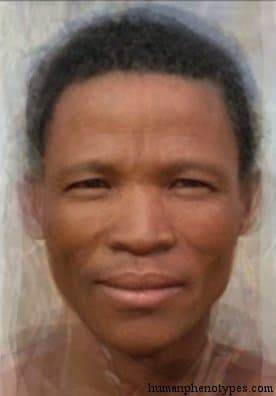
Composite source: Human Phenotypes — Kalaharid
Geographic Distribution
The reference center for Kalaharid sits near 23.0° S, 22.0° E in Sub-Saharan Africa. Around that anchor, prevalence falls off gradually — the type is not confined to one valley or one modern border, and the historical map should be read as a gradient rather than a boundary.
Physical Characteristics
Yellowish/reddish medium brown skin, wrinkled in old age, peppercorn hair (< 15 mm).
- Short, meso- brachyskelic, very ectomorph
- Very infantile, sometimes steatopygic
- Dolicho- mesocephalic, chamaecranic, rather small-headed
- Platyrrhine, depressed nose and a convex upper lip
- Eyes pseudo-Mongoloid, prognathy very weak, penis sub-erect, body hair rather weak
Historical Background
Sanid variety, native to the Kalahari. Very ancient and distinct, specialised desert type with many unique features. Typical for the Northern and Central Bushmen, e.g. the !Kung (e.g. Ju/'hoansi), Naro, Khwe, Amkoe, and related people. Has lived in the region many millennia before Bantu and European arrival. Several thousand typical individuals remain, threatened by loss of culture and displacement.
Research History & Naming
Every label in the historical catalogue has an author and a date, and Kalaharid has accumulated its share of competing attributions. For Kalaharid, the literature extract below shows the naming chain — from the first definition through the later revisions that shaped the current entry.
The northern Sanid was named Kalaharid by Lundman (1967) and described taller and darker by Eickstedt (1934) , too, who called it Sanid like most others ( Baker, 1981 ; Knussmann, 1996 ). So did Biasutti (1967) , calling them Boscìmana. May be further divided in a Central and Northern group ( Cole, 1965 ; Schlebusch et al., 2012 ).
Comparison With Nearby Phenotypes
Geography, not alphabet, ordered this table: the five phenotype centers closest to Kalaharid's, with the traits most likely to be mistaken for it (Chopi-Tswana leads at 266 km). In gameplay, these five account for most of the wrong-but-nearby pins against Kalaharid.
| Phenotype | Region | Distance | Distinguishing trait |
|---|---|---|---|
| Chopi-Tswana | Sub-Saharan Africa | 266 km | Yellowish dark, sometimes medium brown skin, usually kinky, sometimes peppercorn hair. |
| Khoid | Sub-Saharan Africa | 479 km | Yellowish, light brown skin, wrinkled in old age, peppercorn hair. |
| Mountain Dama | Sub-Saharan Africa | 794 km | (Bluish) black skin with kinky or peppercorn hair. |
| Central Bantuid | Sub-Saharan Africa | 951 km | Dark brown, sometimes black skin, usually kinky, sometimes peppercorn hair. |
| Strandlooper | Sub-Saharan Africa | 1,048 km | Yellowish brown skin, wrinkled in old age, kinky, sometimes peppercorn hair. |
Kalaharid in the Game
In gameplay terms, Kalaharid rewards region-level recall: the score is computed from the distance between your pin and 23.0° S, 22.0° E. Players often confuse Kalaharid with Chopi-Tswana (266 km out) in the comparison table above — those confusions are exactly what the distance penalty is designed to expose.
Kalaharid Phenotype FAQ
- Where does the Kalaharid phenotype come from?
- Historical sources center the Kalaharid phenotype on 23.0° S, 22.0° E (Sub-Saharan Africa). Treat that as a rough anchor: the type appeared across a wider surrounding area — its nearest documented neighbors, Chopi-Tswana and Khoid, sit 266 and 479 km from the reference point — and its present-day distribution no longer matches the historical map.
- What does the Kalaharid phenotype look like?
- The composite emphasizes recurring traits: yellowish/reddish medium brown skin, wrinkled in old age, peppercorn hair (< 15 mm). The full trait list for Kalaharid appears in the physical characteristics section above.
- Is the Kalaharid phenotype a race or a nationality?
- No — and the Kalaharid naming history above shows why. Kalaharid was defined, renamed, and regrouped repeatedly by different researchers, which is the opposite of how a fixed racial category would behave. A phenotype is a recurring bundle of visible traits recorded across a population; the Kalaharid label says nothing about where any individual's ancestors were born.
- How does Kalaharid appear in the game?
- When the Kalaharid face comes up in Classic Daily or Challenge Mode, you pin the world map where you believe the type is historically most common, and the score decays with your distance to 23.0° S, 22.0° E. Fair warning: the nearest other entry in our dataset, Chopi-Tswana, sits just 266 km away, so this face rewards precise placement — the right country alone is not always enough.
References & Literature
Primary sources for the Kalaharid entry, listed as cited in the historical literature. The naming and classification debates around Kalaharid referenced above run through these works.
- Lundman, B. 1967. Geographische Anthropologie. Rassen und Völker der Erde. G. Fischer, Stuttgart
- Eickstedt, E. von. 1934. Rassenkunde und Rassengeschichte der Menschheit. Ferdinand Enke. Stuttgart.
- Baker, J.R.. 1981. Race. Oxford Univ. Press. London.
- Knussmann, R. 1996. Vergleichende Biologie des Menschen: Lehrbuch der Anthropologie und Humangenetik. 2ed. Spektrum Akademischer Verlag.
- Biasutti, R. 1967 (1941). Le Razze e i Popoli della terra. 4th Ed. Vol 1-4. U.T.E.T., Torino.
- Cole, S. 1965. Races of Man. Butler & Tanner Ltd. Frome and London.
- S12
Related Phenotypes
More entries from the same region of the historical map as Kalaharid, each with its own composite and trait profile.
Chopi-Tswana
Sub-Saharan Africa · 266 km away
Bantuid variety, overall similar to Central Bantuid, but with weak Khoisan influence, placing it closer to Xhosaid. Developed as a result of...
Khoid
Sub-Saharan Africa · 479 km away
Khoisanid type, similar to Sanid, but with a slightly different morphology. Was more common in farmers and less common in hunter-gatherers c...
Mountain Dama
Sub-Saharan Africa · 794 km away
Ancient type of the Namibian highlands, especially the Brandberg and Otavi mountains. Probably a relict of groups that were widespread in So...
Central Bantuid
Sub-Saharan Africa · 951 km away
Bantuid variety, characterised by elongated features and strong dolichocephaly. Found especially in Mozambique and Zimbabwe, also Malawi, Na...
Strandlooper
Sub-Saharan Africa · 1,048 km away
Almost extinct Khoisanid type, once common along the South African coasts from Cape Colony to the Skeleton Coast. The name derives from the ...
Further Reading
Background articles from the blog that explain where the Kalaharid type fits, how these composites are built, and what a face can and cannot tell you.
AI Ethnicity Test: What a Measurement Would Require
A laboratory test has a reference standard, a defined construct and a published error bar. A face-based ethnicity tool owns none of...
Geography Games Like GeoGuessr: Six Kinds of Clue
Street panoramas, country outlines and average faces all answer one question. Here are six geography games sorted by the clue they hand...