Fengu-Pondo Phenotype - Face Features & Origin
Bantuid variety, similar to South Bantuid, but with weak Khoisan influence, placing it closer to Xhosaid. Its reference coordinates sit near 31.6° S, 28.8° E in Sub-Saharan Africa. Rather than a single portrait, the Fengu-Pondo composite below is a statistical average, and the surrounding sections — traits, distribution, research history, references — give that average its context.
Average Face
What you see below is a statistical construction of the Fengu-Pondo reference population. Faces recorded from the Fengu-Pondo sample were overlaid and merged; the result keeps the features most members shared and discards personal variation. It reads like a Fengu-Pondo portrait, but it works like a histogram.
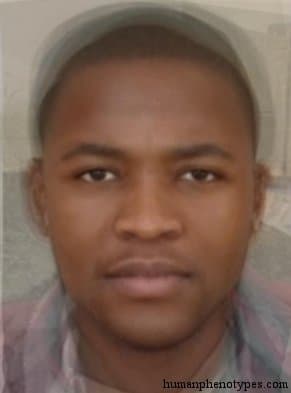
Composite source: Human Phenotypes — Fengu-Pondo
Geographic Distribution
Fengu-Pondo is documented across Sub-Saharan Africa, with its historical reference center near 31.6° S, 28.8° E. The coordinates mark where the type was most characteristic roughly 1500 years ago; population movements since then have scattered and blended the distribution far beyond that point.
Physical Characteristics
Yellowish dark, sometimes medium brown skin, usually kinky, sometimes peppercorn hair.
- Rather tall, often mesoskelic, mesomorph to endomorph
- Often mesocephalic, sometimes dolichocephalic, chamae- orthocranic with wider and lower skulls than other Bantuids
- Platyrrhine, lips rather full
- Prognathy modest, pseudo-Mongoloid eyes in a few cases
Historical Background
Bantuid variety, similar to South Bantuid, but with weak Khoisan influence, placing it closer to Xhosaid. Developed as a result of the Bantu expansion when Bantu assimilated some older Khoisanid elements. Found especially in the eastern provinces of South Africa, e.g. Eastern Cape, KwaZulu-Natal and Free State, also Lesotho and Southern Mozambique. Common in Fengu, Pondo, and Hlubi, but also in some neighbouring groups.
Research History & Naming
Every label in the historical catalogue has an author and a date, and Fengu-Pondo has accumulated its share of competing attributions. For Fengu-Pondo, the literature extract below shows the naming chain — from the first definition through the later revisions that shaped the current entry.
The type was identified by Dart (1962) as the Fingo-Hlubi-Mpondo type (Group D), it is similar to his group B (Bhaca-Swazi-Zulu, c.p. South Bantuid), but with greater Khoisanid influence. Baker (1981) grouped (Ama)pondo in Kafrid, Eickstedt (1934) in South Bantuid.
Comparison With Nearby Phenotypes
The five phenotypes whose documented centers lie closest to Fengu-Pondo, ranked by great-circle distance. They are the types players most often confuse with Fengu-Pondo in the quiz, precisely because their distributions overlap.
| Phenotype | Region | Distance | Distinguishing trait |
|---|---|---|---|
| Xhosaid | Sub-Saharan Africa | 215 km | Medium to dark yellowish-brown skin with kinky or peppercorn hair. |
| South Bantuid | Sub-Saharan Africa | 398 km | Dark, sometimes medium brown skin, usually kinky, sometimes peppercorn hair. |
| Karroid | Sub-Saharan Africa | 553 km | Yellowish light or medium brown skin, heavily wrinkled in old age, peppercorn hair. |
| Chopi-Tswana | Sub-Saharan Africa | 1,024 km | Yellowish dark, sometimes medium brown skin, usually kinky, sometimes peppercorn hair. |
| Kalaharid | Sub-Saharan Africa | 1,166 km | Yellowish/reddish medium brown skin, wrinkled in old age, peppercorn hair (< 15 mm). |
Fengu-Pondo in the Game
Fengu-Pondo is one of the faces that can appear in Classic Daily and Challenge Mode. When it does, the winning pin lands near 31.6° S, 28.8° E in Sub-Saharan Africa — and because the scoring decays with distance, recognizing the region matters more than pixel-perfect placement.
Fengu-Pondo Phenotype FAQ
- Where does the Fengu-Pondo phenotype come from?
- The reference coordinates for the Fengu-Pondo phenotype sit near 31.6° S, 28.8° E, in Sub-Saharan Africa. That point marks the center of the Sub-Saharan Africa distribution documented roughly 1500 years ago — actual prevalence spread well beyond it, toward entries such as Xhosaid 215 km away, and modern migration has blurred those boundaries further.
- What does the Fengu-Pondo phenotype look like?
- In the historical literature, yellowish dark, sometimes medium brown skin, usually kinky, sometimes peppercorn hair. For Fengu-Pondo these are statistical tendencies across a population, not a checklist every individual matches.
- Is the Fengu-Pondo phenotype a race or a nationality?
- No. Phenotypes like Fengu-Pondo are descriptive averages, not ancestry groups. Fengu-Pondo is one of several types documented in and around Sub-Saharan Africa — see the comparison table above — and the same individual can carry traits associated with several of them at once. The Fengu-Pondo entry describes a statistical pattern, not a group of people and not a nationality.
- How does Fengu-Pondo appear in the game?
- In Classic Daily and Challenge Mode, the Fengu-Pondo composite face appears without a label. Your task is to drop a pin on the world map where you think that face is historically most common — the scoring uses the distance between your pin and the reference coordinates near 31.6° S, 28.8° E. The post-round review then shows the correct location, your distance error, and this Fengu-Pondo entry.
References & Literature
Primary sources for the Fengu-Pondo entry, listed as cited in the historical literature. The naming and classification debates around Fengu-Pondo referenced above run through these works.
- Dart, R.A. 1962. Racial Origins. In: Schapera, I.. The Bantu Speaking Tribes of South Africa. Routledge & Kegan Paul. London.
- Baker, J.R.. 1981. Race. Oxford Univ. Press. London.
- Eickstedt, E. von. 1934. Rassenkunde und Rassengeschichte der Menschheit. Ferdinand Enke. Stuttgart.
Related Phenotypes
Other human phenotypes whose documented centers lie in the same part of the map as Fengu-Pondo.
Xhosaid
Sub-Saharan Africa · 215 km away
Bantuid-Khoisan contact type that developed as a result of the Bantu expansion some millennia ago when Bantu assimilated older Khoisan group...
South Bantuid
Sub-Saharan Africa · 398 km away
Bantuid variety, characterised by relatively wide skulls and robust faces. Especially found in the Kwazulu Natal / Transkei regions of South...
Karroid
Sub-Saharan Africa · 553 km away
Sanid variety, named after the Karoo desert. Very ancient and distinct with many unique features. Was dominant in Southern Africa some centu...
Chopi-Tswana
Sub-Saharan Africa · 1,024 km away
Bantuid variety, overall similar to Central Bantuid, but with weak Khoisan influence, placing it closer to Xhosaid. Developed as a result of...
Kalaharid
Sub-Saharan Africa · 1,166 km away
Sanid variety, native to the Kalahari. Very ancient and distinct, specialised desert type with many unique features. Typical for the Norther...
Further Reading
Background articles from the blog that explain where the Fengu-Pondo type fits, how these composites are built, and what a face can and cannot tell you.
AI Ethnicity Test: What a Measurement Would Require
A laboratory test has a reference standard, a defined construct and a published error bar. A face-based ethnicity tool owns none of...
Geography Games Like GeoGuessr: Six Kinds of Clue
Street panoramas, country outlines and average faces all answer one question. Here are six geography games sorted by the clue they hand...