East Pamirid Phenotype - Face Features & Origin
The most Europoid Pamirid subtype. The entry below collects the East Pamirid composite face, its documented distribution around 37.9° N, 71.6° E in Central Asia, its physical characteristics, the research history behind the name, and the academic references that support all of it.
Average Face
The East Pamirid composite below is not a photograph of a real person. Historical anthropologists aligned multiple individual portraits from the East Pamirid reference population and averaged them into one image, so recurring structures — skull outline, nose form, lip thickness, brow position — dominate while individual idiosyncrasies cancel out.
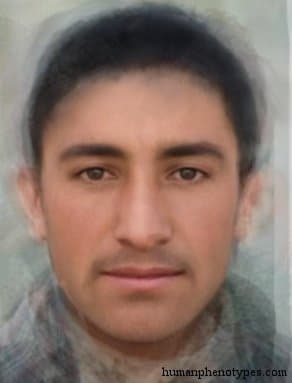
Composite source: Human Phenotypes — East Pamirid
Geographic Distribution
East Pamirid is documented across Central Asia, with its historical reference center near 37.9° N, 71.6° E. The coordinates mark where the type was most characteristic roughly 1500 years ago; population movements since then have scattered and blended the distribution far beyond that point.
Physical Characteristics
Light brown skin, straight or wavy, often brown hair, and mixed eyes.
- Medium height to rather tall, mesoskelic, ectomorph
- Brachycephalic, hypsicranic
- Leptorrhine, prominent, sometimes convex nose
- Body hair relatively strong, eyebrows thick, sometimes united, eyes never slanting
- Compared to Armenoid never prognathous, less hairy, with a lower nasal root and less convex nose
Historical Background
The most Europoid Pamirid subtype. Most common in Pamiri speakers of the Pamir Mountains in Eastern Tajikistan and Northern Afghanistan, especially in the areas of Rushan, Shugan, and Vakhan. Closer to Armenoid than other Turanids. Represents a relict of an Armenoid-like group once widespread in West and Central Asia.
Research History & Naming
Typological names were coined, contested, and renamed repeatedly across the 20th century, and East Pamirid is no exception. The extract below records the researchers who defined East Pamirid, the alternative labels it accumulated, and where the modern consensus settled.
Defined as the Pamir variety of the Central-Asiatic-Inter-River race by Oshanin (1964) , this race was also called Pamiro-Ferghan ( Debets, 1974 ; Alekseev and Gochman, 1983 ). Haddon(1925) identified a Pamir type early, Eickstedt (1937) called it Pamirid. The most typical Turanid for Schwidetzky (1950) . Biasutti (1967) combined it with Anatolid to Anatolico-Pamiran.
Comparison With Nearby Phenotypes
Ranked by great-circle distance from East Pamirid's reference center, these are the five nearest documented phenotypes — the closest being Indo Nordic at 187 km. Overlapping distributions like these are exactly what makes the quiz hard, and the Indo Nordic row is where to start looking.
| Phenotype | Region | Distance | Distinguishing trait |
|---|---|---|---|
| Indo Nordic | South Asia | 187 km | Rosy to light brown skin, blonde to black wavy hair. |
| Central Pamirid | Central Asia | 221 km | Light brown skin, straight or wavy, brown-black hair. |
| Plains Pamirid | Central Asia | 311 km | Light brown skin, often straight, brown or black hair, eyes sometimes mixed. |
| Mountain Indid | South Asia | 842 km | Light brown skin, straight or wavy hair. |
| North Indid | South Asia | 860 km | Light to medium brown skin, straight or wavy, brown or black hair. |
East Pamirid in the Game
When the East Pamirid composite shows up in the quiz, players who know the Central Asia distribution pattern have the edge. The reference answer sits near 37.9° N, 71.6° E; pins on the wrong continent score close to zero, so even a rough regional instinct beats a precise but misdirected pin.
East Pamirid Phenotype FAQ
- Where does the East Pamirid phenotype come from?
- The reference coordinates for the East Pamirid phenotype sit near 37.9° N, 71.6° E, in Central Asia. That point marks the center of the Central Asia distribution documented roughly 1500 years ago — actual prevalence spread well beyond it, toward entries such as Indo Nordic 187 km away, and modern migration has blurred those boundaries further.
- What does the East Pamirid phenotype look like?
- In the historical literature, light brown skin, straight or wavy, often brown hair, and mixed eyes. For East Pamirid these are statistical tendencies across a population, not a checklist every individual matches.
- Is the East Pamirid phenotype a race or a nationality?
- No. A phenotype is a recurring bundle of visible traits documented by historical anthropologists across a population — for East Pamirid, patterns such as light brown skin, straight or wavy, often brown hair, and mixed eyes. The East Pamirid entry is not a genetic ancestry, not a nationality, and not a statement about any individual person. Two people from the same country can match completely different phenotypes — one resembling East Pamirid, another closer to Indo Nordic — and one phenotype can span many modern borders.
- How does East Pamirid appear in the game?
- In Classic Daily and Challenge Mode, the East Pamirid composite face appears without a label. Your task is to drop a pin on the world map where you think that face is historically most common — the scoring uses the distance between your pin and the reference coordinates near 37.9° N, 71.6° E. The post-round review then shows the correct location, your distance error, and this East Pamirid entry.
References & Literature
Every claim on this page traces back to the sources below — the researchers who defined, measured, and argued over the East Pamirid type. The originals behind the East Pamirid entry are worth consulting directly.
- Oshanin, L. V. 1964. Anthropological Composition of the Population of Central Asia, and the ethnogenesis of its Peoples. Vol 1-3.
- Debets, G. 1974. Essay on the Graphical Presentation of the Genealogical Classification of Human Races. In: Bromley, Y. Soviet Ethnology and Anthropology Today. Mouton & Co.
- Alekseev, V.P. and I. I. Gochman. 1983. Physical anthropology of Soviet Asia. In: Schwidetzky, I. Rassengeschichte der Menschheit 9.
- Haddon, A.C.. 1925. The Races of Man and their distribution. Cambridge at the University Press. London.
- Eickstedt, E. von. 1937. Geschichte der anthropologischen Namengebung und Klassifikation. In: Zeitschrift für Rassenkunde. Band 5, 209-282, Band 6, 36-96, 151-210.
- Schwidetzky, I. 1950. Turaniden-Studien. Verl. d. Akademie d. Wissenschaften u.d. Literatur.
- Biasutti, R. 1967 (1941). Le Razze e i Popoli della terra. 4th Ed. Vol 1-4. U.T.E.T., Torino.
Related Phenotypes
If East Pamirid interested you, these neighboring phenotype entries cover adjacent parts of the map with distinctly different trait bundles.
Indo Nordic
South Asia · 187 km away
Type of the Northwestern Himalaya and the Hindu Kush. Connected to Indid, but altered by old unique elements, possibly Proto Nordic that mig...
Central Pamirid
Central Asia · 221 km away
The most typical Pamirid variety, also called Mountain Pamirid. Often considered the most typical Turanid. Most common in highland Tajiks, w...
Plains Pamirid
Central Asia · 311 km away
The most widespread Pamirid variety, typical for the steppes and lowlands from Uzbekistan to Xinjiang and the Ferghana Valley. Somewhat infl...
Mountain Indid
South Asia · 842 km away
(Gracile) Indid variety native to the valleys south of the Western Himalaya and in the Hindu Kush. Once the principal element of the Khas an...
North Indid
South Asia · 860 km away
Indid subtype of Pakistan and Northwestern India, often associated with ancient Indo-Aryan migrations from the North. Common in Punjab, wher...
Further Reading
Background articles from the blog that explain where the East Pamirid type fits, how these composites are built, and what a face can and cannot tell you.
Free Ethnicity Guesser: What Free Actually Costs
The phrase covers a quiz, a photo classifier and a reference library. What separates them is not the price but how each is funded, and...
The Daily Face Quiz: How Classic Daily Works (and How to Get Better)
Ten composite faces, one world map, the same ten questions for every player each day, up to 5,000 points. The mechanics of the daily...